

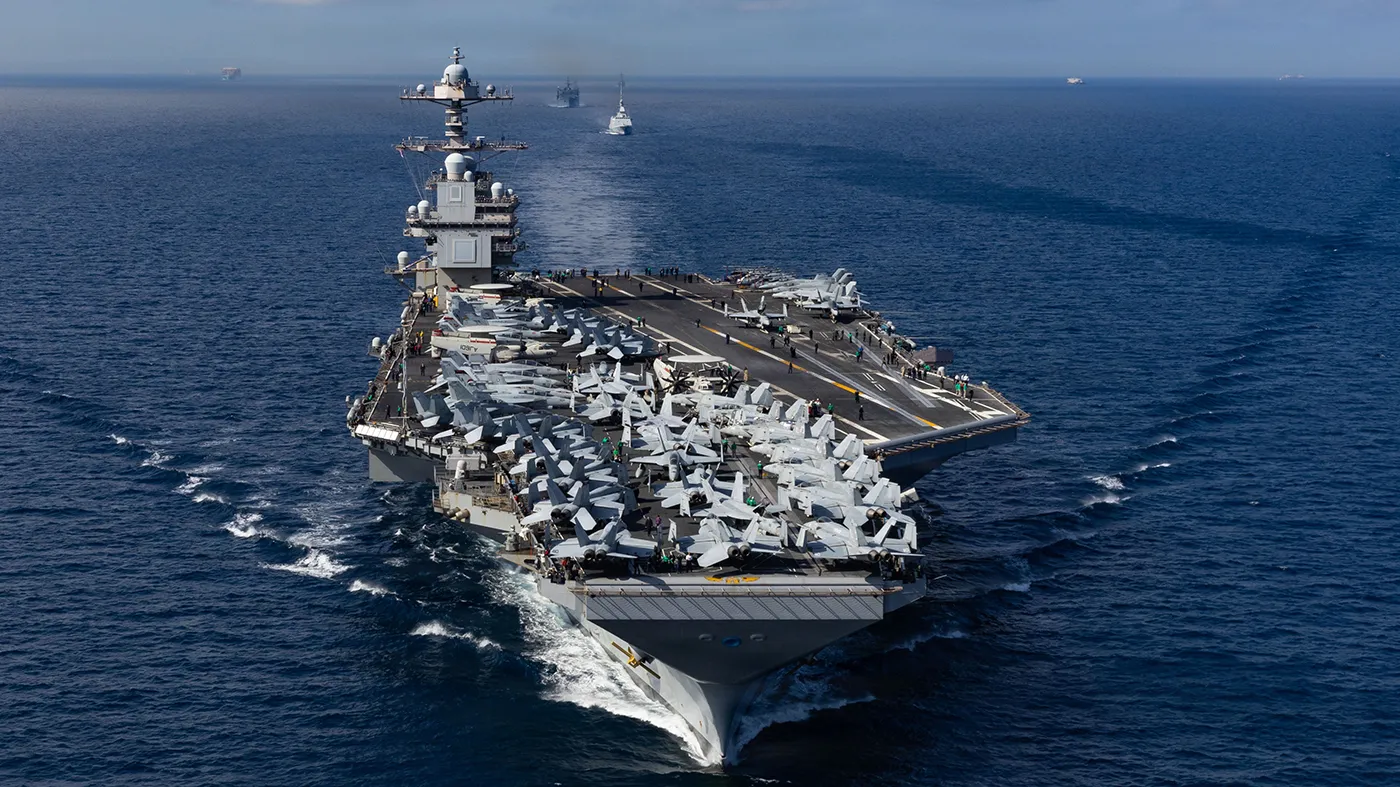
America’s newest super carrier limps back after a grueling 10-month deployment while lawmakers grill officials on the staggering price tag of Operation Epic Fury.
The USS Gerald R. Ford, the most advanced aircraft carrier ever built, is finally heading home — and the bill it leaves behind is eye-watering.
Pentagon comptroller Jules Hurst III told the House Armed Services Committee on Wednesday that Operation Epic Fury, the U.S. military campaign against Iran, has cost American taxpayers roughly $25 billion so far. “Approximately, at this day, we are spending about $25 billion on Operation Epic Fury, most of that is in munitions,” Hurst testified.
The revelation came on the same day the Navy confirmed the Ford and its strike group would begin sailing for its home port in Norfolk, Virginia, in the coming days, ending a record-breaking deployment of more than 300 days.
For the roughly 4,500 sailors aboard the Ford, the journey home cannot come soon enough. The carrier has endured a punishing deployment that included combat operations in the opening days of the Iran conflict from the Mediterranean Sea, transit through the Suez Canal, and sustained operations in the Red Sea.
The deployment has not been without serious setbacks. A fire broke out in one of the carrier’s laundry spaces earlier this year, forcing the Ford to reverse course and return to the Mediterranean for emergency repairs. The blaze left hundreds of sailors without places to sleep, adding to an already strained crew.
Connecticut Representative Joe Courtney did not mince words during the hearing. He noted that the Ford was on day 312 of its deployment, stating it has “gone through fires, plumbing problems, and again, an extended deployment, which, in my opinion, is hitting readiness as hard as anything I’ve seen in the time that I’ve been on this committee.”
The Ford’s departure will reduce American firepower in the region at a critical moment. Two other carriers — the USS George H.W. Bush and the USS Abraham Lincoln — remain in the Arabian Sea to enforce the U.S. blockade targeting vessels carrying oil or goods from Iranian ports. But the Ford’s absence removes a significant air wing from the theatre.
The timing is politically loaded. President Trump has been pressing Tehran to negotiate a peace deal, using the military campaign as leverage. Russia’s President Vladimir Putin has also weighed in, warning Trump against “damaging consequences” of continued military action in Iran. A Kremlin aide emphasized what he called “inevitable and extremely damaging consequences not only for Iran and its neighbors, but also for the entire international community.”
The $25 billion figure is likely to fuel debate in Washington. Hawks argue the spending is necessary to neutralize Iran’s nuclear ambitions and regional proxies. Critics counter that the money could have been spent on domestic priorities — infrastructure, healthcare, education — and question the campaign’s endgame.
For context, $25 billion exceeds the entire annual GDP of several nations. It is roughly equivalent to what the federal government spends on NASA in a year. And Pentagon officials have signaled the costs are still climbing.
The Ford is expected to arrive in Virginia by mid-May, where it will undergo extensive repairs and maintenance. Its deployment will be studied for years — both as a case study in carrier endurance and as a cautionary tale about the physical and financial toll of sustained combat operations.
As the carrier turns westward toward home, the war it leaves behind is far from over. And for lawmakers on Capitol Hill, the questions are just beginning.
This is a developing story. Figures and operational details are based on Pentagon testimony and official Navy statements as of April 30, 2026.