

In February 2011, as Muammar Gaddafi’s forces turned their weapons on Libyan civilians and the Arab Spring tipped into civil war, the United Nations Security Council made an unusual decision. It referred Libya’s situation to the International Criminal Court — only the second time in history the Security Council had taken such a step. The message was clear: accountability would follow. Perpetrators of crimes against humanity would face international justice. The world was watching.
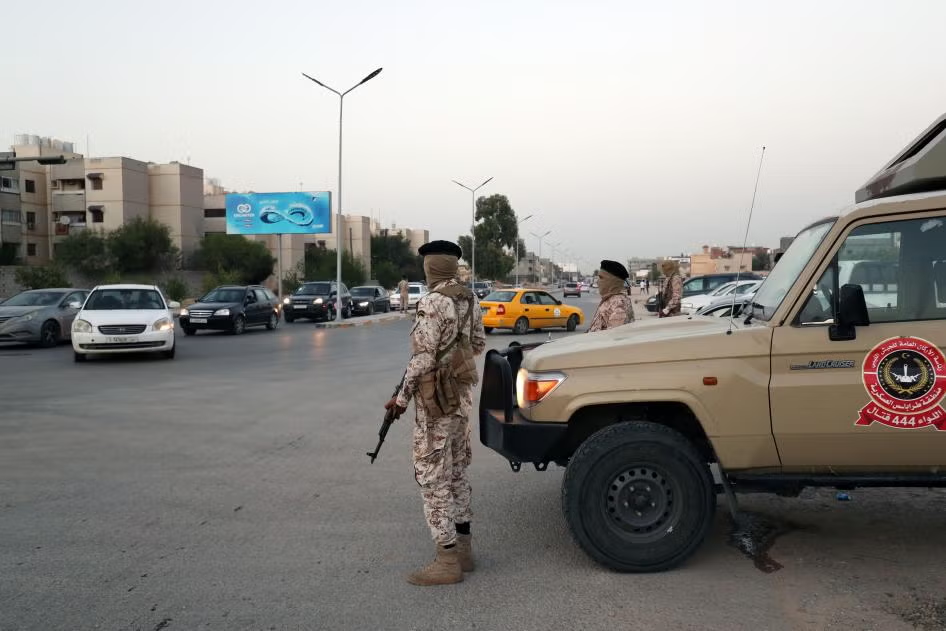
What followed was fifteen years of watching very little happen. Libya’s civil war did not end. It mutated — into a proxy conflict, then a frozen conflict, then a patchwork of competing armed factions backed by an array of foreign powers, each pursuing their own interests on Libyan territory using Libyan lives. The ICC issued arrest warrants that went unexecuted. Suspects remained at large. Victims waited. The court’s credibility in African cases, already battered by years of politically charged prosecutions and prominent acquittals, took another quiet hit every year that passed without a Libyan case moving forward.
On Tuesday, that changed. The ICC opened a confirmation of charges hearing in the case of Khaled Mohamed Ali El Hishri — the first individual to face ICC proceedings in connection with Libya’s conflict. El Hishri is accused of crimes against humanity and war crimes, including what prosecutors allege was the systematic mistreatment, torture, and killing of detained civilians during the conflict. The three-day hearing, concluding Thursday, will determine whether the evidence meets the threshold required for a full trial before ICC judges.
It would be tempting to read Thursday’s hearing as a vindication of the international justice system — proof that, however slowly, accountability catches up. The reality is more complicated. One confirmation hearing, in one case, against one accused, does not constitute accountability for a conflict that has produced documented mass atrocities across multiple factions, multiple cities, and multiple years. The ICC’s record in Libya — a referral in 2011, a first hearing in 2026 — is not a story of justice moving at its own deliberate pace. It is a story of an institution struggling against the structural limitations of a system that depends on state cooperation, political will, and access to evidence in environments where all three are in perpetually short supply.
Libya’s particular tragedy is that it has functioned as a funnel for human suffering extending well beyond its own borders. For years, sub-Saharan Africans attempting to reach Europe overland were routed through Libya, where they encountered detention facilities run by militias and state-linked entities that subjected them to extortion, violence, and conditions that have been documented by Human Rights Watch, Amnesty International, and UN investigators as amounting to crimes against humanity. These victims — Nigerians, Ghanaians, Eritreans, Ethiopians, Sudanese — are among those whose treatment may eventually fall within the scope of ICC investigations. Many of them were never Libyan. All of them were trapped in Libya’s collapse.
For human rights advocates, the significance of El Hishri’s hearing lies not primarily in its outcome but in its occurrence. Every time the court moves — however late, however incrementally — it recalibrates the risk calculation for those who would commit mass atrocities in the belief that chaos and instability will protect them indefinitely. Across the Sahel, in Sudan’s ongoing civil war, in the eastern provinces of the DRC, there are commanders making that calculation right now. The message from The Hague on Thursday is that the calculus is not as safe as it appears.
The court’s relationship with Africa has never been straightforward. The ICC has faced sustained and at times legitimate criticism for focusing disproportionately on African defendants while powerful states and their proxies escape scrutiny. The African Union at various points threatened bloc withdrawal from the Rome Statute. Individual leaders — including some later convicted — dismissed ICC proceedings as instruments of Western neo-colonialism.
These criticisms contain real substance. The ICC’s jurisdiction depends on referrals or on states that have accepted the court’s authority, which means the conflicts most likely to generate cases are those in states least able to resist international pressure — which tends to mean Africa. A world in which Libyan militia commanders face ICC proceedings while Saudi air campaign architects do not is not a world of equal justice under international law.
And yet the alternative — no accountability whatsoever — serves no one, least of all the victims of those Libyan detention facilities or the civilians caught in Libya’s fifteen-year conflict. The imperfect institution is the only institution available. Thursday’s hearing is a reminder of both its failures and its irreplaceable function.