

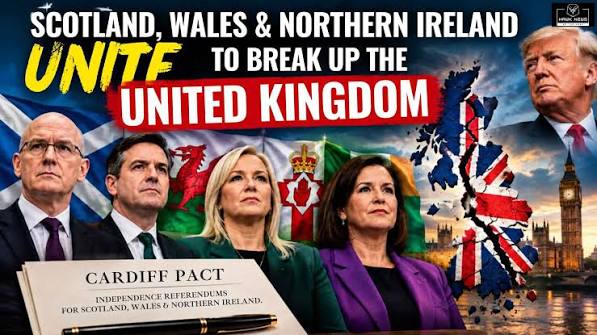
For the first time in the history of the United Kingdom, all three of its devolved nations are led by parties that
want to leave it. That fact — improbable even six months ago — became the political reality of Britain this week
when the first ministers of Scotland, Wales and Northern Ireland gathered in Cardiff and signed a joint
memorandum of understanding they are calling the Cardiff Agreement.
The signing on Monday brought together Scotland’s John Swinney (SNP), Wales’ Rhun ap Iorwerth (Plaid Cymru),
and Northern Ireland’s Michelle O’Neill (Sinn Féin). Their joint statement was unmistakably direct: ‘Our nations
have the right to self-determination. No Westminster government has the right to block democracy or
undermine the principle that our people will decide their own future.’ In plain English: Westminster’s time is
coming to an end.
What was signed does not, by itself, end the Union. The MOU is a coordination pact — a framework for the
three governments to work together on the economy, energy, climate, culture and, crucially, ‘constitutional
change.’ Scotland and Wales say their futures lie back inside the European Union as independent states.
Northern Ireland’s vision is unification with the Republic of Ireland. There is no timetable, no legal mechanism
triggered, no referendum called. What there is, for the first time, is a united political front.
The unity is the story. Until Rhun ap Iorwerth’s Plaid Cymru took power in Cardiff in May 2026, Welsh devolution
had always been led by Labour — a party constitutionally committed to the Union. His election completed a
three-of-three set for the independence movement, and the Cardiff summit was the movement’s first act of
collective muscle.
Then, on cue, Donald Trump lit the match. During a weekend visit to Dublin days before the summit, the US
president publicly endorsed a united Ireland, telling reporters that ‘one of the naturals of all time is to put them
together.’ He repeated the line on Sunday. Whatever one thinks of Trump’s foreign-policy instincts, the
intervention instantly turned an internal British constitutional argument into an international one — and handed
nationalist leaders in Cardiff a talking point they hadn’t had to script for themselves.
Downing Street’s response has been unambiguous, if slightly hobbled. Prime Minister Andy Burnham — the
Labour PM who replaced Keir Starmer after Starmer’s resignation in June — has said a border poll and any
independence referendum remain ‘off the table.’ Downing Street reaffirmed the line within hours of the Cardiff
signing. But Burnham himself was absent from much of the political theatre, having cancelled his public
schedule following the death of his father, and the government’s firmest defense of the Union was being
delivered by proxies rather than the Prime Minister. In politics, absence is content too.
The legal picture, for now, favours Westminster. The UK Supreme Court has already ruled that Holyrood cannot
hold an independence referendum unilaterally. A Section 30 Order — the mechanism that made the 2014
Scottish referendum lawful — has been refused. Any Northern Irish border poll would require the Secretary of
State to conclude a majority now favours a united Ireland, which the Good Friday Agreement leaves as a
judgment call. So the Cardiff Agreement is, strictly speaking, political pressure without a legal route.
But the pressure is real, and the numbers behind it are shifting. Scottish independence polling is now at a
statistical dead heat, roughly 50–50 excluding don’t-knows — a striking swing from March 2026 when No led 56
to 44. The generational divide is starker still: around 55% of Scots aged 16 to 24 support independence,
compared with just 29% of over-65s. Welsh support for independence remains a minority position but has crept
up steadily. Northern Ireland border-poll polling is now close enough that both unionist and nationalist
strategists treat it as a live prospect within the decade.
For the European Union, the Cardiff Agreement is awkward and interesting. Publicly, Brussels will not touch a
member state’s internal constitutional order. Privately, officials know that an independent Scotland and an
independent Wales seeking accession, together with a reunified Ireland, would reshape the map of Europe in
ways the bloc has not seriously contemplated since Brexit itself. The Cardiff signatories know this too. That is
why the memorandum leans so hard on the phrase ‘return to Europe.’
The unionist case is not silent. Scotland in Union and other pro-UK groups argue the pact is symbolic theatre
without a mandate — that no election was fought on ‘break up Britain,’ that the economic costs of separation
would be brutal, and that support for the Union in England, which pays the bulk of the fiscal transfer, has
hardened in response. Some Conservative MPs are already pressing Burnham to legislate away the possibility of
unilateral referendums for good.
Which brings the story back to a very old British question, dressed in new clothes. The Union has always been an
act of political will rather than a natural law. It has held for centuries because enough people in enough of its
constituent nations wanted it to. What the Cardiff Agreement makes visible is that, in three of the four nations,
the will is now formally organized against it. The legal firewall in Westminster is intact. The political ground
beneath it is moving.
Whether the Cardiff Agreement is remembered as a symbolic gesture or as the opening move in the unwinding
of a 300-year union will not be decided this year. But for the first time since devolution began, the question is no
longer academic. It is on the table, in writing, with signatures.