

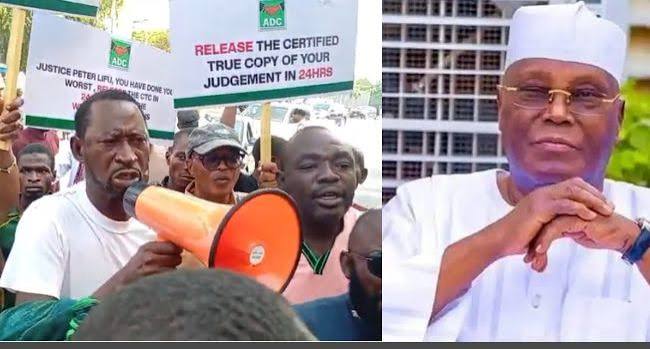
ABUJA — Nigeria’s path to the 2027 presidential election took another sharp turn this
morning. The Independent National Electoral Commission (INEC) has confirmed that it will
keep former Vice-President Atiku Abubakar on the final presidential list for the January 16,
2027 ballot — despite a Federal High Court judgment that nullified the process that
produced his candidacy.
INEC’s reasoning, as set out by its chairman and carried by Tribune Online and Leadership
newspapers, is procedural: a rival ADC faction has written to the commission claiming it, not
Atiku’s wing, controls the party’s leadership. Until the courts finish adjudicating that dispute,
INEC says, it will not act on either letter. The default — the list as published — stands.
It is a classic INEC position: refuse to referee a party’s internal war until a judge has. It is
also, in practice, a win for Atiku. Every day the final list holds is a day he can campaign as the
duly listed candidate of the African Democratic Congress, the opposition vehicle he adopted
after his acrimonious exit from the PDP.
The ADC itself is in open civil war. The party that was meant to be the staging ground for a
2027 opposition coalition is now the stage for a leadership dispute that has drawn in at least
three separate factions, a Federal High Court judge, a court of appeal, and a parade of
lawyers. The legal question — who is the legitimate national chairman — is boring. The
political question — whether Nigeria will have a coherent opposition candidate against
President Bola Tinubu in January 2027 — is existential.
The timing is brutal for Atiku. He has run for president in every cycle since 1993 in some
form. He is 80. This is almost certainly his final campaign. And the vehicle he chose for it is at
risk of being pulled apart in court before the voter card readers even boot up.
INEC, for its part, is trying to project competence. It has endorsed a voluntary Code of
Conduct for independent tabulation and publication of election results ahead of 2027 — a
direct response to the 2023 debacle in which the IReV results portal faltered on election
night and triggered a credibility crisis the commission is still trying to climb out of. INEC has
also, candidly, told reporters that its infrastructure is not ready to upload ward, LG and
state-level results in the upcoming elections, because those systems have not been built or
tested.
That admission is politically explosive. A 2023 result upload partial failure gave rise to a
conspiracy theory that has dominated Nigerian political discourse for three years. A 2027
result upload that is incomplete by design — not by malfunction — will be read by many
voters as proof that the commission is still gameable
The November 28 nationwide mock election, which INEC has now scheduled, is meant to be
the firewall. The commission will test its upgraded accreditation and electronic result
transmission systems in a rolling exercise across all 36 states and the FCT. If it goes well, it
buys INEC credibility heading into January. If it does not, the 2027 election’s legitimacy will
be in dispute before the first vote is cast.
The other candidacies are moving too. In Niger State, former FIRS Chairman Muhammad
Mamman Nami has been confirmed as the PDP governorship standard-bearer. The Labour
Party is still choosing between a Peter Obi re-run and a generational pivot. And smaller
parties are angling for the role of kingmaker in what everyone expects to be a tight race.
For now, the headline is simple. Atiku is on the ballot. The ADC is in court. INEC is caught
between them. And Nigeria’s 2027 presidential election is already being fought — in
affidavits.