

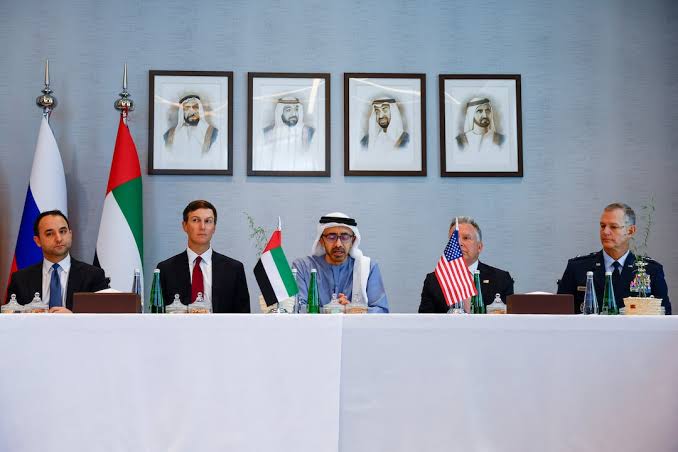
ABU DHABI — High-stakes trilateral talks between US, Russian, and Ukrainian delegations
opened in the United Arab Emirates capital on Tuesday morning, with American envoys Steve
Witkoff and Jared Kushner leading an effort President Donald Trump says could end the nearly
four-year war “soon.”
The meeting — the third round of US-brokered talks in Abu Dhabi this year — began hours ago
and is scheduled to run through Wednesday. Just before the trilateral opened, Kushner and
Witkoff held what Ukrainian officials described as “close consultations” with representatives
from Ukraine, the European Union, NATO, Germany, France, the UK, and Italy, a notable shift
after Europeans were sidelined from earlier rounds.
At the core of today’s agenda: a framework for security guarantees for Ukraine, including the
possibility of a defense commitment modeled on NATO’s Article 5, according to a senior
Ukrainian official. For the first time in this round, Washington is also signaling openness to a
broader European security architecture — a longstanding Russian demand that NATO allies have
resisted for decades.
“Our goal is a negotiated solution that can deliver lasting peace and create the conditions for a
sovereign, secure, and prosperous Ukraine within a more stable European security environment,”
Kushner said in a statement issued overnight.
President Trump, speaking to reporters before the meetings began, called recent conversations
about Ukraine “very good” and predicted the war could “end soon.” His tone is sharper than the
cautious signals coming out of Kyiv and Brussels, where officials are warning that the hardest
issue — territory — remains unresolved. Both Moscow and Kyiv have refused to budge on the
status of occupied regions, and that single disagreement has sunk every prior push.
Ukrainian President Volodymyr Zelenskyy, who is not in Abu Dhabi, said this morning that
Ukrainian forces have made battlefield gains in recent days, a message widely read as an attempt
to strengthen his negotiators’ hand. Russia, meanwhile, has framed the talks as a chance to lock
in territorial realities on the ground.
Axios reports that depending on how the two days unfold, Witkoff and Kushner may fly directly
from Abu Dhabi to Moscow and Kyiv for separate meetings with Vladimir Putin and Zelenskyy
— a sign the White House wants to force decisions, not just consultations.
European leaders are watching warily. For most of this year, Trump’s diplomatic push has moved
faster than European capitals are comfortable with, and the inclusion of EU and NATO
representatives in today’s pre-talks was the result of weeks of lobbying by Paris, Berlin, and London. “There will be no durable peace in Ukraine without European security, and no European
security decided without Europe,” a senior French diplomat said, asking not to be named.
The talks are unfolding against a tense regional backdrop. Just east of the Gulf, Trump this week
signaled that further military action against Iran “doesn’t seem to be a very necessary thing,”
while Tehran’s President Masoud Pezeshkian said Iran is open to direct US talks — a potential
thaw that would reshape the diplomatic chessboard the Abu Dhabi delegations are playing on.
What to watch next: whether a joint statement emerges on Wednesday, whether any mention of a
ceasefire — even a partial one — survives the final draft, and whether Witkoff and Kushner
board planes for Moscow and Kyiv immediately after. Anything less than movement on all three
fronts will be read as another round of talking about talks.