
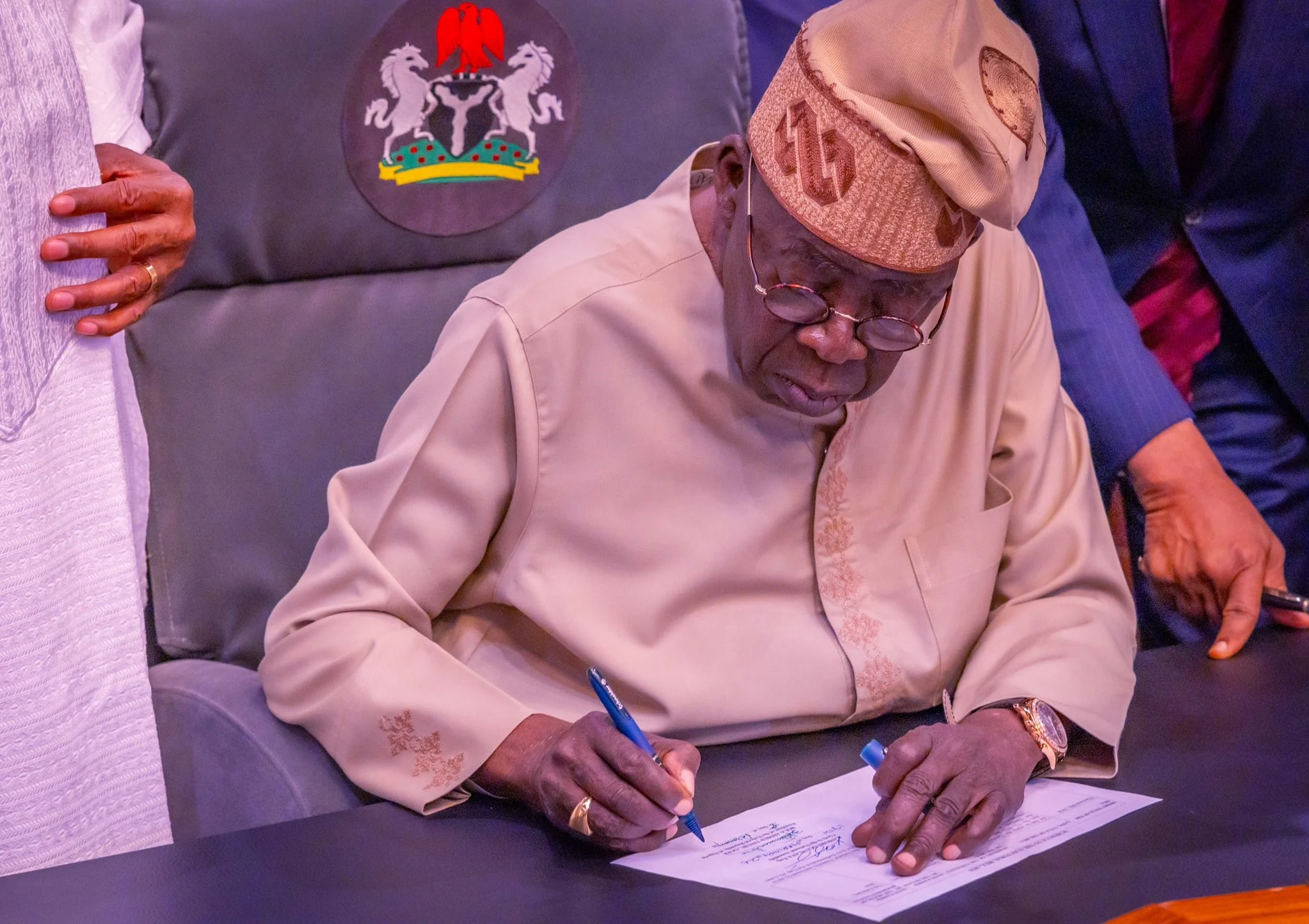
President Bola Ahmed Tinubu has asked Nigeria’s National Assembly to approve a fresh
supplementary external borrowing plan of $20.5 billion and €1.45 billion, in a request that landed in
both chambers over the weekend and is being read on the floor this week. The scale of the proposal
— one of the largest single borrowing asks of his administration — has already set off a fierce
political fight in Abuja.
Government officials familiar with the submission say the funds are earmarked for a mix of
infrastructure, power, rail and social-safety-net projects, with a portion set aside to refinance
existing short-term obligations maturing in 2027. Channels Television reported the letter was
transmitted via Senate President Godswill Akpabio and Speaker Tajudeen Abbas, and would be
debated once standing committees return their initial reviews.
Context for the request is unforgiving. Nigeria’s total public debt stock passed ₦150 trillion earlier
this year, and debt-servicing now absorbs a larger share of federal revenue than any other line item.
Finance Minister Wale Edun has argued the new borrowing is “concessional and project-tied,” not
budget support, and that failing to secure the financing would stall rail and transmission projects
already partly built. Opponents are not persuaded.
“This is the same government that said subsidy removal would end the borrowing cycle,” said a
senior PDP lawmaker who asked not to be named ahead of the floor debate. “We removed the
subsidy, Nigerians are paying almost ₦1,400 for petrol, and now we are back borrowing dollars and
euros. What exactly did the pain buy us?”
The numbers behind that complaint are stark. NNPCL pump prices in Lagos and Abuja have hovered
between ₦1,325 and ₦1,355 per litre since early November, with Dangote Refinery’s gantry rate
climbing to ₦1,350 in September. Industry trackers warn that petrol could touch ₦1,411 per litre by
month’s end if freight and insurance premiums continue their upward trend — a particularly painful
ceiling for small businesses in a country where generators still power most commercial activity.
The borrowing request also lands as the Nigerian Upstream Petroleum Regulatory Commission
(NUPRC) prepares to open its 2026 oil and gas licensing round portal on November 20. The regulator
is offering 40 blocks across onshore, shallow-water and deepwater terrains, in what officials are
branding as a signal of renewed investor confidence. Industry analysts, however, note that previous
rounds have produced slower-than-advertised capital inflows, and that the government cannot
assume licensing revenue will plug near-term fiscal gaps.
Politically, the timing matters. The 2027 general election is now 16 months away, and both the ruling
APC and opposition ADC and PDP coalitions are already in campaign posture. Opposition figures
argue that approving a large external borrowing package in an election cycle would hand Tinubu a
war chest for infrastructure announcements and leave the next government — whichever party wins
— with the repayment bill. APC lawmakers counter that stalling projects would be worse, and that
concessional financing at IMF and World Bank rates is cheaper than domestic bond issuance.
The Central Bank, for its part, is caught between the naira’s relative stabilisation around ₦1,580 to
the dollar and the pressure a new dollar inflow could place on monetary targets. CBN Governor
Olayemi Cardoso has publicly supported external borrowing when it is project-tied, but has warned
against using multilateral loans to finance recurrent expenditure.
Hearings on the request begin this week. Analysts expect a watered-down approval — likely dollar only, with the euro tranche deferred — to emerge before the end of November. For ordinary
Nigerians weighing another month of painful pump prices and rising food costs, the more immediate
question is simpler: when, if ever, does the pain end?