
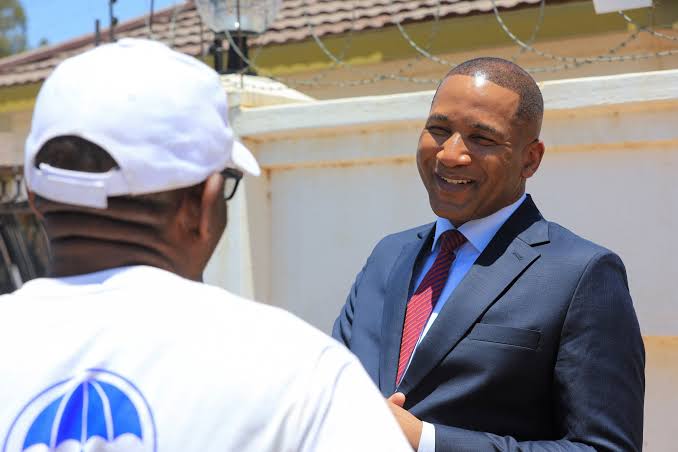
GABORONE — Botswana President Duma Boko said today that his government is actively
pursuing a larger stake in diamond giant De Beers, declaring that “concrete steps are underway
towards the acquisition of Anglo American’s shares in De Beers.” The statement, released
Tuesday morning, is the clearest public signal yet that Africa’s top diamond producer is moving
from rhetoric to action.
Botswana currently owns 15% of De Beers. Anglo American, the Johannesburg- and Londonlisted mining major, owns the remaining 85% — but is divesting the diamond unit as part of a
wider restructuring aimed at focusing on copper and iron ore. Anglo picked the Global Diamond
Consortium, led by former De Beers CEO Gareth Penny, as the preferred bidder in July.
Boko’s language today was carefully chosen. He did not reveal valuation, timetable, or the final
percentage Gaborone is targeting. But by saying “concrete steps” rather than the familiar
“ongoing discussions,” he signalled a decisive shift in posture — one many diamond-industry
analysts have been waiting for since September 2025, when Botswana first floated the idea of
outright majority control.
Behind the diplomatic language is a political and economic story that touches every Botswanan.
Diamonds account for roughly 80% of Botswana’s export earnings and a large share of
government revenue. Jwaneng, the country’s crown jewel, remains one of the richest diamond
mines in the world. For decades, the country has been a quiet partner to De Beers through their
joint venture, Debswana. Taking a bigger slice of the parent company is a logical, if ambitious,
next step.
But the ambition has been scaled back. In October, Bloomberg reported that Botswana, Namibia
and Angola together would hold less than half of De Beers under the proposed arrangement — a
retreat for Boko, who had sought majority control. Vice-President Ndaba Gaolathe described the
target simply as “more than 15%.” Angolan officials, meanwhile, have said they would like a
20% to 30% stake of their own. A final tri-nation structure is still being drawn.
That structure matters far beyond southern Africa. The global diamond trade is in its deepest
slump in two decades. Prices for natural diamonds have collapsed under pressure from lab-grown
alternatives, which now dominate the engagement-ring market in the United States. Anglo
valued De Beers at around $7.6 billion in 2023; the current sale is expected to fetch roughly $1
billion, a stunning markdown that underscores how quickly the industry has changed.
For Boko’s new government — he took office only in late 2024 after historic elections ended the
Botswana Democratic Party’s six-decade rule — the De Beers play is political as much as
economic. His administration has promised to give Botswanans a bigger share of the country’s
mineral wealth. Delivering on a larger De Beers stake would be concrete proof of that pledge.
The risks are real. Buying a bigger piece of a declining asset in a shrinking market is a gamble,
even for the world’s largest diamond-producing nation by value. If natural diamond prices
continue to slide, Botswana could find itself overweight in an industry heading structurally
downward.
Still, the optics today are striking. An African government is moving to take control of an iconic
colonial-era brand, with Namibia and Angola alongside. Fifty years ago, this conversation would
have been impossible. Today, it is the headline out of Gaborone.
Expect the next real update when Anglo closes its preferred-bidder agreement with the Global
Diamond Consortium — likely before the end of this quarter, subject to Botswana’s approval.
Boko just told the market his approval will not come cheap.