

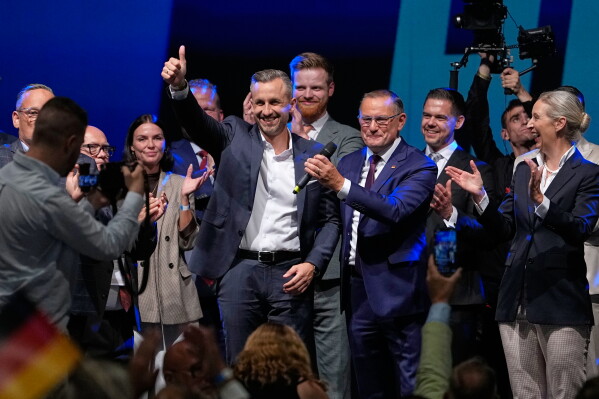
Germany woke up on Monday to a political earthquake. The far-right Alternative for Germany, or AfD, has crashed through a barrier that has stood since 1945, becoming the largest party in a German state parliament and taking 43.8% of the vote in Saxony-Anhalt.
It is more than double the party’s 2021 result. It is more than double what the incumbent Christian Democrats managed on Sunday, and it hands the AfD 39 of the 83 seats in the Magdeburg parliament. The CDU took just 17.2%. The SPD, the party of Chancellor Olaf Scholz’s successor, collapsed to 9.3%, tied with the Greens and the Left on eight seats each. The new left-populist BSW scraped in with 5.3%.
By any historical measure, this is the biggest single-state result any far-right party has scored in Germany since the fall of the Third Reich. Overnight coverage across Berlin, Brussels and Washington was blunt: a taboo has fallen.
And yet — and this is where the story turns — AfD leader Alice Weidel cannot form a government. The party finished three seats short of the 42 it needed for an outright majority. Every other party in the Landtag, from the CDU to the Left, has repeatedly ruled out any coalition with the AfD under the so-called firewall, the informal cordon that mainstream German parties have kept around the far right for a decade.
That leaves Saxony-Anhalt facing what German commentators are already calling the “43.8% paradox”. The AfD has the biggest mandate of any party in the state, but it may still be locked out of the premiership. The CDU is expected to spend the coming days trying to stitch together an awkward coalition with the SPD, Greens and possibly the Left just to keep the AfD out of the state chancellery.
Voters saw it coming. In the final days of the campaign, an attack in the eastern town of Kothen that killed three people supercharged the AfD’s core message on migration and security. Exit polls found that concerns about crime and asylum policy were the top issues for AfD voters, well ahead of the economy.
The political fallout will not stay inside Saxony-Anhalt. National polls have already had the AfD in first place for months. A landslide at the state level is the strongest argument the party has ever had that its rise is not a protest vote, but a genuine electoral shift in the former East. Weidel used her victory speech overnight to demand snap federal elections, calling the firewall “an insult to millions of voters”.
European capitals are watching closely. Marine Le Pen in France and Geert Wilders in the Netherlands both congratulated the AfD within hours. Brussels officials have privately warned that a far-right party controlling a German state — even a small one — would change the tone of every EU debate, from migration to Ukraine aid. For now, Saxony-Anhalt is in political limbo. Coalition talks begin this week. The AfD is boxed out, but no longer boxed in. Germany’s firewall held on Sunday night. Just barely.