
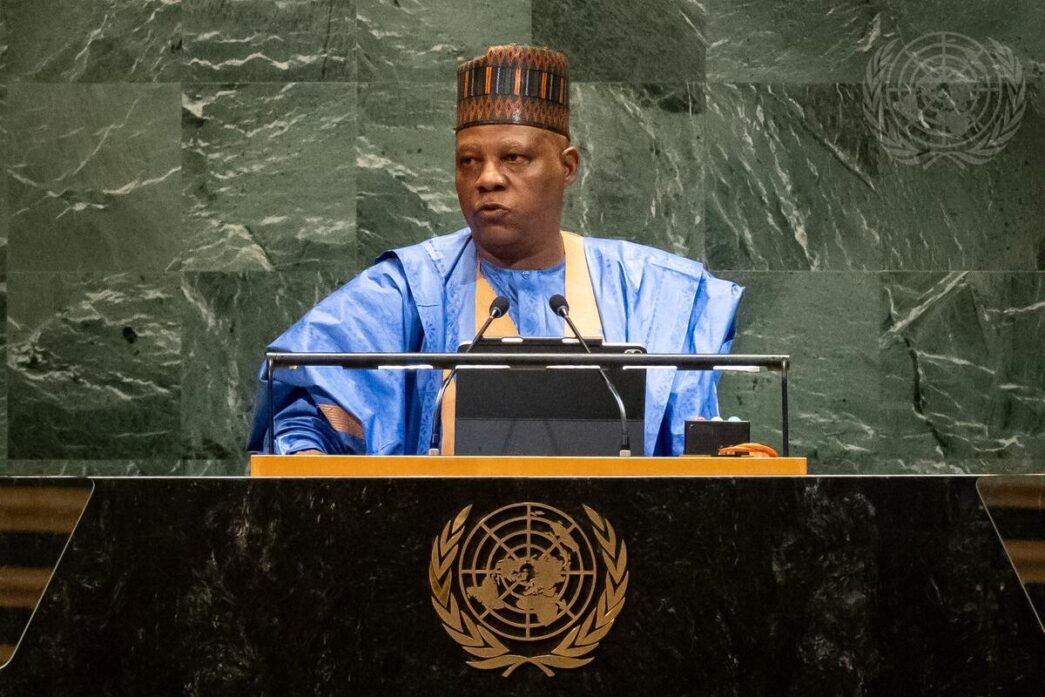
President Bola Ahmed Tinubu will not attend the 81st Session of the United Nations General
Assembly in New York this week — and has instructed Vice President Kashim Shettima to lead
Nigeria’s delegation in his place, the Presidency confirmed in a statement issued on Sunday
night and dominating Monday morning’s front pages.
The announcement, released by Senior Special Assistant to the President on Media and
Communications (Office of the Vice President) Stanley Nkwocha, marks the third consecutive
year Tinubu has skipped the UN’s flagship diplomatic gathering — a pattern that has become
the subject of pointed debate on Nigerian Twitter overnight.
According to the statement, Shettima will deliver Nigeria’s national statement to the General
Debate on Wednesday, September 23, articulating the country’s position on climate change,
the reform of global financial institutions, the Right to Development, and continental security.
He is also expected to hold high-level bilateral meetings on trade, migration, and the ongoing
crises in the Sahel.
The Nigerian delegation, per the statement, includes Rivers State Governor Siminalayi Fubara —
his first major international outing since the resolution of the state’s protracted political crisis
— Zamfara State Governor Dauda Lawal, several federal ministers, and senior officials from the
ministries of foreign affairs, finance, and environment.
The theme of this year’s UNGA General Debate — running September 22 to 28 — is ‘Restoring
trust, managing transformation: A United Nations that delivers for all.’ For Nigeria, whose
diplomatic weight often outstrips its immediate economic pull, the assembly is normally a
marquee moment on the president’s calendar.
The Presidency did not explicitly state why Tinubu is skipping the trip, and his aides have been
unusually tight-lipped. In prior years, absences have been attributed to ‘domestic priorities’ — a phrase that critics say has grown thin. Opposition leaders and civil society voices were quick to
fill the vacuum on Sunday night. Peter Obi, the Labour Party’s 2023 presidential candidate and a
repeat 2027 hopeful, told supporters that Nigeria’s absence from the world stage ‘sends the
wrong signal to investors and partners at a time when we need every microphone we can get.’
Others were more forgiving. Presidential spokesperson Bayo Onanuga defended the decision in
a follow-up post, arguing that Shettima ‘has been an effective statesman’ at prior sessions and
that the president’s decision to stay home reflects ‘discipline, not disinterest.’ Sources close to
the Villa point to the delicate economic moment — the naira closed Friday at ₦1,331.20 to the
dollar in the official window and ₦1,395 in the parallel market — and to unresolved security
operations in the Northwest as reasons Tinubu wants to remain visible in Abuja.
Shettima, for his part, has quietly built a niche as Nigeria’s face abroad. A former Borno State
governor and Central Bank economist, he has led Nigeria’s UNGA delegation in 2024 and 2025
and has cultivated relationships across the G20, the African Development Bank, and the Islamic
Development Bank. Diplomats in New York, briefed overnight, said his delivery style —
measured, technocratic, statistics-heavy — plays well in the assembly hall.
But the political optics inside Nigeria are more complicated. With the 2027 election cycle
already stirring, every high-profile assignment given to Shettima fuels speculation about the
vice-presidential ticket and about internal APC power dynamics. Shettima’s growing
international portfolio is being read by some in Kaduna and Kano as a soft launch of a broader
role — a reading his own camp has been careful neither to confirm nor deny.
For Fubara’s inclusion, the message is different but equally deliberate. His appearance in the
delegation signals a full political rehabilitation after months of open warfare with his
predecessor Nyesom Wike, and it hands the Rivers governor a platform to reintroduce himself
to international investors.
The Presidency has also confirmed that Shettima will attend side events on artificial-intelligence
governance and on the reform of the UN Security Council — a long-standing Nigerian priority
that has taken on new urgency amid this year’s global upheavals.
Whether Tinubu’s absence is a strategic choice or a missed opportunity, one thing is clear on
Monday morning: for the third year running, Nigeria will speak to the world through its vice president. And Nigerians, as ever, will be watching closely — and arguing loudly — about what that means.