

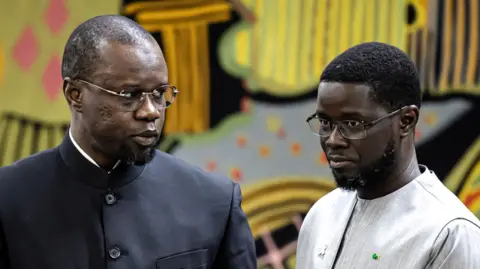
Senegal, long held up as one of West Africa’s steadiest democracies, has just delivered
one of its most dramatic political shocks in years.
President Bassirou Diomaye Faye has fired Prime Minister Ousmane Sonko and
dissolved the entire government. The decision was read out on state television in a
decree delivered by presidential aide Oumar Samba Ba, who announced that Faye “has
ended the duties of Ousmane Sonko… and consequently those of the ministers and
secretaries of state who are members of the government.”
To understand why this is such a bombshell, you have to understand how these two
men ended up in power together.
The backstory: a partnership for the ages
Sonko is arguably the most charismatic politician in Senegal — a firebrand opposition
figure with a huge youth following. But ahead of the March 2024 presidential election,
he was barred from running himself because of a defamation conviction. So he threw
his weight behind his lesser-known protege, Faye, and effectively carried him to the
presidency.
Once Faye won, he repaid the favour by appointing Sonko prime minister. For a while,
the pairing looked like one of Africa’s most fascinating power-sharing experiments: the
mentor running the government, the protege running the country.
On Monday, that experiment ended in a single televised decree.
Officially, the split has been building for months. The two men have increasingly clashed
over how to manage Senegal’s finances, and the numbers are sobering. The
International Monetary Fund estimates that Senegal’s public debt reached the
equivalent of 132% of GDP at the end of 2024 — a staggering figure that has narrowed
the government’s room to manoeuvre and sharpened every internal disagreement about
spending and reform.
Personalities matter too. Faye, the quiet head of state, and Sonko, the crowd-pulling
street politician, were never an obvious fit once the shared goal of winning power was
achieved. Allies describe a relationship that has soured steadily over the past year.
Here is what makes this more than a routine reshuffle: Sonko is not just any sacked
official. His party dominates Senegal’s parliament. That means the president has just
removed a prime minister who commands a powerful political machine and a devoted
national following — and, so far, no replacement has been named.
Political analysts are openly warning that the firing raises the prospect of a genuine
power struggle between the presidency and Sonko’s camp. A president who controls
the executive against a former prime minister who controls the legislature is a recipe for
gridlock at best, and confrontation at worst.
There is also the question of the streets. Sonko’s ability to mobilise young Senegalese
has been the defining force in the country’s politics for years. Any sense that he has
been pushed out unfairly could quickly translate into protests, putting the country’s hardwon reputation for stability to the test.
What happens next
For now, the country is in an unusual limbo: a dissolved government, no announced
prime minister, and a president and his former deputy on a collision course. Faye will
need to name a new government quickly to project control. Sonko, for his part, has built
his entire career on refusing to fade quietly.
Senegal has weathered political storms before without sliding into the instability that has
hit several of its neighbours. But the sacking of Ousmane Sonko is not a normal storm.
It is the rupture of the partnership that defined the current government — and how both
men handle the coming days will shape not just their own futures, but the direction of
one of West Africa’s most-watched democracies.