

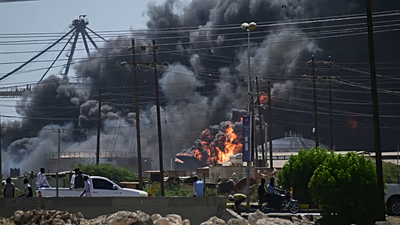
Sudan woke up in the dark on Wednesday. An overnight drone strike on a major electricity
substation in Omdurman has triggered cascading blackouts across Khartoum, Omdurman and
El Gezira states, officials and residents say, and shut down several water-treatment stations in
the process.
The attack — the latest in a widening campaign against civilian infrastructure in Sudan’s
brutal civil war — hit in the hours before sunrise, according to the national electricity utility,
which issued an emergency bulletin minutes after the strike. Engineers were still assessing
damage as of early morning.
Residents of central Khartoum reported hearing a series of low drones followed by two sharp
explosions, then an immediate loss of power across whole neighborhoods. “Everything cut at
once,” one woman in Bahri told reporters by satellite phone. “The hospitals we rely on are
running on generators again.”
Sudan has been consumed by war between the national army (SAF) and the paramilitary
Rapid Support Forces (RSF) since April 2023. The conflict has killed tens of thousands,
displaced more than 10 million people, and pushed parts of the country into famine. In the
last six months, both sides have escalated attacks on power grids and water systems — a
strategy that aid agencies have called a war crime by effect, whatever the intent.
No group has yet claimed responsibility for the Omdurman strike, but Sudanese military
officials have accused the RSF, pointing to a pattern of drone operations against
infrastructure the army controls. The RSF, which has previously said such claims are
propaganda, had not responded publicly as of this writing.
The humanitarian impact is already compounding. The World Health Organization warned on
Tuesday that Sudan’s cholera outbreak, which has already infected thousands, could explode
if water pumps fail. Several of the stations now without power sit in exactly the districts
WHO flagged as high-risk.
Fuel for backup generators, already scarce, became even scarcer within hours of the strike.
Lines formed at the few open stations before dawn. In parts of El Gezira, residents reported
paying triple the morning’s opening price by 8 a.m.
Diplomats in the region say the strike will test an increasingly brittle ceasefire effort being
pushed by Saudi Arabia, the United Arab Emirates and the United States. Those talks, held
intermittently in Jeddah and Manama, have been stalled for weeks. A fresh atrocity against
civilian infrastructure is likely to harden both sides rather than open space for compromise.
The African Union’s Peace and Security Council is expected to convene an emergency
session later today. Egypt — which borders Sudan to the north and has absorbed hundreds of
thousands of refugees — issued a statement condemning the attack within hours and calling
for an “immediate end to the targeting of civilian life support systems.
For ordinary Sudanese, however, political statements no longer carry the weight they once
did. “We have had three years of condemnations,” said one teacher in Omdurman reached by
messaging app. “What we need is electricity, water, and the war to end.”
As engineers worked to isolate damaged transformers and restart what they could of the grid,
the broader fear in Khartoum this morning was simple: the next strike could be worse.