
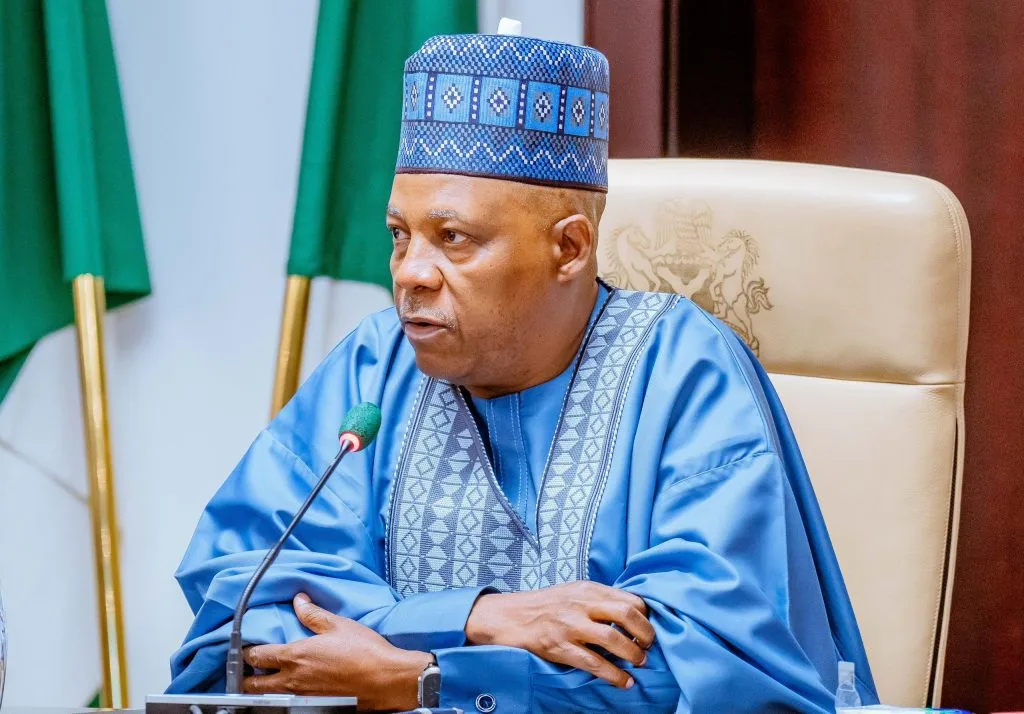
Vice President Kashim Shettima used a high-profile address at the 32nd Nigerian Economic Summit in
Abuja this morning to deliver his sharpest defense yet of the Tinubu administration’s controversial
economic reforms, telling Nigerians that there is no alternative to the current path and warning against
any attempt to reverse course.
Speaking at the Transcorp Hilton as business leaders, foreign investors, and senior ministers looked on,
Shettima acknowledged openly that the past two years have been painful. Our hearts go out to
Nigerians, especially the poor and the young, enduring difficult times, he said. But we have no option if
we must return Nigeria to the path of sustainable economic growth.
The remarks come as inflation remains in double digits, the naira continues to trade in a volatile band
against the dollar, and food prices have become a daily political flashpoint in markets from Lagos to
Kano. The removal of the fuel subsidy in 2023 and the unification of exchange rates — the two pillars of
the Tinubu economic programme — have unlocked foreign investment but also squeezed household
budgets more tightly than anything in recent memory.
Shettima argued that early signs of recovery are now visible. He pointed to a narrowing current account
deficit, stronger non-oil export earnings, and renewed interest from international portfolio investors in
Nigerian treasury bills. The economy, he said, is finally being weaned off its dangerous over-reliance on
crude oil, with agriculture, manufacturing, and the digital economy taking a larger share of GDP than at
any point in a decade.
The story being rewritten, he told the audience, is one of a country that refused to let short-term pain
define its long-term destiny.
The political subtext was unmistakable. With the 2027 general election now scheduled for January 16
following a recent INEC reschedule, the ruling All Progressives Congress is bracing for a campaign fought
almost entirely on bread-and-butter issues. Opposition leaders — including Peter Obi of the newly
rebranded Nigeria Democratic Congress — have already begun framing the reforms as a failed
experiment carried out on the backs of ordinary Nigerians.
Obi, in a statement issued hours before Shettima’s speech, accused the Tinubu administration of
encouraging and facilitating political violence and promised that an NDC government would deliver
measurable results from day one. Activist and former presidential candidate Omoyele Sowore
separately ruled out joining any opposition coalition, dismissing fellow challengers as no different from
Tinubu.
Also hanging over the summit is the lingering shadow of the Ebola outbreak. The Nigeria Centre for
Disease Control and Prevention has indicated the country could declare the outbreak over by December
7 — provided no new cases emerge — but has warned that a resurgence could force a rethink of the election timetable. The NCDC director-general stressed this morning that no government will use Ebola
as a political weapon.
Business leaders in the room said privately that what they want to hear next is specifics: a credible fiscal
consolidation plan, a clearer path on power sector reform, and a predictable foreign exchange window.
Shettima promised that an updated medium-term expenditure framework will be unveiled before the
end of the year.
For now, the message from the second-highest office in the land is unambiguous: the pain is real, the
reforms are permanent, and the 2027 campaign will be a referendum on both.