
Kenya’s bruising fuel-price crisis took a sharp turn overnight, with the government slashing
diesel prices and matatu (minibus) operators agreeing to suspend their nationwide strike for
one week — a fragile peace deal reached hours after at least four people were killed and
dozens injured in protests that paralysed the country on Monday.
The Energy and Petroleum Regulatory Authority (EPRA) announced this morning that diesel will
be reduced by KSh10.06 a litre, effective immediately. The cut is the government’s most
concrete concession yet to public anger over fuel prices that have surged as a knock-on effect
of the U.S.-Israel war on Iran and rising shipping costs through the Red Sea.
Interior Cabinet Secretary Kipchumba Murkomen confirmed in a pre-dawn briefing that publictransport stakeholders had agreed to suspend the strike until Tuesday, May 26, while talks
continue. “Both sides have agreed to give negotiation a chance,” Murkomen said. “This pause
must be used to find a sustainable answer, not just to buy time.”
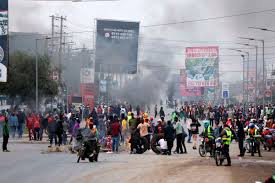
Monday’s protests, called by minibus owners who form the backbone of Kenya’s mass-transit
system, brought Nairobi, Mombasa, Kisumu and Nakuru to a standstill. Plumes of tear gas hung
over the central business district as police clashed with protesters in scenes uncomfortably
reminiscent of the Gen-Z unrest of 2024. At least 348 people were arrested. Four people were
confirmed dead — three from gunshot wounds and one in a road accident linked to the chaos.
The Matatu Owners Association and the Transport Workers Union had been demanding a fuelprice rollback for weeks. They argued that the latest EPRA increase, which pushed pump prices
to their highest level since independence, was untenable for an industry whose passengers
cannot afford to absorb the cost. Small-scale farmers, who rely on the same matatus to move
produce, joined the strike call.
The government’s response has shifted dramatically in 24 hours. As recently as Monday
afternoon, President William Ruto’s administration insisted the EPRA pricing formula was “fair
and transparent” and accused the strike organisers of “political opportunism.” By Tuesday
morning, the talking points had changed: officials emphasised “listening,” “partnership” and
“shared sacrifice.”
Behind the U-turn is real economic pain. Kenya’s inflation rate climbed to 8.4 percent in April,
driven mostly by transport and food costs. The shilling has weakened sharply against the dollar
in recent weeks, and the country’s debt-service burden has consumed more than half of its tax
revenue. Treasury officials privately acknowledge there is little fiscal room for sustained fuel
subsidies — but also no political room to do nothing.
The KSh10.06 cut is partly funded by a temporary reduction in the petroleum development
levy, the same instrument the government quietly raised earlier this year. Petrol and kerosene
prices were left untouched in this morning’s announcement, prompting concern that the
rollback is targeted, not structural.
Economists are split on what comes next. Some see this morning’s announcement as a
textbook example of the Ruto administration’s pattern — push through unpopular fiscal
measures, retreat under pressure, blame external factors. Others say the diesel cut is a
pragmatic response that recognises the political cost of allowing the matatu industry to seize,
which would risk a far broader uprising.
Regional implications are also in play. Uganda, Rwanda and South Sudan all import refined fuel
through Kenya’s pipeline and Mombasa port. The brief shutdown of Kenyan road transport over
the past 48 hours had already begun to ripple through East Africa’s interior, with reports of
delayed fuel and food shipments crossing the borders.
For ordinary Kenyans, this morning brings a cautious sigh of relief. The matatus are running
again. The diesel pumps are turning. But few believe the underlying problem — a country
squeezed between costly fuel imports, a fragile currency and a swollen debt — has been solved.
The one-week truce expires next Tuesday. By then, the government will need a more credible
answer than another last-minute price cut.