

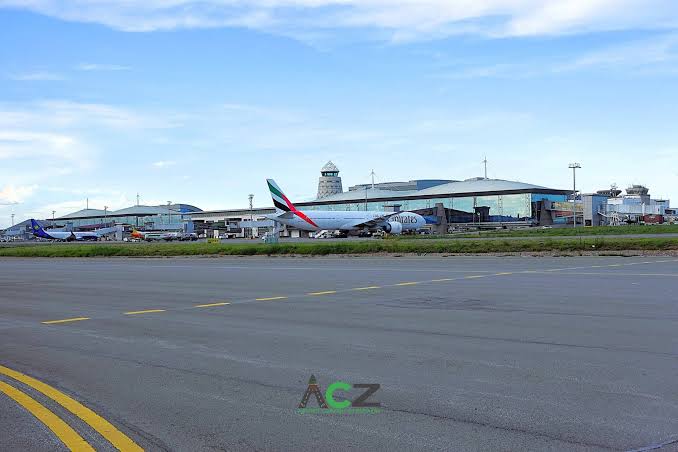
Zimbabwe has unveiled a $1.3 billion air cargo project at Harare’s Robert Mugabe
International Airport, in an ambitious bid to reposition the country as Southern Africa’s
logistics gateway. Construction is set to begin in the first quarter of next year.
The project, confirmed in details that emerged this morning, will be delivered through a
public-private partnership between Transvaal Africa — a private logistics and infrastructure
investor — and the Airports Company of Zimbabwe. It is one of the largest single
infrastructure commitments the country has announced since its multi-year economic crisis
began.
The pitch is geographic. Harare sits roughly equidistant from Johannesburg, Lusaka, Dar es
Salaam and Luanda, and Zimbabwe has long argued that the right airport infrastructure
could siphon cargo flows away from more congested regional hubs like OR Tambo. Until
now, the argument has been more aspirational than actionable. Today’s announcement
attaches a dollar figure and a timeline to it.
The planned hub is expected to include dedicated freighter aircraft stands, cold-chain
facilities for Zimbabwe’s horticulture and pharmaceutical exports, bonded warehousing, and
an integrated customs processing centre designed to cut dwell times for transit cargo. If
delivered to specification, it would be the largest purpose-built air cargo facility in Southern
Africa outside South Africa.
The context is a country trying to climb out of a very deep hole. Zimbabwe’s economy has
been constrained by hyperinflation episodes, currency instability, erratic power supply, and
sanctions-era investor caution. The reintroduction of the ZiG currency has stabilised prices
somewhat, but foreign direct investment remains a trickle compared with what the country
attracted in its tobacco and mining boom years.
For President Emmerson Mnangagwa’s administration, the project is political as much as
economic. It allows Harare to point to tangible, dollar-denominated private-sector
investment at a moment when donor support is thin and regional competitors like Rwanda
and Kenya are far ahead on logistics modernisation. Expect the deal to be heavily featured
in year-end state-of-the-nation messaging.
Not everyone is convinced. Zimbabwean business commentators have already asked who,
precisely, Transvaal Africa is, what the financing structure looks like, and whether the public
side of the partnership comes with sovereign guarantees that could saddle the state with
contingent liabilities. The Airports Company of Zimbabwe has had ambitious
announcements before that failed to materialise, including earlier plans for a Victoria Falls
expansion that stalled for years.
Cargo volume is the other open question. For a hub-and-spoke cargo operation to work, you
need committed anchor carriers. The announcement did not name a launch customer
airline. Sources familiar with the project say talks are underway with Ethiopian Airlines
Cargo, Qatar Airways Cargo, and at least one Gulf freight consolidator, but nothing has been
signed publicly.
Regional implications are real. South African logistics interests will watch nervously;
Johannesburg’s grip on regional air cargo is already being tested by Addis Ababa and
Nairobi. Zambian and Mozambican freight forwarders, by contrast, could benefit from a
closer hub with less border friction than OR Tambo. The East African Community will likely
view the move as competitive encroachment on turf Nairobi has been working to lock in.
Climate and ESG investors will also look closely at the fuel strategy. Any new cargo hub
launching in 2027 or beyond is being asked to show a credible roadmap on sustainable
aviation fuel and ground-handling electrification. Transvaal Africa has not publicly addressed
either so far.
For ordinary Zimbabweans, the practical questions are simpler: will the construction create
meaningful local employment, will the forex revenue be captured or siphoned, and will the
promised multiplier effects on horticulture and manufacturing actually materialise.
The next milestone is Q1 groundbreaking. Watch for the first definitive carrier commitment
and for a clearer breakdown of the $1.3 billion — equity, debt, government contribution.
Both will tell you whether this is Zimbabwe’s logistics turning point, or another
announcement that looks better on paper than on tarmac.