

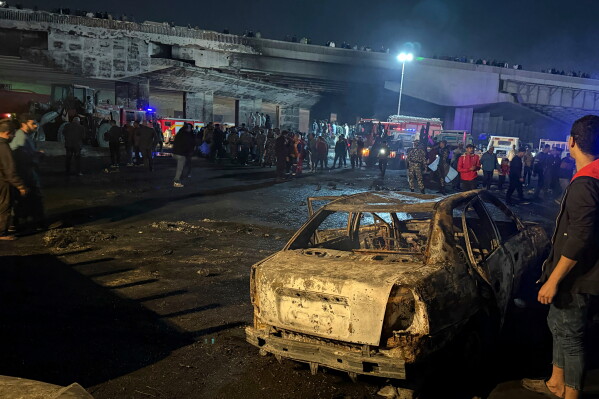
CAIRO – At least 31 people were killed and 21 injured after a fuel tanker
overturned and exploded on the Ring Road outside Cairo, Egypt’s health
ministry said, in what is shaping up to be one of the deadliest road disasters
the country has seen this year.
The crash happened overnight, with the first emergency calls going out in
the late evening and the fire burning into the early hours. By sunrise, the
scene stretched for hundreds of metres: charred vehicle shells, a collapsed
section of guardrail, and a slick of burned fuel that forced authorities to
close the highway in both directions.
Eyewitness accounts carried by local outlets describe a sudden “wall of
flame” as the tanker tipped on a curve and ruptured. Cars behind it had no
time to brake. Several vehicles were consumed almost instantly.
Motorcyclists were among the first casualties.
Egypt’s health ministry put the confirmed toll at 31 dead and 21 injured as
of this morning, but hospital sources in Giza and Greater Cairo warn the
number is expected to rise. Some of the injured are being treated for severe
burns, and identification of the dead is slow because of the condition of the
remains.
Prosecutors have opened an investigation. Early focus is on whether the
tanker was speeding, whether its load was properly secured, and whether
the section of road where the crash occurred had adequate lighting and
barriers. The Ring Road – a key artery looping around the capital – has a
long history of deadly accidents involving heavy trucks and tankers, and
reform campaigners have been demanding a crackdown on overloaded fuel
vehicles for years.
President Abdel Fattah el-Sisi’s office is expected to issue a statement later
today. The UAE, which has lost citizens in past Egyptian road incidents,
moved quickly to send condolences. Regional neighbours are watching
closely: fuel-transport accidents have been a recurring flashpoint across the
Middle East and North Africa, with similar disasters in recent years in
Sierra Leone, Nigeria and Pakistan all producing triple-digit death tolls.
For families on the scene this morning, the questions are more immediate.
Relatives gathered at hospitals in 6th of October City and Giza waiting for
news. Some were still trying to confirm whether loved ones who had been
driving on the Ring Road late last night were among the dead. Egyptian
social media filled overnight with appeals for information about missing
drivers, delivery workers and commuters.
The disaster also raises difficult economic questions. The Ring Road is
critical to the movement of goods in and out of Cairo. A multi-hour closure,
even on a single carriageway, ripples through supply chains that were
already strained by the cost-of-living pressures hitting Egyptian households
this quarter. Fuel distribution in particular depends on exactly the kind of
tanker runs that overnight became a horror.
Road safety in Egypt has been a slow-burning crisis for years. Official data
put road-traffic deaths in the tens of thousands annually, with heavy
vehicles involved in a disproportionate share of fatal incidents. A 2019 trainstation fire in central Cairo – also fuel-related – killed more than 20 and
prompted a round of reforms that critics say were never fully implemented.
Today’s crash will reopen that debate. Civil-society groups are already
calling for mandatory GPS tracking on fuel tankers, stricter night-driving
rules, and better emergency response along the Ring Road’s most
dangerous curves.
For now, the priority is clearing the scene, identifying the dead and treating
the injured. The Ring Road is expected to remain partially closed through
the afternoon. Commuters are being urged to use alternative routes, and
logistics operators are warning of knock-on delays for deliveries into Cairo
for at least the next 24 hours