

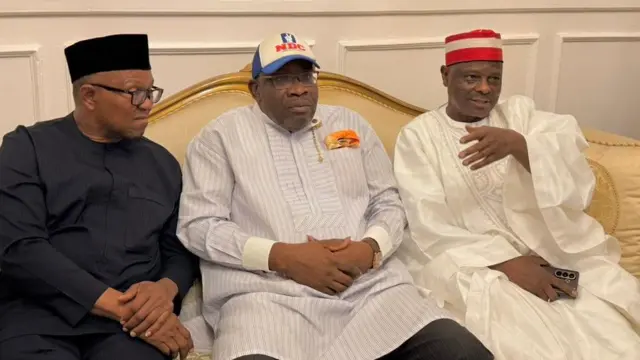
Two of Nigeria’s most prominent opposition figures defect to the Nigeria Democratic
Congress just days after a Supreme Court ruling was supposed to save the ADC. The
dream of a united front against Tinubu is unraveling in real time.
The grand opposition coalition that was supposed to unseat President Bola Tinubu in 2027
is falling apart. On Sunday, former presidential candidate Peter Obi and ex-Kano State
governor Rabiu Musa Kwankwaso officially dumped the African Democratic Congress and
joined the Nigeria Democratic Congress, picking up their membership cards at the NDC
national secretariat in Abuja in a move that has sent shockwaves through Nigeria’s political
landscape.
The defection was swift and deliberate. Obi announced his resignation from the ADC earlier
on Sunday, May 3, citing what he called a “toxic political environment,” deepening internal
crises, and “external interference undermining party stability.” Within hours, both he and
Kwankwaso were at the Guzape residence of NDC National Leader Senator Seriake
Dickson, formalizing what many insiders say had been weeks in the making.
“On behalf of the party, I welcome you both,” Dickson told the arriving leaders. “You may
not have come with a crowd, but you represent one. Nigerians know the value you bring.”
The timing is devastating for the ADC. Just four days earlier, on Thursday, April 30, the
Supreme Court had delivered what was supposed to be a lifeline — restoring former Senate
President David Mark as ADC national chairman after months of a bruising leadership
dispute that had paralyzed the party and prompted INEC to temporarily withdraw
recognition. The ruling was celebrated as the moment the opposition could finally get its
house in order. Instead, it appears to have accelerated the collapse.
The roots of the crisis run deep. When the mega-opposition coalition was formed in 2025, it
brought together an improbable alliance: Atiku Abubakar, David Mark, Rotimi Amaechi,
Nasir El-Rufai, Kayode Fayemi, and eventually Obi and Kwankwaso, all united by a shared
desire to challenge Tinubu’s presidency. By July 2025, they had adopted the ADC as their shared platform. On paper, it was the most formidable opposition front Nigeria had seen in a
generation.
But the coalition was always fragile. The question of who would be the presidential
candidate — and from which region — became a slow-burning fuse. A summit held last
week in Ibadan, hosted by Oyo State Governor Seyi Makinde, pledged to select the
candidate by consensus. But critically, the summit failed to address zoning. For Obi and
other southern stakeholders, this was a dealbreaker: without an explicit commitment to zone
the ticket to the south, the consensus arrangement looked like a cover for a northern
candidate, most likely Atiku.
Internal factions had already hardened. Some members pushed for an Obi-Kwankwaso
ticket. Others backed Atiku paired with either Makinde or Amaechi. The lack of resolution,
combined with the lingering legal uncertainty — the Supreme Court referred the substantive
leadership dispute back to a lower court rather than resolving it outright — created the
conditions for exactly what happened on Sunday.
The NDC, by contrast, is positioning itself as a fresh start. The party has scheduled its first
national convention for May 9 in Abuja and has been holding ward, local government, and
state congresses throughout the past week. Its appeal to Obi and Kwankwaso is obvious: a
clean platform free of the legal baggage and factional warfare that has consumed the ADC.
But questions abound. The NDC is a relatively young party with limited national
infrastructure. Can it realistically organize a credible presidential campaign in just over a
year? And does Obi’s third party move in three years — from Labour Party to ADC to NDC
— risk making him look less like a principled reformer and more like a political nomad?
For the ADC, the damage is severe but perhaps not fatal. Atiku’s allies insist the “coalition
train is still moving” and that the party retains significant national reach. But with INEC’s
May 10 deadline for submission of membership registers fast approaching, the clock is
ticking. Every defection — and more are reportedly coming — weakens the party’s
negotiating position and organizational capacity.
What is clear is that Nigeria’s opposition is now split across multiple platforms heading into
The dream of a single, united challenger to Tinubu looks further away than ever.
Whether that benefits the ruling APC or forces a more competitive multi-party race remains
the defining question of the next electoral cycle
For millions of Nigerians who voted for change in 2023, the sight of their leaders fighting
over party structures and presidential tickets rather than policy is bitterly familiar.