
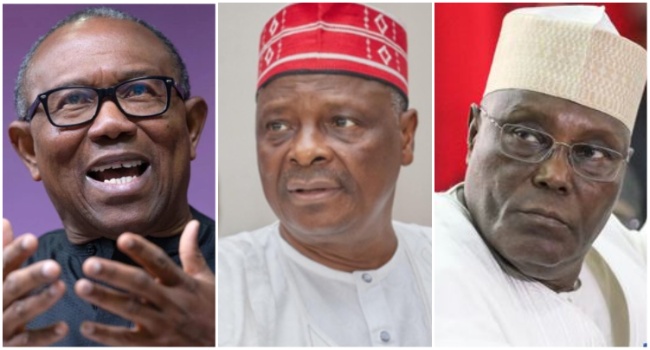
The weeks-long effort to field a single opposition presidential candidate against the ruling
party in Nigeria’s 2027 election has collapsed in public view, after Senator Rabiu Musa
Kwankwaso declared that Peter Obi would not withdraw from the race in favour of former
Vice President Atiku Abubakar.
Kwankwaso, who is the vice-presidential candidate on the Nigerian Democratic Congress
(NDC) ticket, made the comments late yesterday evening, and they dominate every major
newspaper front page across Nigeria this morning. His statement effectively ends, for now,
the most ambitious attempt in years to consolidate Nigeria’s fragmented opposition behind
one standard-bearer.
The plan had been simple on paper and almost impossibly complicated in practice. Senior
figures across the Peoples Democratic Party, the Labour Party, the African Democratic
Congress and smaller platforms had been meeting quietly for months to agree on one
candidate who could challenge the All Progressives Congress in 2027. Atiku’s camp, inside
the ADC, had been pushing hardest for the role.
Peter Obi, whose 2023 run electrified young voters and remade Nigerian political geography,
was always the hardest piece to move. His supporters, the self-styled ‘Obidients’, have
consistently rejected the idea that he should stand aside for any older politician, and privately
Obi’s team has signalled he views the single-candidate pitch as a trap designed to absorb his
movement rather than empower it.
Kwankwaso’s intervention closes that door bluntly. Speaking to reporters in Abuja, he said
talks had reached a point where it was clear ‘Obi is not going anywhere’, and that attempts to
force him off the ballot would ‘destroy the opposition rather than unite it’. Allies of Atiku
have so far declined to comment on the record.
The political cost is real. Analysts at Lagos-based policy shops told local outlets this morning
that a divided opposition in 2027 almost mathematically favours the APC, which can rely on
structural advantages, incumbency and a split anti-government vote. One commentator
described the collapse as ‘the APC’s best political news of the quarter’.
There are also implications for the economic conversation. The three main opposition camps
had been inching toward a joint platform on subsidy policy, exchange-rate management and
insecurity. Without a single candidate, those positions now risk fragmenting again, giving
voters three overlapping but non-identical opposition offers in a country already fatigued by
economic hardship.
Inside Obi’s circle, the mood is defiant. One senior aide told reporters overnight that the
Labour Party was ‘open to coalition but not to surrender’, and that the party would unveil its own 2027 roadmap in the coming weeks. The ADC, meanwhile, is expected to double down
on Atiku as its presidential choice.
For ordinary Nigerians already contending with rising rents, insecurity in Zamfara and the
aftermath of the Dangote Refinery public offering, today’s news lands with a familiar
weariness. The country has watched coalition talks collapse before. What is different this
time is the clock: 2027 is now close enough to count in months, and the opposition has
arguably just lost its best structural play.
Whether Kwankwaso’s statement is a final word or an opening bid in a longer negotiation
will be clearer within days. For now, Nigeria wakes up to an opposition that is still,
stubbornly, three.