

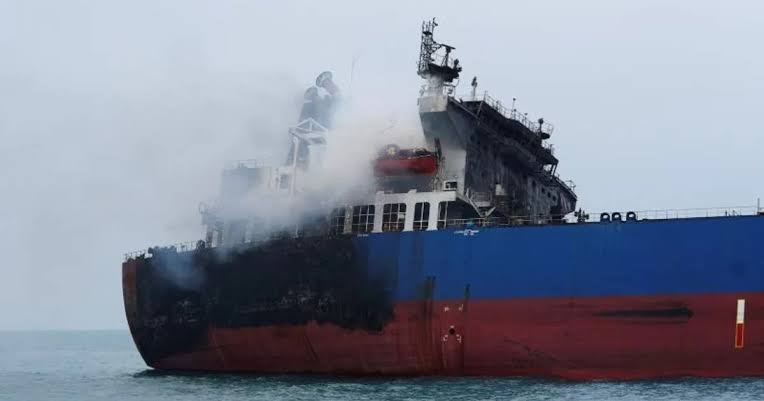
Iran’s Revolutionary Guard Corps Navy said early Tuesday that three oil tankers struck naval
mines and caught fire while transiting the Strait of Hormuz, in the most provocative shipping
incident reported in the waterway in weeks.
The IRGC said one vessel was hit near Iran’s southern coast and two more in the eastern
approach to the strait. Tehran claimed the ships were under US air escort at the moment of the
explosions, saying American protection “failed to prevent the incidents from occurring.” The
navy did not identify the tankers, name their flags, or disclose casualties.
A rival Iranian account, carried by Anadolu, said only two tankers caught fire, and that both had
switched off their identification and navigation systems before entering a “prohibited area.”
The conflicting counts underline how little independent information has emerged in the first
hours after the event.
The timing is combustible. Attacks on shipping in and around the Strait of Hormuz have surged
to their highest level since Iran’s war with Israel and the United States flared earlier this year,
according to maritime intelligence tracked by the UK Maritime Trade Operations, which logged
six tanker attacks in the week to November 18 alone.
Markets reacted quickly. Roughly a fifth of the world’s seaborne oil passes through the narrow
chokepoint, and any sustained closure risks spiking crude prices into territory not seen since the
July 12 closure, when Tehran briefly sealed the strait after US strikes on its nuclear facilities.
Analysts urged caution on the mine story itself. “Mines tend not to cause fires,” one maritime
expert told The National, suggesting the fires may point to a different weapon or a secondary
explosion inside a tanker’s cargo.
The incident lands as the US Treasury Department widened sanctions overnight on more than
two dozen Iranian exchange houses, front companies and named individuals tied to oil-revenue
laundering. Washington framed the move as part of the “maximum-pressure” architecture
President Donald Trump revived after the summer war.
Diplomatically, Iran hardened its posture. Parliament Speaker Mohammad Baqer Qalibaf said
Tehran would not open any new channel with Washington until seven conditions, outlined in a
sealed memo, are met. A June memorandum of understanding between the two sides
collapsed over disagreements on freedom of navigation through the very strait now at the
center of the latest crisis.
If the IRGC’s account holds up, it marks the first time Tehran has publicly claimed an attack
succeeded against US-escorted tankers. If, as some analysts suspect, mines were not the cause,
the crisis still broadens: a non-state actor or Iran-aligned proxy would then be operating with
impunity inside one of the world’s most watched sea lanes.
Either way, insurers, oil traders and NATO naval planners are now re-pricing risk in the Gulf in
real time. Expect the next headlines from Lloyd’s of London and Brent futures within hours.