

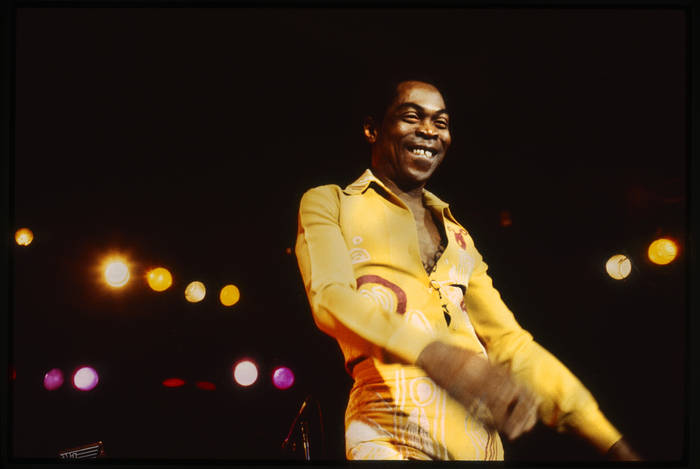
Fela Anikulapo-Kuti has made history. The Afrobeat pioneer, who died in 1997, has become the first
African artist to be inducted into the Rock & Roll Hall of Fame, a recognition Nigerians have been
pushing for publicly since at least 2021. He entered the Hall in the Early Influence category at a
ceremony in Los Angeles on Saturday, alongside Queen Latifah, Celia Cruz and — in a double moment
for Nigerian music — fellow Nigerian-British legend Sade Adu.
The weekend ceremony, confirmed in follow-up reporting through this morning, caps a two-year arc of
mainstream American recognition for Fela. In February 2026 he received a posthumous Grammy
Lifetime Achievement Award, the first time an African artist had claimed that honour. The Hall of Fame
nod closes the loop: the institution that once defined global popular music on an almost exclusively
Anglo-American axis has now written Fela, and by extension Afrobeat, into its own founding story.
The citation leans heavily into the “Early Influence” framing, and for good reason. Fela’s Afrobeat — a
fusion of jazz, highlife, Yoruba music and American funk and soul — rippled into the DNA of hip-hop,
electronic music, Western jazz, and the contemporary Afrobeats wave now carrying artists like Burna
Boy, Rema and Tems onto global charts. Western artists from Brian Eno to Questlove to Paul McCartney
have, over the decades, cited him as formative. His production methods and politically charged longform compositions are still studied in music schools.
The induction is also, unavoidably, political. Fela’s music was built as a weapon: against military
dictatorship, against colonial residue, against police brutality, against corruption. His Kalakuta Republic
was burned down by soldiers in 1977. His mother, the activist Funmilayo Ransome-Kuti, was thrown
from a window during that raid and later died of her injuries. The Rock Hall’s honouring of Fela is, in that
sense, honouring a record of dissent that cost him and his family almost everything.
For Nigeria, the significance of this week is both cultural and commercial. The country’s creative
economy — music, film, fashion, design — is now routinely cited as one of its most powerful export
engines, and government policy under President Bola Tinubu has repeatedly flagged the creative
industries as a growth priority. The Fela moment hands that policy case an enormous piece of free
marketing: the single most iconic Nigerian musician in history has just been placed inside the global canon.
The business implications are concrete. Rock & Roll Hall of Fame induction typically triggers a
measurable spike in streaming numbers, catalogue sales, biopic pitches, sync licensing and brand
interest. The Fela estate, managed through his family and the Felabration cultural movement, is already
one of the better-organised music estates on the continent. Expect a renewed surge of catalogue
reissues, documentary projects and stage productions over the next 12 months. The recently announced
biopic, “Fela,” co-produced by Steve McQueen, now has an induction speech to open its promotional
cycle with.
Sade Adu’s simultaneous induction adds another thread. Born in Ibadan, raised in the UK, Sade has
quietly been one of the most commercially successful British artists of the past four decades. Her entry
alongside Fela underscores a point many African fans have made for years: Nigerian-origin artists have
been rewriting the global pop canon for a generation; the industry is just finally admitting it.
Reactions across Lagos, Abuja and the diaspora were swift. Felabration organisers called the induction
“overdue but still monumental.” Tributes from Burna Boy, who has cited Fela as his single biggest
influence, and from Salif Keita, flooded social media overnight. The Kuti family — Femi, Seun and Yeni,
who have all carried the Afrobeat torch — attended the ceremony and spoke on stage.
The deeper message, for a Nigerian audience in 2026, is this: the country’s cultural power is no longer
waiting for permission. Afrobeats is a global format. Nollywood is a global industry. Nigerian fashion
walks every major runway. And now the man who invented Afrobeat — who played in a shared musical
universe with James Brown and challenged presidents from a stage in Ikeja — is formally in the same
room as Chuck Berry and Jimi Hendrix.
Fela once sang, memorably, that “music is the weapon of the future.” Nearly 30 years after his death, his
weapon just walked into the Rock & Roll Hall of Fame carrying a Nigerian passport.