
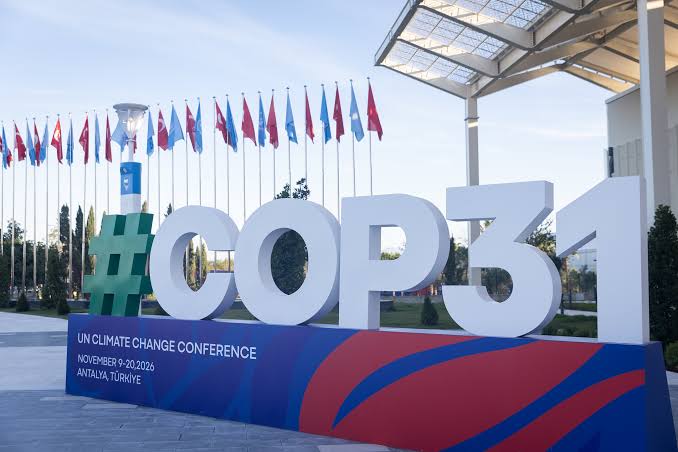
The COP31 climate summit opened this morning in Antalya, Türkiye, with United Nations climate
chief Simon Stiell delivering a blunt opening verdict: global progress on emissions is “nowhere near
fast enough.” The warning set the tone for two weeks of negotiations that officials concede could be
the most politically fraught climate talks since Paris.
Delegates from close to 200 countries filed into the Antalya Expo Centre for a conference that was
originally supposed to launch on a note of ambition. Instead, the opening ceremony was delayed by
about an hour with no public explanation — a small procedural stumble that many observers took as
an omen for the harder battles ahead over climate finance and a fossil fuel phase-out.
UN Secretary-General António Guterres opened proceedings with a direct challenge to heads of
state, urging them to “get serious” and treat the summit as a last realistic chance to keep the 1.5°C
warming target within reach. A UN Environment Programme report published in October already
warned the world is set to overshoot 1.5°C under current policies, sharpening the sense of a closing
window.
Turkey, hosting its first COP, is using the moment to push a flagship pledge: electrify more than a
third of the global economy by 2035, up from roughly a fifth today. Environment and Urbanisation
Minister Murat Kurum, who is presiding over the talks, has asked governments and corporations to
sign onto the target along with a separate pledge on developing artificial intelligence sustainably — a
first for a COP agenda.
The talks are shadowed by the absence of the United States. The Trump administration, which
withdrew Washington from the Paris Agreement earlier this year, has not sent a federal delegation
to Antalya. A handful of US governors and city mayors are attending in an unofficial capacity, but no
American minister will take the floor. European and small-island negotiators privately acknowledge
that the vacuum changes the math on finance pledges before a single gavel falls.
Money remains the central fight. African and other developing nations are pressing to triple
adaptation finance, arguing the roughly $40 billion a year on the table is a fraction of what is needed
to defend coastlines, farms and water systems already buckling under heat and drought. Wealthy
donors counter that fiscal pressure at home — from debt-service costs to defence budgets — leaves
little room for new transfers without reforms to multilateral development banks.
Fossil fuels, the ghost that haunted every COP since Dubai, is back on the agenda. The EU and a bloc
of Latin American states are circulating language that would commit signatories to a phased end to
unabated oil and gas, a demand that Saudi Arabia, Russia and several Gulf states are expected to
resist. Turkey, itself a major gas transit hub, will try to broker a compromise focused on
electrification and efficiency rather than explicit phase-out dates.
The World Leaders’ Summit is scheduled for November 11 and 12, when heads of state are due to
deliver national statements. Brazil, which hosted last year’s COP30, is expected to table a joint plan
with Turkey on Amazon and Mediterranean forest protection. India and China are sending senior
ministers but, so far, no updated national emissions targets.
The next 11 days will show whether the Antalya presidency can convert warm rhetoric into binding
text. For now, the dominant feeling inside the hall is impatience, not optimism — a sense that the
planet has run out of time for another summit that ends with a communiqué but little else.