

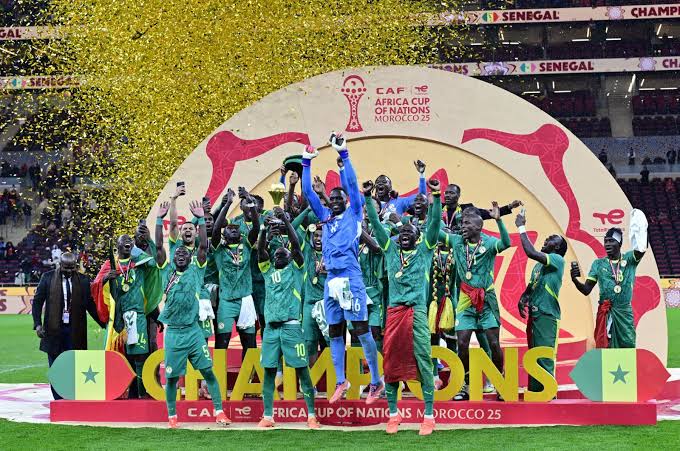
The Court of Arbitration for Sport delivered one of African football’s most dramatic verdicts in a
generation on Tuesday, unanimously reinstating Senegal as champions of the 2025 Africa Cup
of Nations and stripping Morocco of the title CAF had awarded it eight months ago.
In a decision released from Lausanne and digested across the continent overnight, the CAS
panel ruled that the final result stands as a 1-0 win for Senegal. The judgment doesn’t just
change a trophy’s home; it rewrites the record books of African football’s biggest tournament.
At the heart of the ruling is the “field of play” doctrine. The CAS panel held that once the
referee decided to resume the final after Senegal’s on-pitch protest, that call was covered by
the long-standing principle that a match official’s in-game judgement is sovereign. Articles 82
and 84 of the AFCON regulations — the rules Morocco had leaned on — were deemed to apply
only when a referee is forced to permanently abandon a match. That, the panel said, never
happened on the night.
The backdrop is explosive. Morocco had paraded the CAF-awarded trophy through Rabat in
April after CAF’s Appeal Board ruled in March that Senegal had forfeited the final by leaving the
pitch without the referee’s authorisation. Senegal’s federation filed its CAS appeal on March 25
under case number CAS 2026/A/12295, arguing the walk-off never amounted to an
abandonment because the referee had already restarted the game.
Reactions arrived within minutes of the ruling. CAF, caught in the awkward position of seeing its
own disciplinary verdict overturned, issued a short statement saying it “respects the CAS award
and will take all the necessary measures to implement it.” In practice that means updating
record books, redirecting prize money, reissuing the trophy, and amending FIFA ranking entries
dating back to January.
Morocco’s federation is not accepting defeat quietly. The FRMF announced its intention to
challenge the decision before Switzerland’s Federal Tribunal, the only legal avenue left under
the CAS framework. More sensationally, it alleged “improper contact” between Senegal’s
football president and a CAS arbitrator in the days before the verdict — a claim CAS has yet to
respond to publicly, and one that will land hard if evidence surfaces.
In Dakar, celebrations were immediate and uncontainable. The Place de la Nation filled by midafternoon with flag-waving fans, drums and Baye Fall processions. President Bassirou Diomaye
Faye called it “justice restored” in a statement from the Presidential Palace and announced that the Lions of Teranga squad would be formally re-honoured at a state ceremony in the coming
days.
Casablanca woke up to a very different mood. Café TVs cycled through replays of the disputed
final while fans questioned the referee, the CAF appeal process and, inevitably, the CAS panel
itself. The FRMF’s public complaint about “improper contact” is partly aimed at this domestic
audience, giving Moroccan supporters a rallying point even as their legal odds narrow.
The consequences stretch far beyond a single trophy. FIFA ranking points, confederation prize
money, sponsorship bonuses tied to “reigning African champions,” players’ individual-contract
clauses and even national lottery payouts in Senegal — all turn on this ruling. Several
Senegalese internationals have brand deals whose activation triggers were quietly linked to
recovery of the title.
Precedent-watchers are also recalibrating. The ruling sends a message well beyond AFCON: a
team’s protest on the pitch, however disorderly, cannot be used to strip a result if the referee
elects to restart play. That interpretation will almost certainly be cited in future continental and
intercontinental cases.
For CAF, the institutional wound is real. Patrice Motsepe’s confederation now carries the
embarrassment of having its appeal board reversed unanimously, which will fuel renewed
questions about refereeing standards, disciplinary consistency and the broader governance
architecture in Cairo.
The next flashpoint is Morocco’s challenge in Switzerland, and the parallel fight over the alleged
arbitrator contact. But for today, the answer African football waited eight months for is in:
Senegal lifted the trophy, and the law finally agrees.