

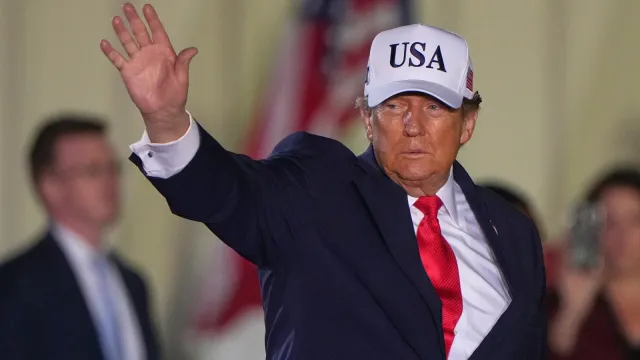
Polling stations across all 50 US states opened in the past few hours for a midterm election that
could reshape President Donald Trump’s second term before it reaches its halfway mark. Every
one of the 435 seats in the House of Representatives is on the ballot, along with 35 Senate
seats and 36 governorships, in what analysts have billed as the most consequential non presidential vote in a generation.
Trump heads into Election Day with an approval rating that pollsters put at roughly 32 percent,
the lowest for any sitting president facing a midterm in modern memory and second only to
Harry Truman in the post-war era. More than 18 million Americans have already cast early
ballots, according to the University of Florida’s Election Lab, suggesting turnout could rival or
beat the record-smashing midterm of 2018.
The House is the Democrats’ prize to lose. Independent forecasters and prediction markets
have been pricing in a flip for weeks, with some models giving the party as much as an 85
percent chance of winning back the chamber. A Democratic majority would hand Hakeem
Jeffries the Speaker’s gavel and the power to launch investigations, block appropriations and
freeze large chunks of the president’s legislative agenda.
The Senate is a tighter story. Republicans currently hold both chambers and are defending the
upper house in a map that favors them, but Democrats need to flip only a handful of seats to
force an even split or seize outright control. Prediction market Kalshi still has the GOP at 60
percent to retain the Senate, while national polling leans Democratic. Races in Pennsylvania,
Ohio, Arizona, Nevada and North Carolina are expected to decide the night.
The vote lands at a moment of unusual turbulence. The Supreme Court on Monday rejected a
Trump administration push to set aside thousands of California ballots, a last-minute legal effort
that drew sharp dissents and raised fresh concerns about the postelection count. Separately,
House Speaker Mike Johnson spent the final days of the campaign urging supporters to ignore
public polling, pointing to a recent scandal over falsified survey data.
Campaign spending has been staggering. Total outlays across House, Senate and gubernatorial
races are projected to top $12 billion, a record for any US midterm cycle. Groups aligned with
both parties blanketed battleground states with ads on abortion rights, grocery prices,
immigration enforcement and the state of American democracy.
International investors are watching closely. A divided Congress would almost certainly stall
further tax cuts and spending bills, but it would also constrain Trump’s ability to push through
sweeping tariff legislation. Wall Street futures were muted overnight as traders braced for a ong count. Several Senate races in the eastern time zone are scheduled to close at 8 p.m. and 9
p.m. ET, with results expected to trickle in through the night and possibly into Wednesday.
For voters in line this morning, the stakes feel personal. Grocery inflation, rent, Medicaid cuts
and the fallout from a bruising summer of federal workforce reductions have dominated
kitchen-table conversations. Abortion access remains the single most-cited issue among women
under 45 in exit-poll previews, while Republican voters list border security and crime as their
top concerns.
By Wednesday morning, Washington should know whether Trump still has a Congress willing to
carry his agenda — or whether the next two years will play out as a bare-knuckle fight between
a Republican White House and a Democratic House determined to run out the clock on his
presidency.