

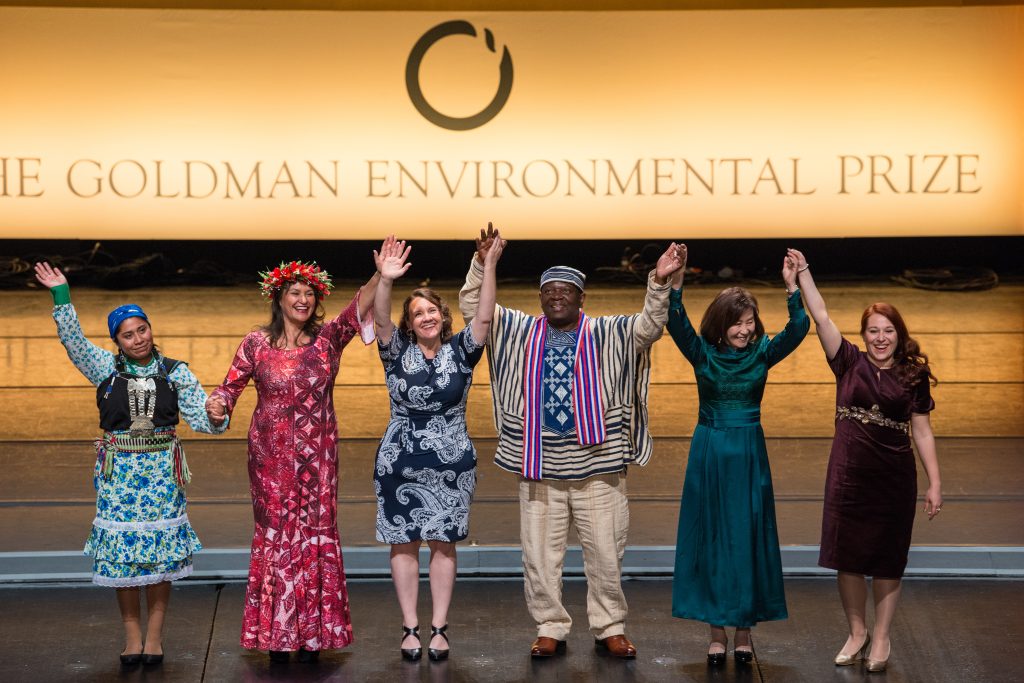
Nigerian bat conservationist Iroro Tanshi leads a historic all-female class honored for fighting wildfires, mining giants, and climate destruction across six continents.
The Goldman Environmental Foundation made history on Monday by announcing an entirely female slate of winners for its prestigious annual prize, the first time in the award’s 37-year existence that all six honorees are women. Among them is Nigerian conservation ecologist Iroro Tanshi, whose community-led campaign to protect one of the world’s rarest bat species has become a model for grassroots conservation across West Africa.
Tanshi’s story begins in 2016, when she rediscovered a small colony of short-tailed roundleaf bats roosting in Nigeria’s Afi Mountain Wildlife Sanctuary, the first confirmed sighting of the critically endangered species in the country in 45 years. The discovery set her on a mission that would eventually earn her the world’s most prestigious environmental honor.
Through painstaking fieldwork, Tanshi identified that human-induced wildfires posed the primary existential threat to the bats’ survival. Rather than pursuing a top-down enforcement approach, she launched a community-led fire brigade made up of local residents living around the sanctuary. The brigade has since responded to more than 70 fire outbreaks, protecting not only the bats but the broader ecosystem that supports surrounding communities.
Tanshi’s approach has been hailed by conservationists as a blueprint for how to protect endangered species in regions where formal government enforcement is limited. By empowering local communities to become stewards of their own natural heritage, she built a sustainable protection network that continues to function even without external funding.
The other five winners represent a remarkable spectrum of environmental activism spanning six continents. Borim Kim of South Korea was honored for her decade-long fight to protect tidal flats from industrial development. Sarah Finch of the United Kingdom won for a landmark legal victory that established the principle that governments must account for the climate impact of fossil fuel projects when granting planning permission.
Theonila Roka Matbob of Papua New Guinea was recognized for leading opposition to a deep-sea mining operation that threatened one of the Pacific’s most biodiverse marine environments. Alannah Acaq Hurley, an Alaska Native leader from the United States, was honored for her work defending the Bristol Bay watershed from a proposed copper and gold mine that would have imperiled the world’s largest sockeye salmon run.
Rounding out the class is Yuvelis Morales Blanco of Colombia, who organized Afro-Colombian communities to resist illegal mining operations that were poisoning their waterways with mercury and destroying their ancestral lands.
The Goldman Prize, often described as the Nobel Prize for the environment, carries a $200,000 award for each winner and is presented annually to grassroots environmental leaders who take significant personal risks to protect the natural world. Past winners have included Wangari Maathai, the Kenyan activist who later won the Nobel Peace Prize, and Berta Caceres, the Honduran environmentalist who was assassinated in 2016.
The all-female class arrives at a moment when women are playing an increasingly prominent role in the global environmental movement. From Greta Thunberg to Vanessa Nakate to the young climate lawyers challenging governments in court, women and girls have been at the forefront of the most consequential environmental battles of the decade.
For Tanshi, the prize is both validation and fuel. In interviews following the announcement, she emphasized that her work is far from finished. The short-tailed roundleaf bat remains critically endangered, and the pressures of deforestation, agricultural expansion, and climate change continue to threaten Afi Mountain and countless other habitats across Nigeria.
The Goldman Foundation said the all-female class was not a deliberate decision but rather a reflection of the quality and impact of this year’s nominees. In a statement, the foundation noted that the winners were selected by an international jury based purely on the significance of their achievements, calling it a powerful testament to women’s leadership in the fight for the planet.