

Tehran escalates the eight-month war with drones aimed at U.S. forces, while new
mine strikes in the Strait of Hormuz push global oil shipping closer to the edge.
Iran’s Revolutionary Guards launched a fresh drone barrage at Bahrain’s Riffa air base
overnight, Iranian state media said, targeting a facility that hosts U.S. military personnel and
reigniting fears that the eight-month war between Tehran and Washington is about to burst
open again.
Bahrain’s military said it intercepted and destroyed “several” Iranian aerial attacks, the
kingdom’s first such interceptions since September. Iran’s IRGC claimed it fired six drones in
retaliation for what it called “hostile U.S. actions.” U.S. Central Command had not confirmed
any damage at the base by Monday morning, and the American military previously disputed
Iranian claims of casualties.
The air strike came as the Strait of Hormuz, through which roughly a fifth of the world’s oil
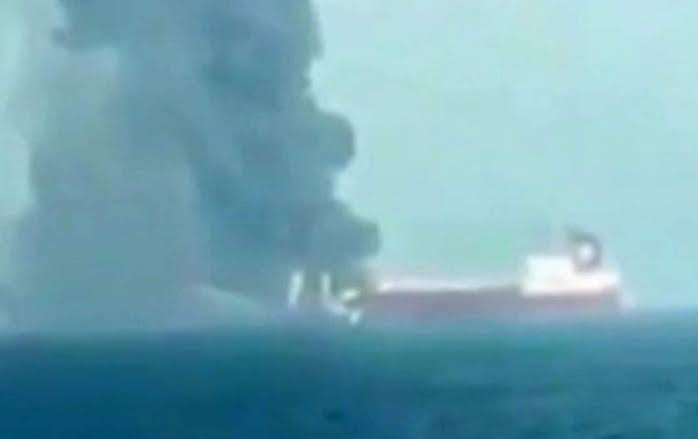
passes, descended into deeper chaos. Iranian state TV said five vessels had struck naval
mines in the strait within 48 hours, with two tankers on fire after sailing an “unauthorized
southern route.” UK maritime monitors confirmed at least one separate tanker incident but
reported no casualties. Oil markets wobbled in early Asian trade as insurance costs surged.
The U.S. Navy continues to enforce a blockade on the waterway, demanding Iran accept a
seven-point framework before shipping lanes are fully reopened. Iranian officials say any
deal must begin with an end to the blockade. Foreign Minister Abbas Araghchi is scheduled
to fly to Oman on Tuesday for a new round of back-channel talks mediated by Muscat,
Iranian state media said.
President Donald Trump, speaking from Washington, said Gulf Arab allies had privately told
him they prefer the current “status quo” to a wider war, and signaled he was weighing
holding off on new strikes unless “fresh provocations” emerged. But his administration is
simultaneously tightening economic pressure, with new sanctions on Iran’s shadow tanker
fleet expected this week.
Regional capitals are on edge. Saudi Arabia reinforced its Patriot batteries along the Gulf
coast over the weekend, according to defense officials quoted by Reuters. Qatar quietly
rerouted several LNG carriers around the Cape of Good Hope rather than risk the strait. In Yemen, anti-Houthi forces are reported to be retreating in the south, a sign that Tehran’s
proxies are also moving.
For global markets, the stakes are enormous. Brent crude jumped more than 3% in the first
hour of Asian trading before stabilizing. Shipping giants Maersk and MSC are said to be
reviewing Gulf routings for a second time this month. Analysts warn that if the mine
campaign continues, the world could be weeks away from a full shutdown of Hormuz traffic,
something not seen since the 1980s Tanker War.
Iran’s leadership appears to be betting that Washington will blink first. Supreme Leader
Ayatollah Ali Khamenei warned over the weekend that any U.S. response “will not be met by
a limited or short-lived reply.” Trump, for his part, is navigating the fallout from last week’s
midterms, in which Democrats clawed back ground in several state legislatures and now
have fresh leverage over his war powers.
What happens in the next 72 hours could shape the rest of the conflict. Bahrain has
requested an emergency meeting of the Gulf Cooperation Council. The International
Maritime Organization is preparing a rare advisory warning vessels to avoid specific sectors
of the strait. And at the United Nations, a Security Council session is being hastily arranged
after the UAE and Kuwait jointly requested consultations.
For now, the war is no longer a slow burn. It is back on the front page, and the next
flashpoint may already be in the air.