

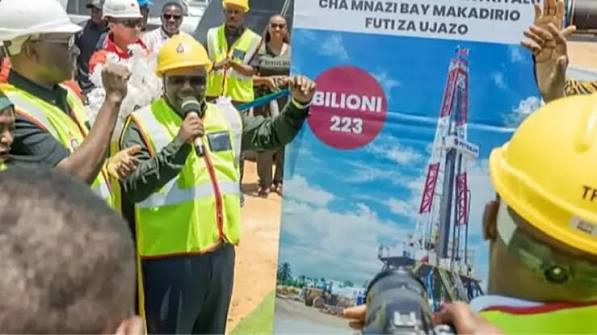
Tanzania has officially unveiled its first major natural gas discovery in more than a
decade, with the energy ministry confirming estimated reserves of roughly 223
billion cubic feet in the Mnazi Bay area off the southern Mtwara coast. The
announcement, formalised at an inauguration event in Msimbati this week, has
quickly become the talking point in East Africa’s energy circles.
The discovery was made in three recently completed wells operated by Francebased Maurel & Prom. The company’s preliminary estimate from its Kasa-1X
exploration well alone sits at about 200 bcf of gross volumes, with first production
potentially starting as early as November and a gross output potential of around 50
million cubic feet per day.
For a country sitting on roughly 57.54 trillion cubic feet of existing reserves but
struggling to translate that resource into revenue, the new find offers both a
political and an economic lift. Energy ministry officials said the discovery could
boost national reserves and strengthen Tanzania’s negotiating hand with
international partners weighing long-stalled LNG export plans.
President Samia Suluhu Hassan’s government has made gas monetisation a
centrepiece of its medium-term economic plan. Tanzania signed a Host Government
Agreement last year with Shell, Equinor and ExxonMobil for a long-delayed $42
billion LNG project. The Mnazi Bay result adds commercial weight to that broader
push even if, analysts caution, the new volume will likely be tied back to existing
infrastructure rather than developed as a stand-alone project.
Analysts at Newsquawk described the find as “incremental” – a significant word in
an industry where headline numbers can mislead. Mnazi Bay has been producing gas commercially since 2004, and additions in a mature play usually need appraisal,
drilling confirmation and a tie-back plan before they translate into cash flow.
Still, the political symbolism matters. In a region where Mozambique’s LNG dreams
have been battered by security problems in Cabo Delgado and where Uganda’s
crude pipeline project has drawn fierce opposition from climate groups, Tanzania is
quietly positioning itself as the stable energy story.
The announcement also lands amid a broader scramble for African gas as Europe
hunts for non-Russian supply. Tanzania’s Mtwara basin, long overshadowed by
Mozambique’s Rovuma offerings, is now being pitched as a complementary piece of
a regional supply puzzle.
There are domestic stakes too. Mtwara, one of Tanzania’s poorest regions, has long
complained that its hydrocarbon wealth has not translated into local development.
Government officials used Monday’s ceremony to promise new revenue-sharing
arrangements and infrastructure spending in the gas-producing districts – a
politically sensitive issue as the ruling CCM gears up for the next election cycle.
Industry watchers will now be looking for appraisal drilling results, revised reserve
bookings and firm offtake deals. Maurel & Prom’s share price moved higher on the
Paris exchange on the back of the news, and analysts said the smaller operator could
become a takeover target if the find firms up.
For now, the discovery is being sold back home as a milestone – a reminder,
Tanzania’s leaders say, that East Africa’s energy future still has room for upside
surprises.