

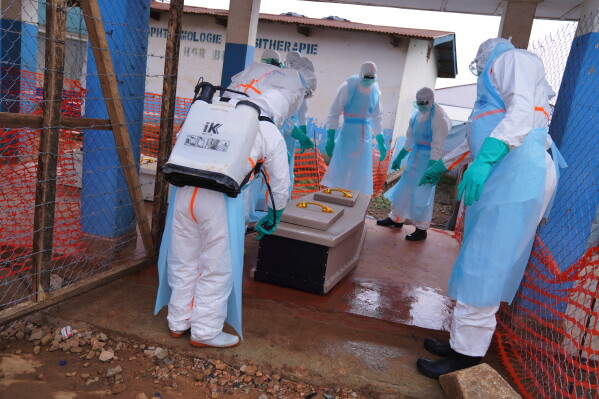
The World Health Organization and the Africa Centres for Disease Control and Prevention
raised the alarm on Friday, calling the Ebola outbreak now unfolding across the continent the
most geographically extensive on record. Officials said the fast-moving crisis has already
reached three African regions and is on track to eclipse the deadliest outbreak in history.
Dr Jean Kaseya, director general of Africa CDC, said in remarks released this morning that the
fatality rate so far hovers at nearly fifty percent of confirmed cases. The outbreak began in the
Democratic Republic of Congo earlier this year and has since jumped to Uganda, a third East
African country, and now Nigeria, which confirmed its first imported case this week in Abuja.
Nigeria’s entry into the case list has unsettled regional health officials because it marks the first
West African infection of this outbreak. The patient, a female diplomat, became symptomatic on
7 October and was admitted to a private hospital in Abuja four days later before her samples
returned positive for the Bundibugyo strain.
The practical worry is movement. The current outbreak is spreading faster than any Ebola event
previously documented, aided by denser urban populations, more frequent cross-border travel
and health systems still bruised by Covid-era disruptions. Health workers in Congo and Uganda
report that community reluctance to report symptoms has worsened case detection, allowing
silent chains of transmission to grow before they are spotted.
The WHO used Friday’s briefing to urge African governments to step up airport screening, rapid
testing capacity and contact tracing, especially in capitals that serve as transport hubs. The
agency also warned donor countries that funding gaps for mobile labs and personal protective
equipment are hampering the response.
For ordinary Africans the message is twofold. On one hand, Ebola does not spread as easily as
respiratory viruses: it requires direct contact with bodily fluids of a symptomatic person, which
gives health systems a chance to break transmission chains quickly if they move fast. On the
other hand, every delay in detection widens the circle of exposed contacts, and that is exactly
what the current outbreak keeps demonstrating.
Civil aviation authorities in Nigeria have already begun tightening Ebola surveillance at
international airports, and Kenya and Rwanda have signalled they may follow with their own
enhanced screening or restrictions. Several African airlines are reviewing their boarding
checklists for passengers transiting from affected countries.
Africa CDC said it would convene an emergency ministerial meeting within days to coordinate a
continent-wide response. Officials stressed that the outbreak is still containable, but only if governments move with the same urgency the virus is showing. “This is not a time for business
as usual,” Dr Kaseya said. “We are watching an outbreak outrun our systems in real time.”