

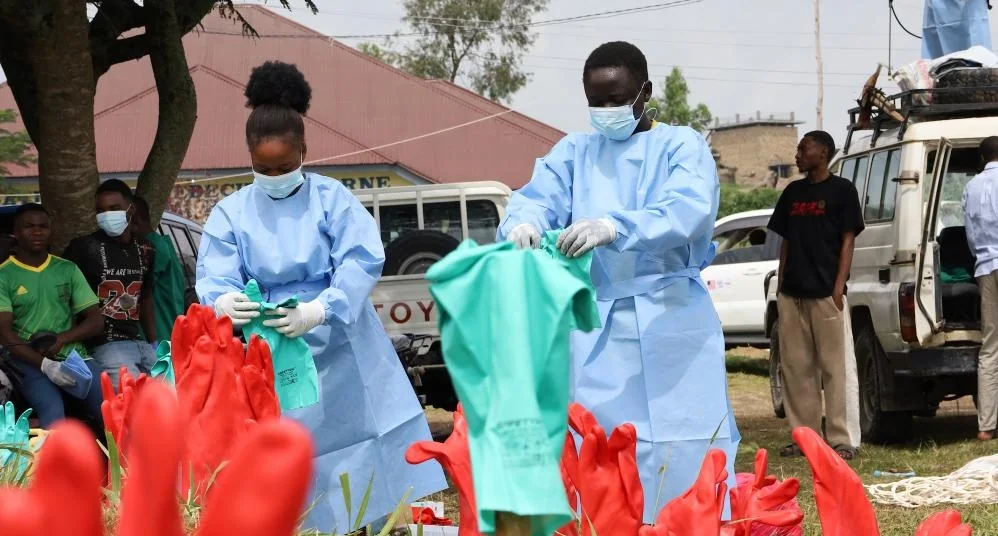
Kenya’s health authorities are racing to contain a widening Ebola scare after confirming the country’s
first-ever case of the virus, with contact tracing now stretched across borders and more than 650,000
travellers screened at airports and crossing points.
Health officials said Thursday that ten people who had direct contact with the index patient — a
Kenyan who had lived in the Democratic Republic of Congo for seven years before returning via
Uganda — have been placed in quarantine. Teams are still trying to locate 57 others believed to have
been exposed, as well as 23 passengers and four crew members on the Jambojet flight that carried him
into Nairobi on Saturday.
The man, whose identity has not been released, fell ill about a month ago in Congo. He was treated at
several hospitals before travelling overland to Kampala and boarding a Nairobi-bound flight. On
arrival at Jomo Kenyatta International Airport he cleared health screening, then was taken by a
relative to Nairobi Hospital with fever, chills and sub-dermal bleeding. He died late Monday. Lab
tests confirmed Ebola — specifically the Bundibugyo strain — on Tuesday.
Health Cabinet Secretary officials said 267 suspected samples have already been tested since
surveillance was tightened, and that mobile labs have been activated in border counties. The ministry
has also asked all health facilities nationwide to report unexplained haemorrhagic fevers within hours,
not days.
The outbreak link is a worrying one. Kenya is now the fourth country to record a case tied to the
ongoing Ebola epidemic in eastern Congo — the second-largest Ebola outbreak on record, with more
than 8,000 cases to date. Each cross-border export sharpens fears that the virus could reach a dense
urban centre with international air connections. Nairobi is exactly that.
For many Kenyans the news is landing hard. The country has for years prided itself on avoiding the
explosive outbreaks that have struck West and Central Africa. Hospitals in Nairobi have activated
isolation protocols, and the health ministry has urged the public not to panic but to report fever,
bleeding or sudden weakness immediately.
There is also pressure on regional cooperation. Uganda’s health ministry confirmed Thursday morning
that it is tracing contacts along the overland route the patient used, including guesthouses and transit
stops. The East African Community has called an emergency consultation of health ministers.
Economic nerves are showing too. Kenya Airways shares dipped in early Nairobi Securities Exchange
trading, and tour operators reported a trickle of cancellation inquiries from European and East Asian
clients. The ministry has insisted there is no advisory against travel to Kenya and that airports remain
safe, with thermal screening and health declaration forms now mandatory for all arrivals from Congo,
Uganda, Rwanda and Burundi.
International partners are moving. The World Health Organization said it is deploying additional
epidemiologists, and the Africa Centres for Disease Control has activated a regional incident
management team. A ring-vaccination strategy — pioneered in the 2014-16 West African outbreak —
is being prepared for Nairobi Hospital staff and family contacts.
Experts caution that the next 21 days are decisive. Ebola’s incubation window means the real picture
of community spread, if any, will emerge in the next three weeks. If no secondary cases are detected
by early November, Kenya can begin counting down to an “all clear.” If any are, the fight gets harder
— and faster.
For now, Nairobi is holding its breath, scanning passports at the airport, scanning foreheads at
hospital gates, and hoping ten quarantined contacts is where the story ends.