

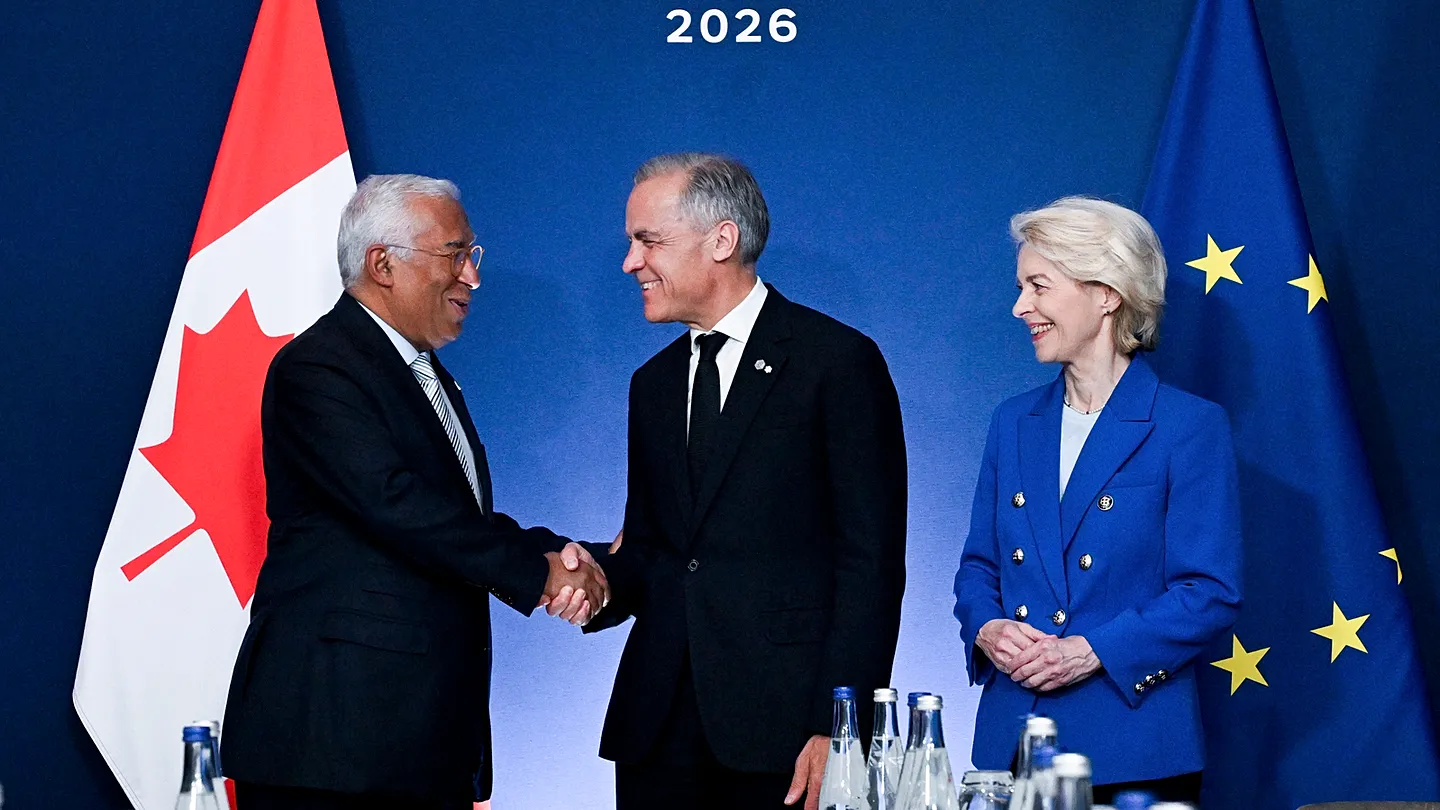
Canada is seeking a much closer relationship with the European Union as Prime Minister Mark Carney moves to reduce the country’s dependence on the United States, calling for what he described as a “unique alliance” with the bloc.
Carney has ruled out full EU membership, but said Canada will begin discussions with European leaders on a new form of partnership built around shared values, economic interests and security priorities. His comments came as Canada’s trade dispute with the United States intensifies.
The proposal follows reports that Ottawa is exploring the possibility of becoming an “associate member” of the EU. The idea would give Canada a closer relationship with the bloc without making it a full member or giving it the same rights and obligations as European Union states.
The precise structure of such an arrangement has yet to be agreed, and European officials have not formally endorsed a new associate-membership category. But discussions are gaining momentum as Canada looks to diversify its trade and investment relationships.
Carney is due in Europe this week, including a visit to Strasbourg where he will address the European Parliament and attend European Commission President Ursula von der Leyen’s State of the Union address. He is also scheduled to travel to Liverpool for talks with British Prime Minister Andy Burnham.
The Canadian government says its European strategy is already producing closer cooperation. Canada joined the EU’s Security Action for Europe, or SAFE, initiative in February, becoming the first non-European country to participate. Ottawa and Brussels have also expanded cooperation on defence, technology, energy and critical minerals.
Trade is at the centre of the push. The EU is already Canada’s second-largest trading partner, with trade in goods and services worth about 178 billion Canadian dollars in 2025. European investment in Canada was estimated at 217 billion Canadian dollars last year, while Canadian investment in the EU stood at about 315 billion dollars.
Carney has also urged European countries that have yet to fully ratify the Canada-EU Comprehensive Economic and Trade Agreement to complete the process. Deeper cooperation could extend into artificial intelligence, energy infrastructure, critical minerals, defence production, research and the movement of people.
The shift reflects a broader reassessment of Canada’s economic position. The United States remains by far Canada’s largest trading partner, absorbing roughly 70% of Canadian exports. But growing tariff disputes under President Donald Trump have encouraged Ottawa to seek alternatives and strengthen ties with other major economies.
For the EU, closer ties with Canada could also bring strategic benefits. Canada has abundant energy and critical minerals, while its defence capabilities and close relationship with the United States make it an important partner as Europe seeks to strengthen its own security.
Carney’s European initiative therefore goes beyond trade. It signals an attempt to reshape Canada’s place in the international economy and build stronger links with partners that Ottawa sees as sharing its democratic values and strategic interests.
Whether the EU agrees to a new form of associate relationship remains uncertain. But with Canada facing a more difficult relationship with Washington, Carney’s message is clear: Ottawa wants Europe to become a much more important part of Canada’s economic and strategic future.