
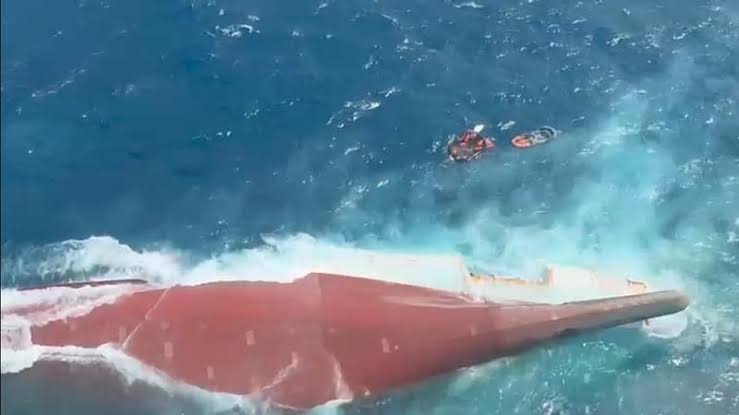
Indonesian rescuers were racing against time on Monday to locate 129 people still missing after
the Virgo Transport 8 ferry overturned in rough seas in the Java Sea, in one of the country’s
deadliest maritime incidents in recent months.
At least six people are confirmed dead. The ferry, carrying more than 240 passengers and crew,
was travelling from Surabaya in East Java to Banjarmasin in South Kalimantan on Borneo Island
when its captain issued a distress call, reporting the vessel was listing badly in waves reaching
up to three metres — around ten feet.
Contact with the ship was lost around 2 a.m. Sunday, local time. Roughly two hours later,
authorities received word that the vessel had capsized in the Masalembo waters, about 148
kilometres from Banjarmasin. Ships, helicopters and coast-guard vessels have been combing
the area since first light.
According to the manifest, the ferry was carrying 243 people — 213 passengers and 30 crew. In
Indonesia, however, actual passenger counts often exceed the manifest, and officials fear the
true number aboard may be higher.
Survivor accounts point to overcrowding and possible imbalance. Ahmad Saudi, one of those
pulled from the water, told local media that many passengers had been forced to sleep in
hallways and common areas because cabins were full. He said the ferry suddenly listed without
warning, sending panicked passengers scrambling as heavy seas battered the hull. Saudi
speculated that trucks loaded on one side of the vessel may have thrown its balance.
The Java Sea is one of the world’s busiest ferry corridors, moving millions of people every year
between Indonesia’s many islands. But maritime safety has long been a concern in a country
where enforcement of passenger limits, life-jacket rules and weather advisories is uneven. This
year alone, several ferry incidents have raised fresh questions about oversight in an industry
that remains the lifeblood of inter-island transport.
Indonesian authorities have ordered the transport ministry and the National Search and Rescue
Agency, known as Basarnas, to prioritise the operation. Officials say the search will continue
through the night, but rescuers warn that darkness, currents and worsening weather could slow
efforts significantly.
Families of passengers have gathered at ports in both Surabaya and Banjarmasin, waiting for
news. Local hospitals are on standby. In several videos circulating on Indonesian social media,
relatives could be seen weeping and clutching photos of loved ones as officials read out lists of
confirmed survivors.
The tragedy is likely to reignite a long-running debate about ferry safety in Indonesia — a
nation of more than 17,000 islands where boats remain the cheapest and often only way to
travel. Advocacy groups have repeatedly called for stricter enforcement of passenger caps,
mandatory real-time tracking of vessels and heavier penalties for operators who ignore
weather warnings.
For now, however, the focus remains on the sea. As dawn broke on Monday, a widening rescue
perimeter was being drawn around the last known coordinates of the Virgo Transport 8, with
hopes still alive that survivors may be found clinging to debris or on nearby islets. Every hour
that passes narrows those odds.