

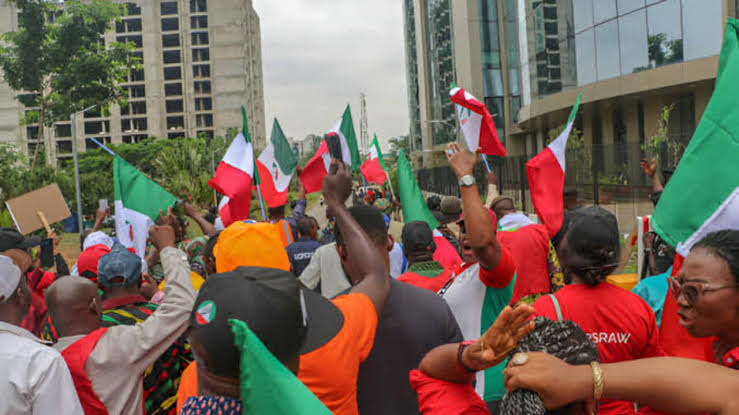
Nigeria’s federal workers have thrown down the gauntlet. In a fresh petition addressed to
President Bola Tinubu and the National Assembly, the Federal Workers Forum (FWF) is
demanding that the country’s minimum wage be raised from N70,000 to N300,000, with a
maximum salary of N1.5 million for Level 17 officers.
The letter, which surfaced widely across Nigerian media on Thursday morning, was signed by
FWF National Coordinator Andrew Emelieze and General Secretary Ogundele Ayodele, and
copied to the Senate President, the Speaker of the House of Representatives, the Chief Justice
of Nigeria, and the Head of the Civil Service of the Federation.
At the heart of the demand is a simple argument. The N70,000 minimum wage, approved in
2024, has already been shredded by inflation, currency depreciation, and rising food and
transport costs. Federal workers say they have yet to receive the full consequential adjustment
and associated allowances that were promised when the last wage review was signed into law,
and the gap between paper pay and actual purchasing power has become impossible to ignore.
The FWF is asking for a lot more than a headline number. The petition calls for payment of all
outstanding salaries and promotion arrears, implementation of a 40 percent peculiar
allowance, a permanent Cost of Living Allowance, family support payments, comprehensive
health insurance, and housing and car loan schemes for federal workers. The forum is also
demanding free education for children of federal workers in federal institutions, reduced
taxation on allowances, and a broader social security programme for unemployed Nigerians.
The timing is politically charged. President Tinubu is currently on a three-week working vacation
in London, leaving the immediate response to the demand in the hands of his economic team
and the National Assembly, both of which are already juggling a fragile fiscal outlook and a
currency that traded around N1,400 to the dollar in the parallel market on Thursday.
The economic backdrop is grim for civil servants. Food inflation has stayed stubbornly high,
transport costs surged after fuel subsidy removal, and school fees, rent, and healthcare bills
have climbed at a pace no single wage adjustment has kept up with. Workers argue that any
minimum wage that leaves a family unable to cover rent, food, and transport in a single month
is a wage in name only.
The government’s response will be closely watched. Meeting the FWF’s demands in full would
blow a serious hole in the federal budget at a time when Nigeria is trying to rein in its debt
service ratio and attract foreign investment. On the other hand, ignoring the petition risks
triggering another wave of coordinated labour action, and Nigeria’s civil servants have shown
they can bring the machinery of government to a halt when pushed.
Organized labour is already circling. The Nigeria Labour Congress and the Trade Union Congress
have made no secret of their frustration with the pace of implementation of the last wage
review, and the FWF letter effectively gives them political cover to escalate their own demands.
Analysts in Lagos and Abuja are warning that the country could be heading into another
confrontation between the presidency and organized labour before the end of the year.
For businesses, the calculus is complicated. A meaningful raise for federal workers would inject
spending power into the economy at a time when consumer demand has been weak, but it
would also fuel inflation and force private-sector employers to consider matching wage moves
they may not be able to afford. Small and medium-sized businesses, already squeezed by high
energy costs and expensive credit, are especially exposed.
There is also a broader political message baked into the letter. By addressing it to Tinubu
personally and copying every major arm of the federal establishment, the FWF is signaling that
this is not a routine bargaining exercise but a stress test of the president’s economic reform
agenda. Tinubu’s team has argued that painful reforms today will produce a more competitive
Nigeria tomorrow. Federal workers are, in effect, asking how they are supposed to survive
between now and that promised tomorrow.
The next move belongs to the presidency and the National Assembly. Nigerian workers,
meanwhile, are watching closely, and, if history is any guide, willing to take the fight to the
streets if they feel ignored.