
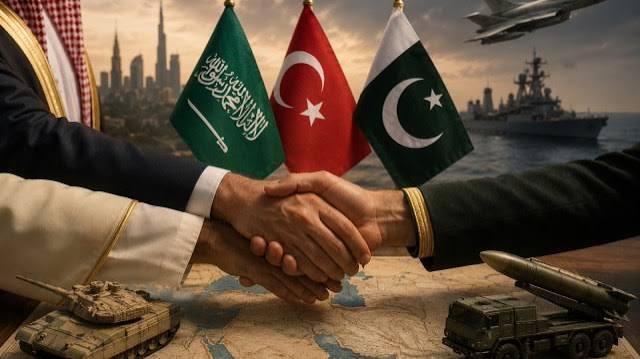
Saudi Arabia, Turkey and Pakistan have signed a landmark trilateral defence agreement committing the three countries to treat an armed attack against one member as an attack against all, creating one of the Middle East’s most significant new security alliances. (AP News)
The agreement was signed during a high-level summit in Saudi Arabia attended by Crown Prince Mohammed bin Salman, Turkish President Recep Tayyip Erdoğan and Pakistani Prime Minister Shehbaz Sharif. According to Pakistan’s Foreign Ministry, the pact establishes a mutual defence commitment while expanding military cooperation through joint exercises, intelligence sharing and defence technology collaboration. (AP News)
The new accord builds on the Strategic Mutual Defence Agreement signed by Saudi Arabia and Pakistan in September 2025, which committed both countries to regard aggression against either nation as aggression against both. Turkey’s accession expands that arrangement into a three-way alliance. (Associated Press of Pakistan)
The alliance brings together three major military powers: Saudi Arabia, the region’s largest defence spender; Turkey, which has NATO’s second-largest military and a rapidly growing defence industry; and nuclear-armed Pakistan, one of the world’s largest standing militaries. (AP News)
Officials said the agreement is intended to strengthen regional deterrence amid growing security challenges across the Middle East. In addition to the mutual defence clause, the three countries agreed to deepen cooperation in military training, intelligence exchange, defence procurement and joint strategic planning. (AP News)
The pact comes against the backdrop of heightened regional instability following recent conflicts involving Iran, Israel and armed groups across the Middle East. Analysts say the agreement reflects a broader shift in regional security architecture as countries seek stronger partnerships beyond traditional alliances. (AP News)
Security experts believe the alliance could significantly reshape the regional balance of power by institutionalising military cooperation among three influential states with growing strategic interests across the Middle East, South Asia and the wider Islamic world. The agreement is also expected to boost defence industrial cooperation, particularly in areas such as drone technology, missile systems and joint weapons development. (AP News)
While the three governments have presented the pact as a defensive arrangement aimed at preserving regional stability, its “attack on one, attack on all” provision is likely to draw close attention from other regional powers and global allies monitoring the evolving security landscape. (AP News)