

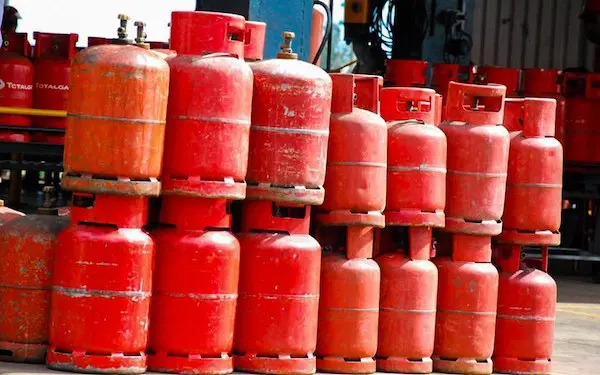
The Federal Government has gone to war with cooking gas profiteers. After an
emergency stakeholders’ meeting in Abuja this morning, the Minister of State for
Petroleum Resources (Gas), Ekperikpe Ekpo, directed the Department of State
Services (DSS), the Economic and Financial Crimes Commission (EFCC) and the
Nigeria Police Force to immediately clamp down on illegal storage, diversion and
market manipulation along major LPG supply corridors.
The intervention follows weeks of rising household anger as cooking gas, the lifeline
fuel for millions of urban Nigerian families, climbed toward N2,500 per kilogram in some
markets. A 12.5kg cylinder that retailed below N15,000 in March is now selling for
between N18,500 and N22,000 depending on the city, pushing thousands of
households back to charcoal and firewood. Restaurants and roadside food vendors
have either raised prices or quietly cut portion sizes.
The new measures announced this morning are sharper than analysts expected. The
Federal Government will clamp down on cooking gas exports, with regulators ordered to
enforce existing domestic supply obligations on producers. Storage and distribution
infrastructure will be expanded with NMDPRA backing. Product-tracking systems will be
rolled out across major terminals to choke off the diversion routes that have been quietly
fattening informal middlemen. And market monitoring will be intensified, with the DSS,
EFCC and Police given explicit authority to prosecute hoarders.
Officials presented numbers designed to take the edge off public anger. National LPG
supply sufficiency, government figures show, has already risen from 11 days to 22 days.
Average daily supply has climbed from 4,262 metric tonnes in May to 5,040 metric
tonnes in June, an 18% increase month-on-month. “The supply is there,” Ekpo said.
“What we are dealing with is sabotage.”
Industry insiders, however, are sceptical that policing will solve a structural problem.
The Nigerian Association of Liquefied Petroleum Gas Marketers (NALPGAM) told
Premium Times this morning that the real driver of the price spike is foreign-currency exposure on imported LPG, the cost of marine freight to Apapa and Lagos terminals,
and the patchy reliability of domestic production from Nigerian LNG. “You cannot arrest
your way out of a dollarised cost structure,” one marketer said, asking not to be named.
There is also the politics of it. The cooking gas crisis is hitting at the worst possible time
for President Bola Tinubu’s administration. With Plateau still burying its dead from
Sunday’s massacre and Nigerians complaining loudly about the cost of food, fuel and
tuition, an everyday product like LPG has become a stand-in for the broader cost-ofliving anger. Federal officials know that if the price doesn’t fall noticeably by July, the
protest energy that has been simmering on social media could spill into the streets.
There is one structural bright spot. The Dangote Petroleum Refinery, now operating at
close to full capacity, has fundamentally rewired Nigeria’s downstream economy. Petrol
imports collapsed 96.2% year-on-year in the first quarter of 2026, easing FX demand
and helping the naira hold near N1,400 to the dollar. External reserves climbed to
$50.42 billion as of June 10. The naira opened today at N1,408 sell and N1,395 buy on
the official window.
But Dangote does not yet refine LPG at scale, and that is where the pain is sitting.
Several analysts argue that the government should fast-track the long-promised
Domestic Gas Delivery Obligation, which would require producers to allocate a fixed
share of output to the local market before exporting. Without it, every spike in
international gas prices will continue to hit Nigerian kitchens first.
Civil society groups gave the announcement a guarded welcome. SERAP urged the
EFCC to publish names of any companies it sanctions, warning that closed-door
enforcement “creates the very conditions for the corruption it is supposed to fight.” The
Centre for the Promotion of Private Enterprise (CPPE) said the supply measures were
necessary but called for a parallel review of LPG-related taxes and levies that were
quietly increased in last year’s budget.
On WhatsApp and Twitter (now X), Nigerian households reacted with a mix of relief and
weary scepticism. “We’ve heard this song before,” one Lagos user posted, attaching a
photo of a half-empty cylinder. “Until I buy 12.5kg for N12,000 again, na story.”
Watch three things over the next seven days. First, whether any LPG-related arrests are
announced — the EFCC and DSS need to show visible enforcement quickly. Second,
whether the NNPC Ltd and Nigeria LNG publish allocation data for the domestic market, which would prove the supply numbers are real. And third, the retail price. If a 12.5kg
cylinder is still selling above N18,000 in Lagos and Abuja by next Tuesday, today’s
emergency meeting will be remembered as another communique that did not reach the
kitchen.