
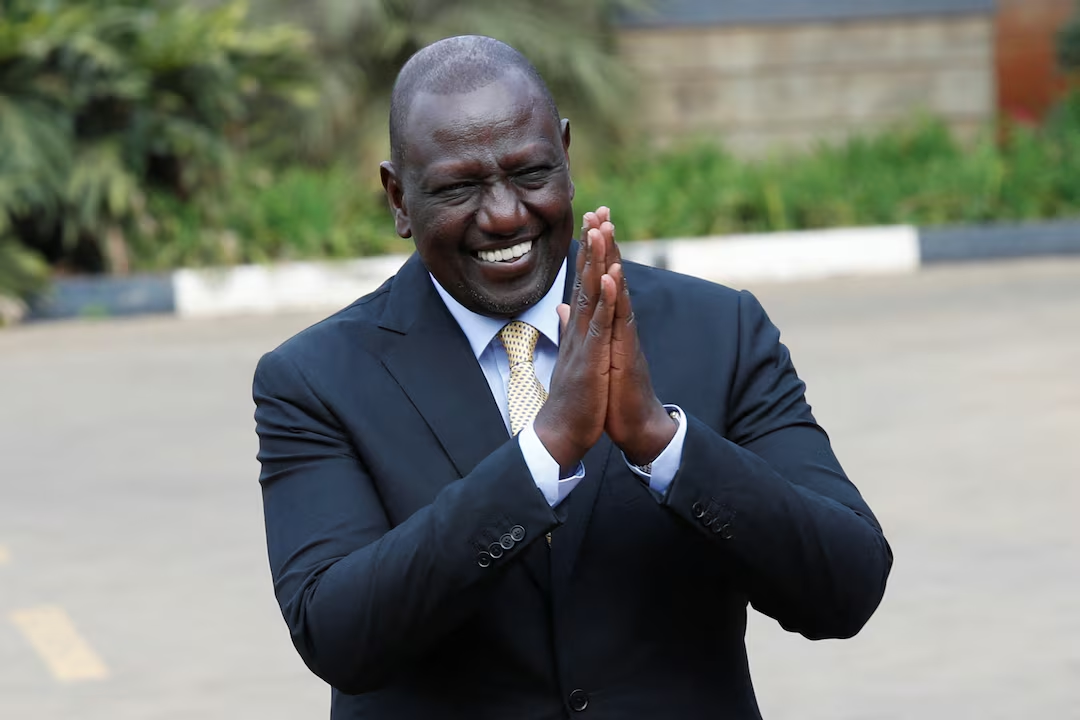
Kenyan President William Ruto leaves Pretoria today carrying one of the thickest folders of
bilateral deals any African leader has produced from a single state visit this year. By the time his
motorcade rolled out of the Union Buildings, Kenya and South Africa had added six new
memoranda of understanding to their relationship — taking the total stock of formal bilateral
agreements between the two countries to 34.
The signing ceremony, presided over by President Cyril Ramaphosa on Thursday afternoon,
covered trade, maritime transport, skills development, gender equality, arts and culture, and
sport. A joint communique released as Ruto departed framed the package as the most
substantive economic-cooperation deepening between the two countries since their postapartheid normalisation.
What’s actually in the deals
The trade MoU is the headline. It is squarely aimed at improving market access by tackling the
technical barriers that have long made it harder for Kenyan tea and South African machinery to
move across each other’s borders. Officials on both sides say it will plug directly into the African
Continental Free Trade Area (AfCFTA), the long-stalled flagship for intra-African commerce that
finally began moving real cargo under preferential terms in 2024.
The skills-development pact is the sleeper hit. It commits both governments to deep cooperation
on Technical and Vocational Education and Training (TVET) — the sector that South Africa has
spent the past decade trying to expand and that Kenya leans on heavily to absorb its young
workforce. The maritime transport agreement, meanwhile, is expected to ease container
handling at Mombasa and Durban, both groaning under volumes well above design capacity.
Why this visit was different
State visits are usually choreographed photo-ops with a thin trail of paperwork. This one wasn’t.
The combination of six new MoUs, an open-press joint cabinet session, and a Ruto address to a
packed business forum in Sandton has set a markedly higher bar for the substance SouthSouth diplomacy is expected to produce.
There is also a competitive subtext. South Africa and Kenya have rival ambitions to anchor East
and Southern Africa’s logistics, tech and finance networks. Today’s editorial in the Sunday Times described the relationship as brotherly but rivalrous — and noted that yesterday’s pacts
will be judged less by their signing than by whether they survive the inevitable arguments over
visa fees, tariff lines and airline route rights that have soured previous warm moments between
the two capitals.
The continental angle
Pretoria and Nairobi together account for roughly a quarter of sub-Saharan Africa’s GDP. When
they move in the same direction — on AfCFTA implementation, on climate finance, on UN
reform — the rest of the continent tends to follow. When they pull apart, the bloc fractures. The
34-deal scorecard suggests this is, for now, a phase of alignment.
Ruto’s team has been explicit about what they want from this momentum: lifting bilateral trade
above the current modest level toward a more ambitious target by the end of 2027. South
African officials privately think that is achievable if even half of the new MoUs are implemented
in earnest.
Implementation is the test
African diplomacy has no shortage of signed pieces of paper. The continent has cumulatively
put its name to thousands of bilateral and multilateral agreements over the past two decades;
only a fraction have produced measurable change. Both presidents acknowledged the
implementation gap in their closing remarks, and committed to a joint ministerial review every
six months — a cadence noticeably tighter than the once-a-year cycles other African bilateral
commissions use.
Watch what happens at the next AfCFTA secretariat meeting. If the Kenya-South Africa axis
arrives with implementation data rather than fresh announcements, today’s visit will count as a
real shift. If not, it joins the long shelf.