

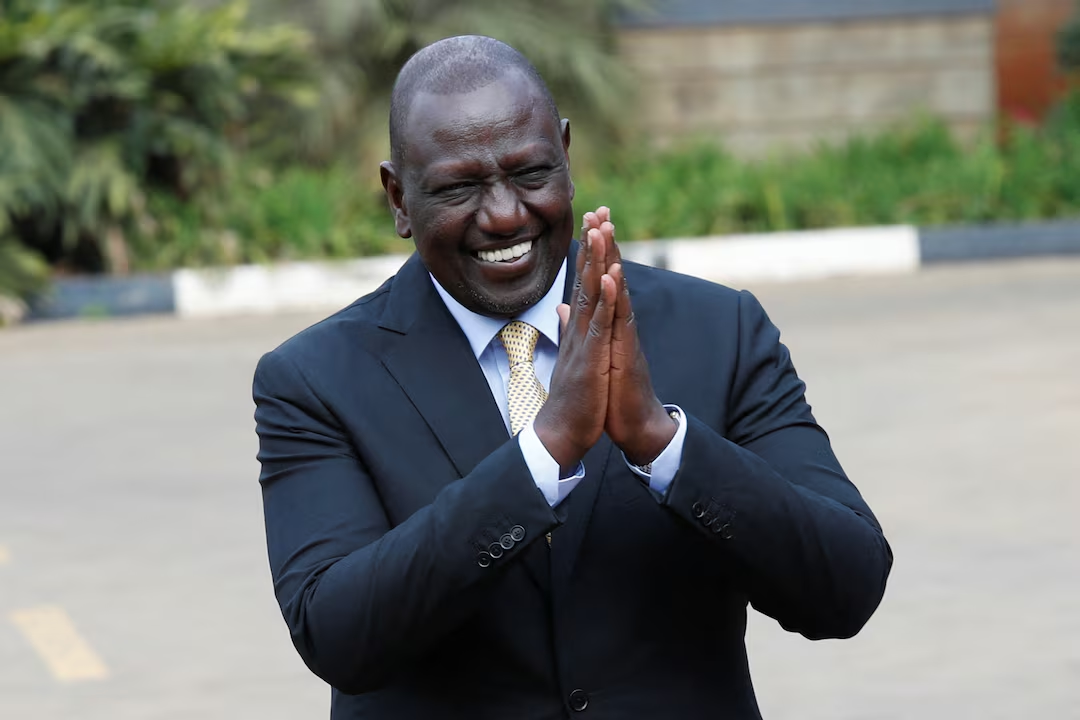
Two of Africa’s most influential presidents shook hands on the lawns of the Union
Buildings on Thursday morning, and behind the choreography sat one of the more
consequential bilateral resets the continent has seen this year. South African President
Cyril Ramaphosa formally received Kenyan President William Samoei Ruto in Tshwane
at 09h30 local time, kicking off a three-day state visit aimed squarely at unlocking trade
between Africa’s two most strategically positioned economies.
This is more than a flag-and-handshake event. The day’s schedule reads like a dealmaking sprint: a welcome ceremony, closed-door discussions between the heads of
state, a memoranda of agreement signing at the Union Buildings at 12h30, and then a
South Africa–Kenya Business Forum at 17h00 at Gallagher Estate in Johannesburg. By
the time the sun sets on Thursday, both governments expect to walk away with signed
agreements in their hands.
The strategic logic is hard to miss. Kenya is the gateway to East Africa and the largest
economy in the East African Community. South Africa is the industrial and financial
anchor of Southern Africa, with deep capital markets, large pension funds and
continental corporate champions. The two have flirted with closer integration for years,
but bilateral trade has remained stubbornly below potential — held back by visa
frictions, regulatory mismatches and a habit of routing African business through Dubai,
London or Paris.
Ramaphosa’s office said the visit is framed around “deepening cooperation between
Kenya and South Africa” and exploring “strategies for unlocking trade and investment
potential.” Translated out of diplomat-speak: both presidents want their corporates
talking to each other directly, and they want the bureaucracies on both sides to stop
being the bottleneck.
Ruto walks in with momentum. Fresh off Kenya’s Madaraka Day celebrations, he has
been pushing a pan-African economic agenda that leans hard on the African
Continental Free Trade Area (AfCFTA) and on building Africa-to-Africa supply chains.
South Africa, for its part, is looking to revive growth at home and re-establish itself as
the indispensable convener of African economic policy.
For the business forum at Gallagher Estate, the guest list reads like a who’s-who of
Kenyan and South African capital. Banking, logistics, agribusiness, fintech and energy
delegations are all expected. South African firms have historically had a strong footprint
in Kenyan retail, telecoms and financial services; Kenyan companies, particularly in
fintech and digital banking, are increasingly eyeing southern African markets where their
mobile-money expertise is still ahead of the local curve.
Politically, the timing matters. Both leaders face real pressure at home — Ramaphosa’s
coalition government continues to negotiate internal frictions, while Ruto is managing a
vocal opposition and a cost-of-living narrative that has dominated Kenyan headlines for
the past year. A productive state visit, with hard deliverables on trade and investment, is
the kind of foreign-policy win that plays well in domestic media for both men.
There is also a continental subtext. With the African Union’s peace and security
architecture under strain, and with leadership questions hovering over institutions like
the Confederation of African Football, the Pretoria–Nairobi axis is positioning itself as a
credible counterweight to Africa’s political drift. If Ramaphosa and Ruto can
demonstrate that two of the continent’s heavyweight democracies can move from
rhetoric to ratified agreements in 72 hours, that itself is a signal.
Officials on both sides briefed local media that the MOUs to be signed cover trade
facilitation, visa easing for business travellers, cooperation on climate finance and green
hydrogen, and joint frameworks for digital trade. None of that, on its own, is
revolutionary. But stacked together, and backed by political will from the top, it is the
kind of incremental, technocratic integration that actually moves needles.
By Thursday evening, Johannesburg’s Sandton corridor will be hosting the largest
gathering of senior Kenyan and South African business leaders in years. The pictures
will be smiles and signatures. The real test, as always, will come in the weeks
afterwards — whether the agreements signed on June 4 produce visible movement in customs queues, port calls and capital flows, or whether they join the long shelf of bilateral promises that never quite delivered.