
Polling stations across Ethiopia opened at 6 a.m. local time this morning as Africa’s
second-most populous country began voting in a general election widely expected to
extend Prime Minister Abiy Ahmed’s grip on power — even as parts of the country
remain trapped in armed conflict.
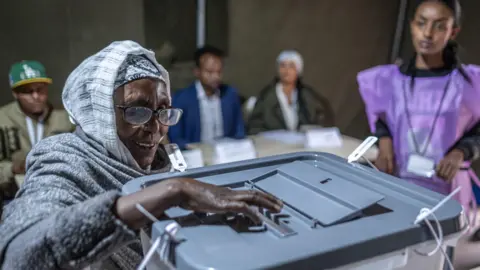
Long queues formed before dawn in Addis Ababa, where heavy military and federal
police deployments lined major streets. The National Election Board of Ethiopia (NEBE)
said more than 54 million people are registered to vote at over 50,000 polling stations,
choosing more than 500 members of the federal House of Peoples’ Representatives
who will, in turn, vote in the next prime minister.
On paper, the race is wide open: more than 10,000 candidates from 42 political parties
are contesting. In practice, Abiy’s ruling Prosperity Party is the overwhelming favorite. It
already controls the outgoing parliament and faces a fractured opposition, several of
whose biggest names have either boycotted, been jailed or pulled out citing intimidation.
It is the first nationwide vote since the devastating 2020–2022 Tigray war and arrives
with fresh wounds. Fighting between federal forces and the Fano militia rages across
the Amhara region. Insurgent activity by the Oromo Liberation Army continues in parts
of Oromia. Both regions are home to tens of millions of voters, and NEBE has
acknowledged that voting will not take place in dozens of constituencies for security
reasons.
“Today is about peace as much as it is about politics,” Abiy told reporters after casting
his ballot in Addis Ababa, urging Ethiopians to vote “with calm and dignity.” Critics
counter that the calm is enforced, not earned. Opposition leaders from Ezema and the
Enat Party have spent recent weeks accusing security agencies of harassment,
blocking rallies and arresting campaign workers.
Western diplomats are watching closely but quietly. Ethiopia, headquarters of the
African Union and a regional power bordering Sudan, Somalia and Eritrea, has been a
critical security partner. Yet relations with Washington and Brussels have cooled over
human rights concerns since the Tigray war.
For ordinary Ethiopians, the issues on the ballot are immediate and economic. Inflation
is biting hard. The birr has lost more than half its value since the government floated the
currency in 2024 under an IMF-backed reform program. Fuel and bread prices have
risen sharply, and youth unemployment in major cities is at record highs.
“I came to vote because we need change,” said Hiwot, a 28-year-old teacher in Addis
Ababa, who declined to give her last name. “But I don’t know if my vote will really
change anything.” Another voter, a small-business owner named Tadesse, said he was
backing Prosperity “because at least there is some stability — we don’t want another
war.”
Polls close at 6 p.m. local time. Preliminary results from urban constituencies are
expected later tonight, with full national results in the coming days. NEBE has invited
African Union and Intergovernmental Authority on Development (IGAD) observers, but
the European Union declined to send a mission, citing concerns about access.
Abiy, a Nobel Peace laureate whose reformist halo has dimmed since the Tigray war,
has signaled that another five-year mandate would be spent pushing through politically
painful economic reforms, completing the Grand Ethiopian Renaissance Dam’s final
operational phase and attempting to negotiate a settlement with the Fano insurgency.
Whether today’s vote produces the legitimacy he needs — at home and abroad — to
deliver on any of that is the question hanging over Ethiopia tonight.