
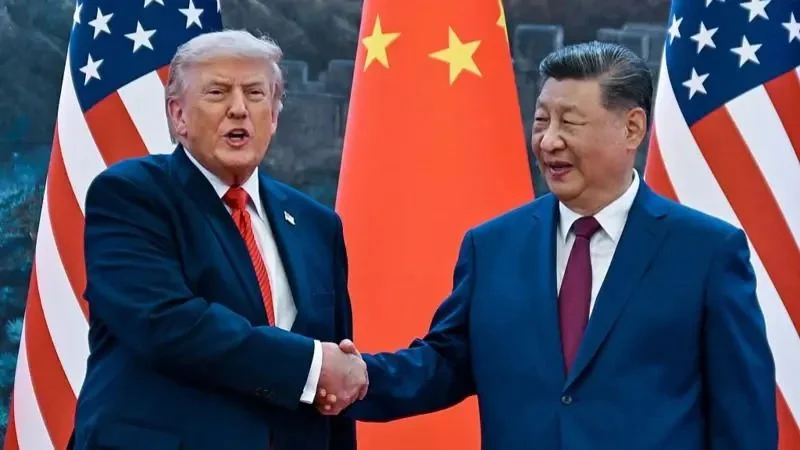
US and Chinese leaders close two-day meeting agreeing to stabilize ties — but no joint statement, and no Taiwan breakthrough.
The biggest diplomatic event of the year ended quietly Friday morning in Beijing, but its
consequences will echo for months. President Donald Trump and Chinese President Xi
Jinping concluded a two-day summit at the Zhongnanhai compound, the secretive
leadership complex inside the Forbidden City, with both leaders claiming the visit had
produced “historic” results — even as the most contentious issues between the two
superpowers remained unresolved.
Trump told reporters as he prepared to leave the Chinese capital that he and Xi had
reached “fantastic trade deals” during their talks. Xi, more measured but visibly
satisfied, called the meetings a “landmark” moment, saying the two countries had
agreed to develop “a constructive China–U.S. relationship of strategic stability.”
According to Beijing’s official readout, that framework will guide bilateral relations for the
next three years and beyond. But notably absent from the carefully choreographed
closing was a joint statement — analysts had predicted as much, citing the gulf between
the two sides on Taiwan, technology export controls and human rights.
Behind the cordial smiles, this was a summit defined by sharp warnings.
On day one, Xi delivered a pointed message about Taiwan, the self-ruled island Beijing
claims as its territory. He told Trump that mishandling the issue could push the United
States and China into “great jeopardy” — a thinly veiled reference to military conflict. He
called Taiwan “the most important issue in U.S.–China relations.” Trump, for his part,
reaffirmed the long-standing American position on the One China policy while
continuing to pursue arms sales to Taipei.
The Iran war, now in its fourth month, ended up being the area of clearest convergence.
Both leaders said the Strait of Hormuz — the narrow choke point through which roughly
a fifth of global oil flows — must be reopened to support world energy demand. Trump
said the two countries “feel very similar about (how) we want it to end.” Xi, in a striking
gesture, expressed interest in China potentially purchasing significant volumes of U.S.
crude oil to reduce Chinese dependence on Gulf supplies, a move that would represent
one of the largest energy realignments in decades.
On trade, Trump touted what he called “fantastic” agreements but offered few details.
Behind the scenes, sources briefed on the talks said the two sides agreed to pause new
tariff escalations and to set up a working group on rare earth exports, an area in which
China holds a near-monopoly that has rattled Western defense and tech industries.
What did not happen is just as telling. There was no announcement of an end to U.S.
export controls on advanced semiconductors. There was no Chinese pledge to alter its
industrial subsidies. There was no movement on the long-running fight over TikTok and
other Chinese-owned tech platforms. And there was no joint declaration — diplomatic
shorthand for “we still disagree on too much to put it on paper.”
Markets reacted with cautious optimism. Asian stocks rose modestly in late trading, and
oil prices dipped on the Hormuz signal. The U.S. dollar weakened slightly against the
yuan, the latter benefitting from the perception that Beijing emerged from the talks with
its strategic position strengthened.
For Trump, the optics were the prize. The private tour of Zhongnanhai — a compound
foreign leaders rarely see — was an unusual courtesy. State media broadcast images
of Xi personally walking Trump through the grounds. For Xi, the message to a domestic
audience was that he is being treated as an equal, the leader of a peer superpower, on
Chinese soil.
Critics in Washington were less charitable. Heritage Foundation analysts described the
summit as a “win on style, draw on substance.” Several China hawks in Congress
questioned whether Trump had quietly softened the U.S. line on Taiwan in exchange for
what they called “vague trade promises.”
The next test arrives quickly. Trump heads home with follow-up meetings scheduled in
Washington next week, including with Taiwanese officials. Beijing, meanwhile, is
expected to release a more detailed economic statement in the coming days outlining
what it expects from the new “strategic stability” framework.
For now, the most important takeaway may be the one neither side spoke aloud: in a
world increasingly defined by U.S.–China competition, even a summit that produces no
breakthrough is itself a kind of victory — if it keeps the two largest economies talking.