
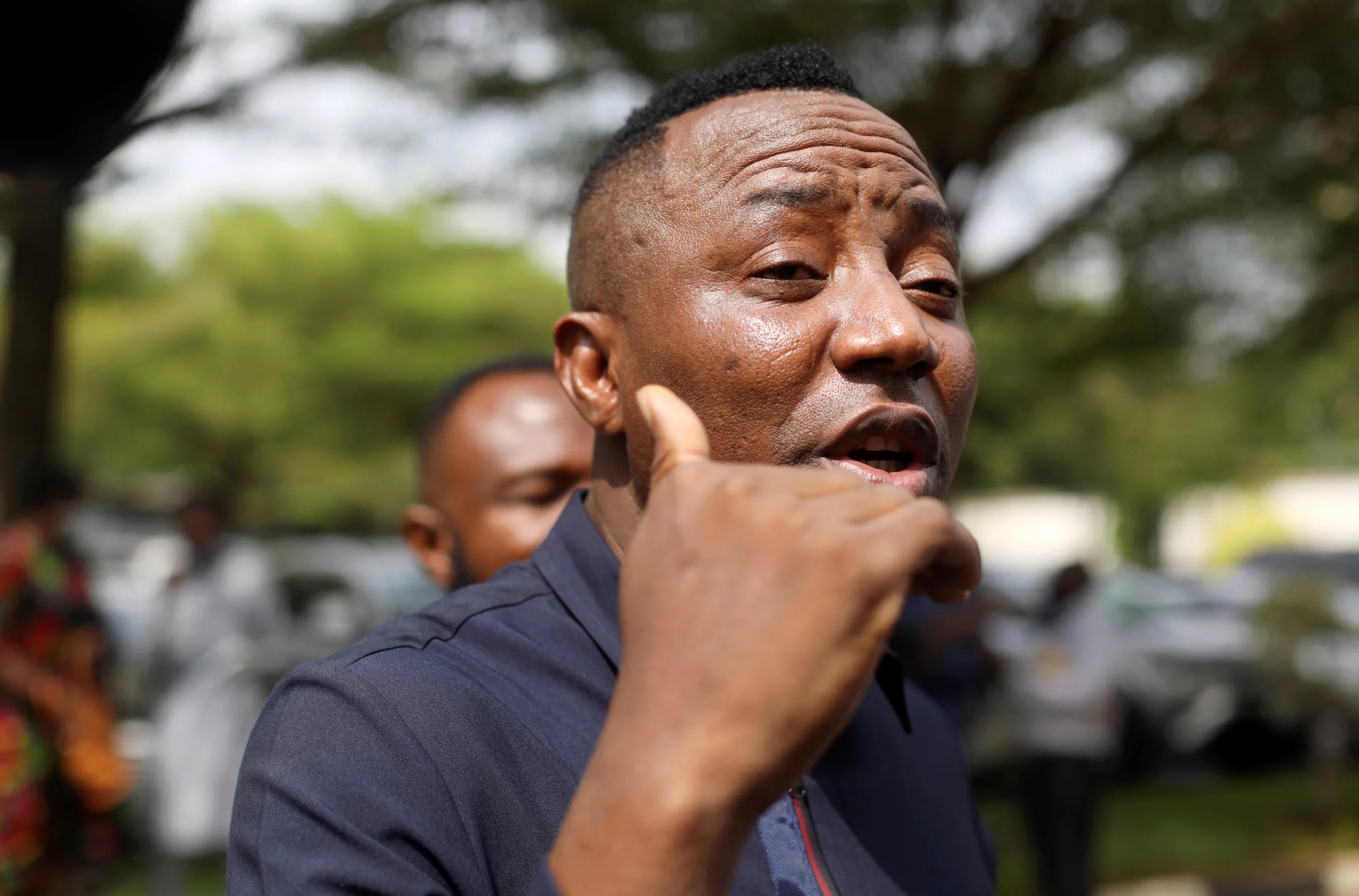
On Friday morning, all eyes in Nigeria’s political and journalism circles turn to courtroom 4 of the
Federal High Court in Abuja, where Justice Mohammed Garba Umar is set to rule on whether the
cyberbullying trial of activist Omoyele Sowore goes ahead — or whether the case against him
collapses before he ever opens his defence.
It is the moment Sowore’s lawyers have been pushing toward for months. Last December, the
State Security Service (DSS), prosecuting on behalf of the Federal Government, re-arraigned the
African Action Congress presidential candidate on a two-count charge under the Cybercrimes
Act. The complaint: that Sowore, on his X handle, called President Bola Ahmed Tinubu “a
criminal” — language the DSS argues amounted to cyber-stalking.
After the prosecution closed its case, Sowore’s counsel, Marshall Abubakar, filed a no-case
submission. He told the court that the DSS had failed to link Sowore to the offence, that no prima
facie case had been established, and that his client should be discharged and acquitted on both
counts.
Friday’s ruling decides whether Justice Umar agrees. If the no-case submission is upheld, the
matter ends — Sowore walks free, and Nigeria’s most relentless online critic of Tinubu becomes
a little harder to silence. If the judge rules he has a case to answer, the trial proper begins, with
Sowore expected to mount a high-profile defence that civil-rights lawyers say will test whether
ordinary Nigerians can be jailed for sharply worded posts about the President.
The case has already become a constitutional flashpoint. Sowore’s supporters and many bar
associations argue that the Cybercrimes Act, particularly Section 24 dealing with cyber-stalking,
has been weaponised over the past decade by successive governments — first PDP, now APC
— to harass journalists, activists and youth voices online. The Economic Community of West
African States (ECOWAS) Court of Justice ruled as far back as 2022 that the section is
incompatible with regional human rights protections, but Nigerian authorities have continued to
charge under it.
Sowore himself, the publisher of Sahara Reporters and a long-time thorn in the side of Nigerian
governments, has framed the trial as an attempt to criminalise political speech. “I will not stop
calling out criminality,” he said in a video posted ahead of the ruling, “whether it sits in Aso Rock
or in a market in Lagos.”
The Tinubu camp has stayed publicly quiet, but allies in the National Assembly have argued that
public officials, including the President, deserve protection from sustained online harassment.
They say Sowore’s posts went beyond political criticism and crossed into defamation and
incitement.
Friday’s ruling lands inside an already crowded political calendar. The All Progressives Congress
kicked off screening of aspirants for 2027 elections this same morning, with the process set to run
through Tuesday. The opposition African Democratic Congress is now openly courting defectors,
including former Kaduna lawmaker Bello El-Rufai, who quit APC for the ADC on Wednesday in a
move that rattled APC’s strategists.
A win for Sowore would energise opposition movements ahead of 2027 by signalling that courts
can still push back on cyberbullying charges seen by many as politically motivated. A loss —
meaning the trial proceeds — would put Nigeria’s most prolific dissenting voice on the witness
stand within months, with risk of imprisonment if convicted.
Outside the courtroom, the broader news cycle is loaded. The Federal High Court convicted
former Power Minister Saleh Mamman of N33.8 billion money laundering on Thursday, with
sentencing fixed for May 13 — handing the EFCC a rare high-profile conviction. The naira firmed
slightly to N1,357 against the US dollar at the official window, supported by CBN intervention.
Petrol pumps remain volatile after the Federal Government this week ruled out any return of fuel
subsidy, with the Dangote Refinery raising ex-depot prices again.
But it is Sowore’s ruling that is dominating Nigerian Twitter Friday morning. By mid-afternoon
WAT, Justice Umar will have spoken — and either Nigeria’s loudest online critic walks out of the
courtroom a free man, or he opens a defence that could define the boundaries of online speech
in Africa’s largest democracy for years to come.
Whichever way the gavel falls, the consequences will not stay confined to Abuja. They will ripple
across the country’s newsrooms, social-media feeds and political war rooms, where everyone —
APC, ADC, PDP and the army of independent activists — is watching to see how much room is
left in Nigeria for telling presidents, in plain language, exactly what you think of them.