
A bitter leadership war, INEC’s refusal to recognize any faction, and talk of top opposition figures jumping ship threaten to collapse the most serious challenge to APC dominance in years.
Just months ago, the African Democratic Congress looked like the vehicle that would finally unite Nigeria’s fractured opposition ahead of the 2027 general elections. Today, the party is tearing itself apart, and the biggest names in Nigerian opposition politics are reportedly eyeing the exit.
The crisis centers on a power struggle between two men who both claim to be the rightful leader of the ADC. On one side is former Senate President David Mark, who emerged as national chairman following a party convention in July 2025 that was meant to formalize a broad opposition coalition. On the other is Nafiu Bala, the former deputy national chairman, who insists the convention was illegitimate and that he holds authority over the party structure.
Bala filed a lawsuit at the Federal High Court in Abuja on September 2, 2025, seeking to restrain the Mark-led faction from presenting itself as the party leadership and demanding that the Independent National Electoral Commission recognize him as acting national chairman. The case has been winding through the courts ever since.
Then came the bombshell. In March 2026, the Court of Appeal issued a ruling directing all parties to maintain the status quo ante bellum, meaning conditions must remain as they were before the lawsuit was filed. INEC responded by striking David Mark and Rauf Aregbesola, the party’s national secretary, from its portal entirely. The commission announced it would no longer recognize any faction of the ADC leadership and would refuse to monitor any conventions or congresses organized by rival groups until the courts deliver a final judgment.
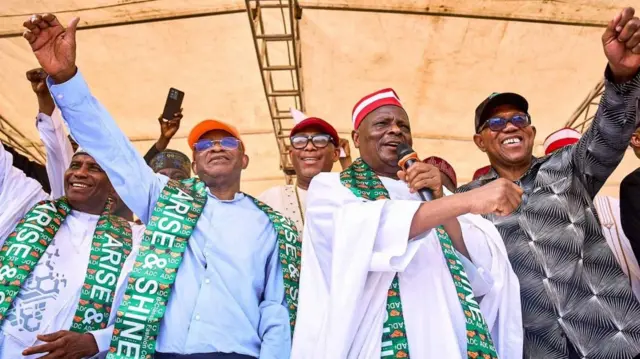
For a party that had been building serious momentum, INEC’s decision was devastating. The ADC had attracted an impressive roster of opposition heavyweights. Former Vice President Atiku Abubakar, former Labour Party presidential candidate Peter Obi, and former Kano State Governor Rabiu Kwankwaso had all thrown their weight behind the coalition. Kwankwaso formally joined the ADC in late March 2026.
The party had also been gaining ground in the National Assembly. Nine senators defected to the ADC in March, including notable figures like Enyinnaya Abaribe of Abia South and Aminu Tambuwal of Sokoto South. In the House of Representatives, eight members crossed over, bringing the party’s lower chamber presence to 15 lawmakers. Small numbers in absolute terms, but significant for a party positioning itself as the main opposition platform.
All of that progress now hangs in the balance. Reports indicate that Atiku, Obi, and Kwankwaso are holding high-level consultations about whether to abandon the ADC altogether. The Action Peoples Party and the New Democratic Congress have reportedly been identified as potential fallback platforms should the leadership crisis prove irresolvable.
The Mark-led faction has rejected INEC’s position and pushed forward with plans for a national convention scheduled for April 14 in Abuja. But without INEC recognition, any decisions taken at that convention would carry no legal weight in the context of candidate nominations and electoral participation.
The ruling APC has not been a passive observer. Opposition figures have accused the governing party of quietly fueling the ADC’s internal divisions to prevent a unified challenge in 2027. The APC has dismissed these claims, with party officials stating that the ADC is responsible for its own crisis. Some opposition leaders have gone further, alleging a deliberate plot to impose a one-party state, and have called for the removal of the INEC chairman. For ordinary Nigerians hoping for a competitive election in 2027, the ADC saga is deeply discouraging. The promise of a united opposition that could hold the ruling party accountable is slipping away, consumed by the same factional infighting and legal warfare that has undermined previous attempts at opposition consolidation. Whether the courts can resolve the dispute in time, or whether the opposition will scatter to new parties and start the coalition-building process from scratch, remains the most consequential political question in Nigeria right now.