
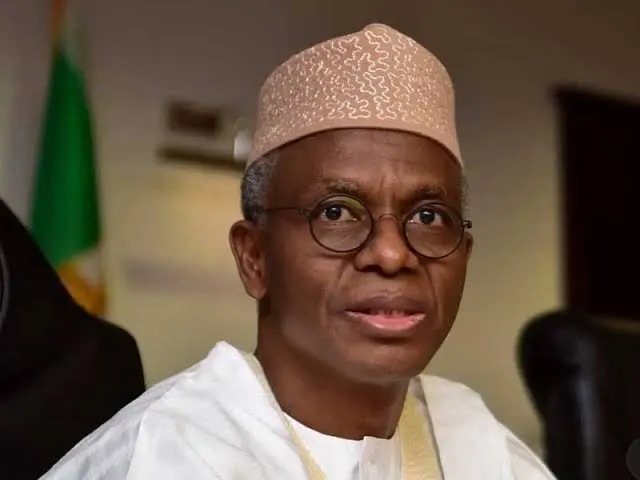
Former Governor of Kaduna State, Nasir El-Rufai, is scheduled to be arraigned on Tuesday, February 25, 2026, before the Federal High Court in Abuja on charges of cybercrime and breach of national security. The case, filed by the Department of State Services (DSS) and marked FHC/ABJ/CR/99/2026, has been assigned to Justice Joyce Abdulmalik following administrative approval by the Chief Judge of the Federal High Court, Justice John Tsoho.
The three-count criminal charge stems from allegations that El-Rufai unlawfully intercepted the telephone communications of the National Security Adviser (NSA), Nuhu Ribadu. According to court documents, the charges were triggered by statements the former governor made during a live appearance on Arise TV’s Prime Time programme on February 13, 2026.
During the televised interview, El-Rufai claimed he had become aware of an alleged plot to arrest him through leaked communications from the NSA’s phone. He reportedly stated that an unnamed associate had wiretapped Ribadu’s phone line, and that he had listened to the intercepted conversations. The former governor linked the alleged directive to an attempted arrest at the Nnamdi Azikiwe International Airport on February 12, upon his return from Cairo, Egypt.
The DSS moved swiftly. By the following week, prosecutors had filed formal charges accusing El-Rufai of violating provisions of the Cybercrimes (Prohibition, Prevention, etc.) Amendment Act, 2024, and the Nigerian Communications Act, 2003.
Count One alleges that on February 13, while on Arise TV, El-Rufai admitted that he and his associates unlawfully intercepted the NSA’s phone communications an offence punishable under Section 12(1) of the Cybercrimes Act.
Count Two accuses the former governor of acknowledging that he knew and associated with an individual who carried out the unlawful interception, yet failed to report the individual to relevant security agencies. This is contrary to Section 27(b) of the Cybercrimes Act.
Count Three alleges that El-Rufai and “others still at large” used technical equipment or systems in Abuja in 2026 that compromised public safety, endangered national security, and instilled apprehension of insecurity among Nigerians by unlawfully intercepting the NSA’s communications. This charge falls under Section 131(2) of the Nigerian Communications Act, 2003.
The cybercrime charges represent just one front in an unprecedented multi-agency legal offensive against the former governor. El-Rufai is simultaneously under investigation by three separate agencies — the DSS, the Economic and Financial Crimes Commission (EFCC), and the Independent Corrupt Practices and Other Related Offences Commission (ICPC).
On February 17, El-Rufai was invited to the EFCC headquarters in Abuja for questioning over allegations of financial misconduct amounting to over ₦432 billion during his eight-year tenure as Kaduna governor (2015–2023). The Kaduna State House of Assembly had in 2024 indicted him for alleged diversion of public funds and money laundering, subsequently referring the matter to anti-corruption agencies.
After spending 48 hours in EFCC custody, El-Rufai was granted administrative bail on February 18 — only to be immediately taken into custody by ICPC operatives. The ICPC confirmed his detention in a late-night statement, noting that he was being held “in connection with ongoing investigations.” The commission subsequently raided his Abuja residence, a move that prompted El-Rufai to file a ₦1 billion lawsuit against the ICPC, alleging an unlawful search that violated his constitutional rights.
The legal actions come at a politically charged moment. El-Rufai, once a prominent member of the ruling All Progressives Congress (APC), recently defected to the opposition African Democratic Congress (ADC). He has consistently described the investigations as politically motivated, characterising them as “witch-hunts” orchestrated by the current administration.
The coordinated approach involving three separate agencies DSS, EFCC, and ICPC is rare in Nigeria’s political landscape and signals what observers describe as a pivotal moment in the intersection of anti-corruption enforcement and political rivalry ahead of the 2027 general elections.
All eyes will be on the Federal High Court on February 25, when El-Rufai is expected to take his plea before Justice Abdulmalik. His legal team has yet to issue a formal public response to the scheduled arraignment, though the former governor’s combative posture on social media and in interviews suggests a vigorous legal defence is being prepared. The outcome of the cybercrime case, alongside the parallel corruption probes, could have significant implications not only for El-Rufai’s political future but for broader questions about the use of state security apparatus against political opponents in Nigeria’s evolving democratic landscape.