
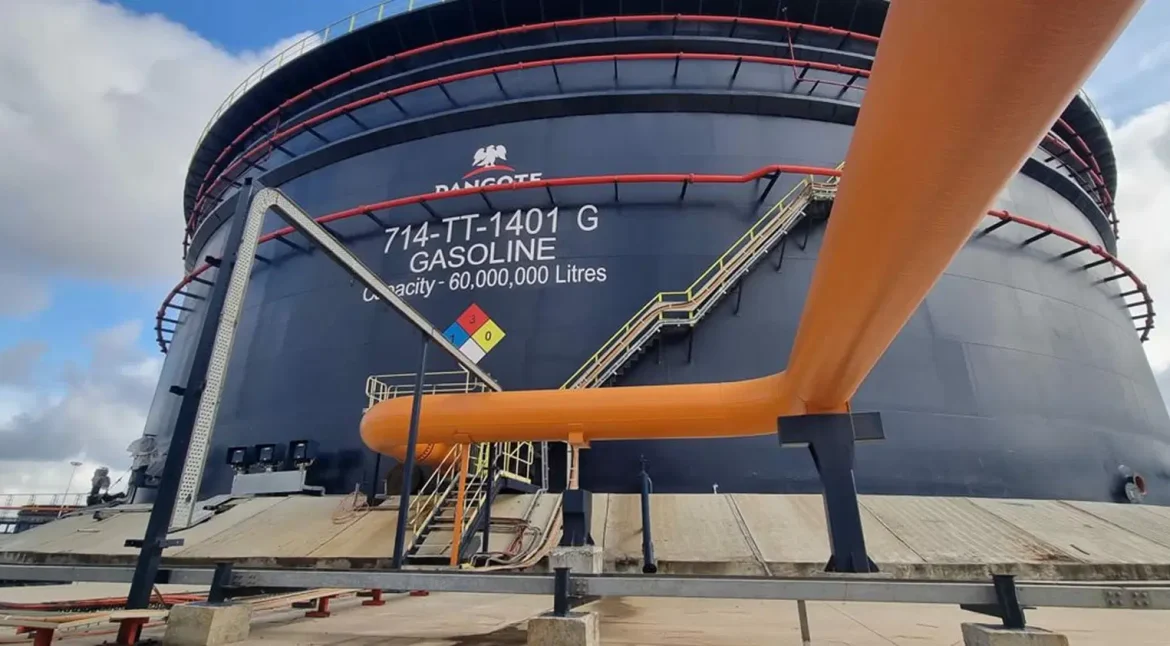
History was made on the trading floor of the Nigerian Exchange this morning. Dangote
Petroleum Refinery and Petrochemicals officially opened its Initial Public Offering — the largest
share sale ever attempted on African soil — inviting ordinary Nigerians to own a slice of the
continent’s biggest industrial project.
The numbers are staggering. The company is offering 4.1 billion new ordinary shares at ₦525
each, targeting roughly ₦2.15 trillion, or about $1.63 billion. If fully subscribed, the offer values
the refinery at approximately ₦65.22 trillion — around $49 billion.
For Aliko Dangote personally, the prospectus dropped a small bombshell. It confirms that the
industrialist owns 87 percent of the refinery, a stake that on Bloomberg’s numbers pushes his net
worth up by roughly $23 billion overnight, cementing his status as Africa’s richest man and
lifting him into the global top tier of billionaires.
The offer will remain open until October 13, with trading scheduled to begin on the NGX in
November. The minimum subscription is 10 shares — ₦5,250 — a deliberately low bar designed
to bring millions of retail investors into the deal alongside institutional buyers and the diaspora.
The launch ceremony this morning drew a heavy contingent from Nigeria’s financial
establishment. Investment bankers, regulators, brokers and executives crowded the floor as the
offer bell rang, symbolising a milestone not just for Dangote but for Nigeria’s longunderperforming capital market, which has needed a moment like this for years.
The timing is remarkable — and complicated. Crude oil prices have surged above $100 a barrel
amid Middle East tensions, pushing Nigerian pump prices to as high as ₦1,450 per litre in Abuja
and ₦1,400 in Lagos. Dangote itself raised its gantry price to ₦1,350 per litre in recent days, and
independent marketers followed.
On the one hand, higher crude prices raise the refinery’s revenue outlook, making it more
valuable to prospective shareholders. On the other, they place fresh pain on Nigerian households
already struggling with inflation, and turn the refinery into a political flashpoint just as its owner
asks the public to buy in. Analysts are calling the IPO a stress test for the Nigerian Exchange. A successful,
oversubscribed offer would signal renewed confidence in Nigerian markets and could pave the
way for other large private companies to list. A soft close, however, would be read as a verdict
on the state of household spending power.
There is also a broader African subplot. The offer is open to eligible investors across the
continent, aligning with Dangote’s long-stated ambition to build pan-African ownership of panAfrican infrastructure. If Kenyans, Ghanaians and South Africans buy in meaningfully, this
becomes more than a Nigerian story — it becomes a template.
For now, phones are ringing at stockbrokers across Lagos, Abuja and Port Harcourt. Nigerians
who have never bought a share in their lives are asking how to subscribe. Whatever happens
next, September 14, 2026 has already secured its place in the history of African finance.