
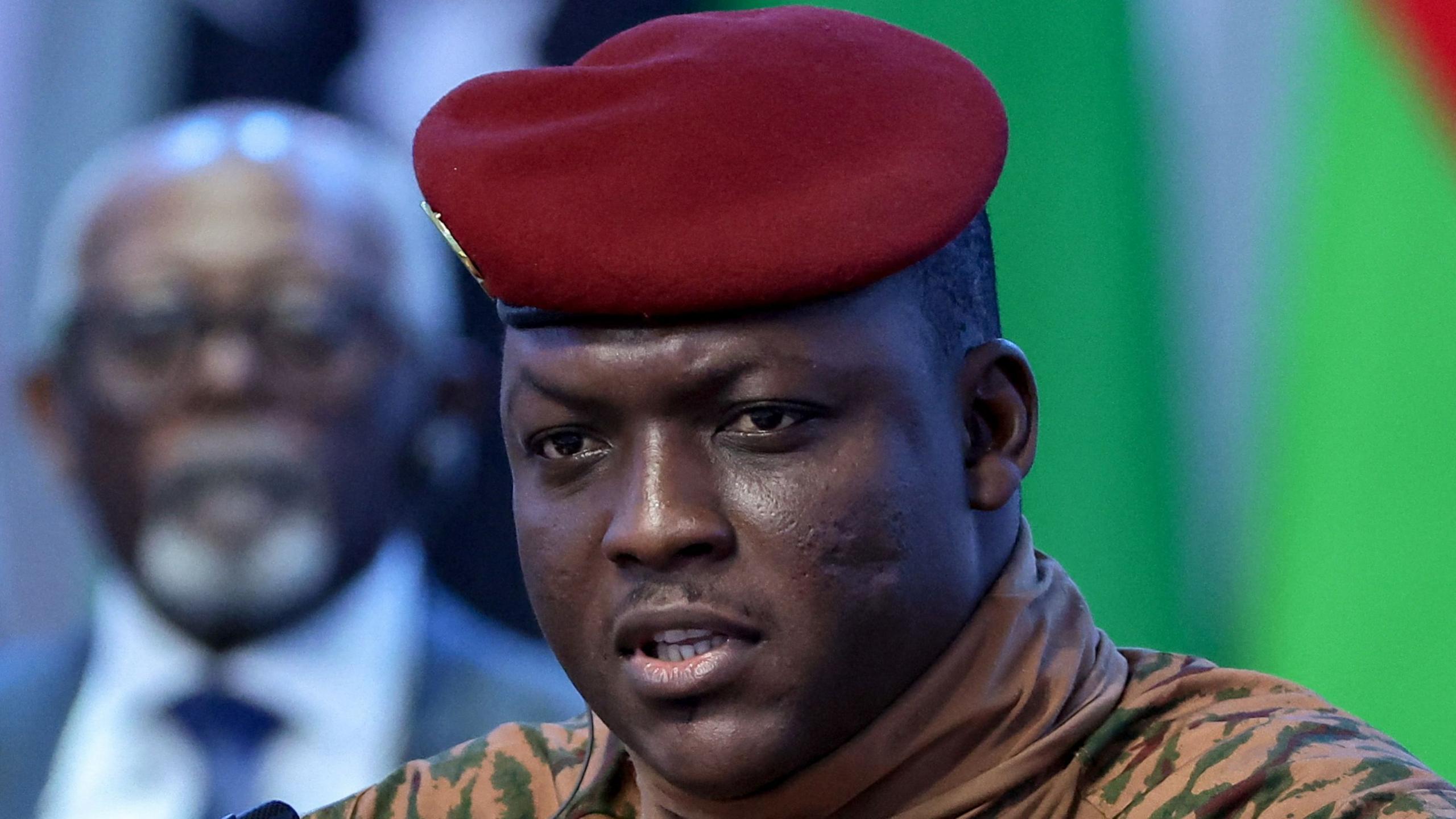
Captain Ibrahim Traore’s blunt rejection of democratic governance signals indefinite military rule in a country where political freedoms have been systematically dismantled since the 2022 coup.
In one of the most brazen statements by any African leader in recent memory, Burkina Faso’s military ruler Captain Ibrahim Traore has told his nation to abandon any hope of returning to democratic governance. His exact words left little room for interpretation.
“People need to forget about the issue of democracy,” Traore declared. “We have to tell the truth: democracy isn’t for us. Democracy kills.”
The statement, made this past week, represents the clearest signal yet that Burkina Faso’s military junta has no intention of restoring civilian rule. It comes just three months after Traore’s government dissolved more than 100 political parties and seized their assets in January 2026.
Traore, who took power in a September 2022 coup at the age of 34, initially presented himself as a transitional leader. He promised to organize elections by 2024. That deadline came and went. He then pushed the timeline back, citing security concerns related to the Islamist insurgency that has plagued the Sahel region for over a decade.
But his latest remarks suggest the delays were never about security at all. They were about consolidating power.
The systematic dismantling of democratic institutions has been methodical. The Independent National Electoral Commission was dissolved in July 2025, with the government claiming the agency was too expensive to maintain. Political parties were banned in January. Journalists, opposition leaders, and prosecutors who have dared to criticize the military government have been forcibly conscripted and sent to fight on the front lines against armed groups.
The security situation that Traore uses to justify his grip on power has, by most measures, worsened dramatically under his leadership. According to analysis by the U.S.-based Africa Center for Strategic Studies, conflict-related fatalities nearly tripled in the three years since Traore took power, reaching 17,775 deaths. That compares with roughly 6,630 deaths in the three years before his coup.
Despite this deteriorating record, Traore has cultivated a significant following, particularly among young Africans and members of the diaspora, through fiery anti-Western rhetoric and close alignment with Russia and other members of the Alliance of Sahel States, a bloc that also includes military governments in Mali and Niger.
France, the former colonial power, was expelled from Burkina Faso in 2023. The United Nations and other international organizations have seen their access increasingly restricted. Russia’s Wagner Group, now rebranded as Africa Corps, has maintained a presence in the country.
The African Union has largely been silent on Traore’s latest declaration, a response that critics say reflects the continental body’s growing inability to enforce its own governance standards. ECOWAS, the regional bloc, previously suspended Burkina Faso’s membership following the coup but has limited leverage.
For the roughly 23 million people living in Burkina Faso, Traore’s words formalize what many already knew. The democratic experiment that began with the popular uprising that toppled longtime ruler Blaise Compaore in 2014 is, for now, over. Whether the international community will respond with anything more than statements of concern remains to be seen.