
Spain woke to a national tragedy on Thursday morning, with the government
confirming that at least 68 people were killed when two high-speed trains collided
in the olive-covered countryside near Urda, in the province of Toledo, south of
Madrid. The death toll climbed through the overnight hours as rescue crews
continued working through twisted carriages lit by portable floodlights.
Prime Minister Pedro Sanchez has declared three days of national mourning. Flags
on public buildings were lowered to half-staff at dawn, and planned political events
across the capital were suspended. “This is one of the darkest days our railways
have ever known,” Sanchez said in a brief statement from Moncloa Palace.
Spain’s transport minister told reporters that an onboard safety system failed in the
moments before the collision. According to the minister’s account, controllers then
cleared one of the trains to resume movement without imposing speed restrictions –
a sequence investigators are now scrutinising as the probable chain of events
behind the crash.
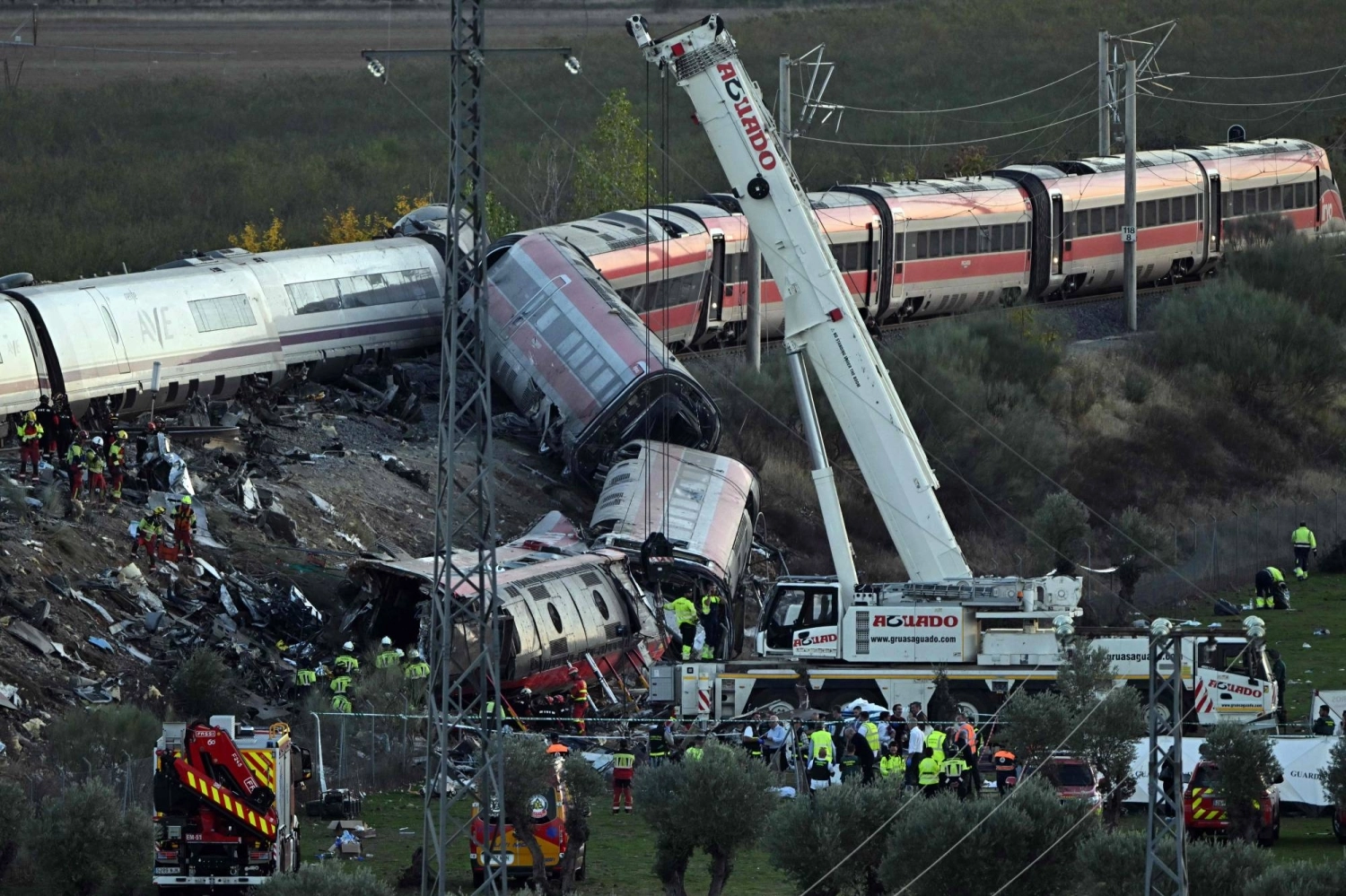
The two AVE-class trains were travelling in opposite directions on a stretch of track
that funnels into a shared corridor between Madrid and Andalusia. Early images
from the scene showed carriages buckled off the rails and emergency teams cutting
through metal to reach passengers trapped inside. Dozens more are reported
injured, several of them critically.
Spain’s rail network has been widely considered one of the safest and most modern
in Europe. The country has invested billions of euros over the past two decades to
build the second-largest high-speed network in the world after China. Thursday’s
disaster now ranks among the worst rail accidents in the country’s modern history, revived painful memories of the 2013 Santiago de Compostela derailment that killed
80 people.
Spanish rail operator Adif has suspended all high-speed services on the affected
corridor and set up a crisis coordination centre with regional authorities in CastillaLa Mancha. Hospitals in Toledo and Ciudad Real activated mass-casualty protocols
overnight. The health ministry said blood donation points were being opened across
the region.
European leaders began posting messages of condolence within hours of the
collision. European Commission President Ursula von der Leyen said the EU “stands
with Spain in grief”. France, Portugal and Morocco each said they had offered
technical assistance.
Attention is now turning to the signalling system and to whether human error
compounded the technical failure. Spain’s independent accident investigation
agency, CIAF, has deployed teams to the scene, and the ministry has promised a
preliminary report within days. Prosecutors in Toledo have opened a parallel
criminal probe.
For families waiting outside hospitals in Toledo and at Madrid’s Atocha station, the
hours ahead will be agonising. Authorities have set up a hotline and a reception
centre at a nearby sports hall, where psychologists and translators are helping
relatives of the victims, several of whom were foreign tourists travelling to Seville
and Cordoba.
The investigation is expected to look closely at how a safety alert can be
acknowledged and then overridden in rapid sequence – a question that may ripple
far beyond Spain’s borders in a Europe that has staked its climate transition on rail
travel.