

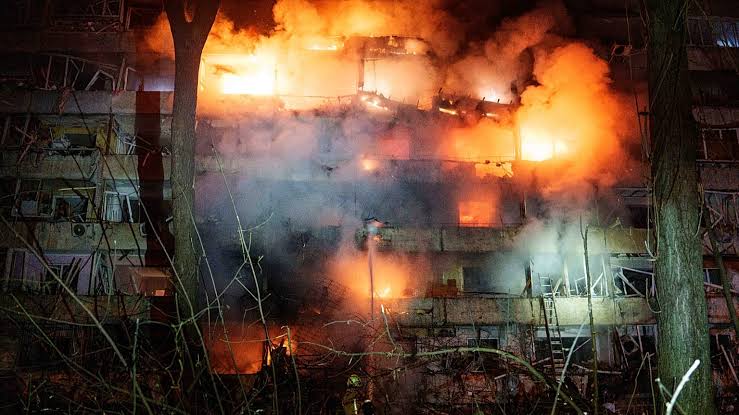
Russia launched a fresh wave of missile and drone strikes against Kyiv in the predawn hours of Wednesday, slamming into an energy infrastructure facility in the
capital region and knocking out power across multiple districts, Ukrainian officials
said on the morning of October 15.
Deputy Head of the Presidential Office Kyrylo Tymoshenko urged residents of Kyiv,
Zhytomyr, Cherkasy and Chernihiv to immediately limit power consumption as
emergency crews raced to stabilise the grid. National operator Ukrenergo warned of
rolling blackouts and said water supplies had been disrupted in at least five districts
of the capital.
The strikes came hours before Ukrainian President Volodymyr Zelensky arrived in
London for a hastily arranged meeting with UK Prime Minister Andy Burnham, who
pledged what he called “rock-solid” support for Ukraine as the war grinds through
another brutal winter.
By mid-morning, Ukrenergo said the situation in Kyiv had been stabilised and that
no further planned outages were expected in the capital. But officials cautioned the
damage to the targeted substation was significant, and emergency repairs could
take days.
The timing of the attack is widely being read as a message. For weeks Moscow has
focused its long-range strikes on Ukraine’s energy backbone, a tactic that European
officials fear is designed to drive civilians out of major cities before temperatures
drop. The country has already lost an estimated 40 per cent of its generating
capacity since the start of the year.
Three people were confirmed killed and 21 wounded in Kyiv alone, with casualty
figures expected to rise as rescue teams continue to clear rubble in residential
buildings struck during the barrage. Nearly 600,000 households briefly lost power
at the height of the attack, according to municipal authorities.
The strikes also come as crude prices tick higher after a Saudi-led coalition
intercepted a Houthi ballistic missile aimed at Riyadh overnight, adding to a sense of
a world lurching between crisis points. Analysts said the combination of Russian
escalation in Ukraine and renewed Red Sea instability could tighten energy markets
heading into November.
In London, Burnham—who took office earlier this year—is expected to announce a
new tranche of air-defence support, including additional interceptor missiles and
funding for Ukraine’s drone programme. European leaders have been scrambling to
shore up Kyiv’s defences amid uncertainty about future US military aid.
Zelensky, speaking to reporters on arrival, called Russia’s overnight assault “a
deliberate attempt to freeze our people into submission” and said Ukraine needed
longer-range weapons to hit the airbases from which Russian bombers launch.
“Defence is not enough,” he said. “We must be able to answer.”
The Kremlin has not commented on the overnight strikes. But Russian state media
quoted an unnamed defence official claiming the operation had hit “militaryindustrial targets” rather than civilian infrastructure—a line Moscow repeats after
nearly every major strike despite extensive video evidence of damage to apartment
blocks, substations and water facilities.
For Kyiv residents, the attack was depressingly familiar. Air-raid sirens wailed for
more than two hours, and metro stations filled with families clutching blankets and
children. One resident told reporters outside a damaged building in the Darnytskyi
district: “We don’t ask when it will end anymore. We only ask how to survive the
next night.”