

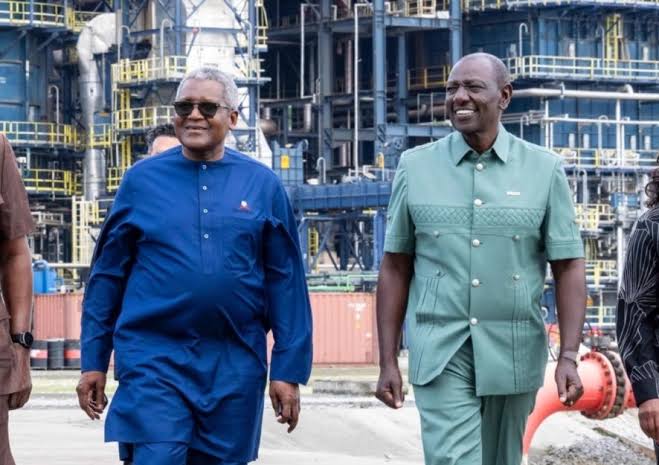
Nigerian industrialist Aliko Dangote and Kenyan President William Ruto have formally launched construction of a $16 billion oil refinery in the coastal county of Lamu, setting in motion one of East Africa’s biggest industrial projects despite protests and a court dispute over land.
The Dangote East Africa Petroleum Refinery is designed to process up to 700,000 barrels of crude oil a day. Construction is expected to take about 40 months, with completion targeted for 2030. The facility is expected to produce petrol, diesel and jet fuel for Kenya and other markets across East Africa.
The groundbreaking ceremony on Wednesday brought together several African leaders, including Uganda’s Yoweri Museveni and Ethiopia’s Abiy Ahmed, underscoring the project’s regional ambitions. The refinery is expected to draw crude from producers in the region and other international markets.
Dangote has described the investment as part of a broader effort to increase Africa’s capacity to process its own raw materials rather than depend heavily on imported finished products. Kenya and other East African countries currently rely substantially on imported petroleum products, leaving consumers exposed to international prices and disruptions in global supply.
The project is also expected to include a 1,000-megawatt power plant. Dangote Group says the refinery could create tens of thousands of jobs during construction, while Kenya’s government expects it to support investment, industrial activity and regional trade around Lamu Port and the LAPSSET transport corridor.
But the launch has been overshadowed by opposition from some residents of Lamu.
Protesters say families have occupied and cultivated parts of the affected land for generations. They are demanding higher compensation and assurances over land rights, jobs and the environmental impact of the refinery.
A group of residents has also taken the dispute to court, arguing that some of the land is ancestral property and that adequate compensation and resettlement arrangements have not been provided. A Kenyan court ordered the parties to maintain the status quo while the dispute is considered.
The legal challenge did not stop the ceremonial groundbreaking. Dangote said the court decision could affect some site activities but would not prevent the official launch of the project. He has also rejected claims that his company acquired land beyond what was allocated to it by the Kenyan government.
Dangote has separately accused local fuel marketers and international oil companies of encouraging the protests, a claim those he referenced would need to address. The businessman has maintained that the refinery will proceed and be ready by 2030.
President Ruto has strongly backed the investment, portraying it as an opportunity to expand Kenya’s industrial base and create jobs. His government says the refinery will strengthen the country’s energy security and reinforce Lamu’s position as a regional trade and logistics hub.
The project is modelled partly on Dangote’s 650,000-barrel-per-day refinery in Lagos, although the planned Lamu facility would have a higher nameplate capacity. Regional governments have also been offered a stake in the Kenyan refinery, with Dangote saying the project should remain substantially African-owned.
For Kenya, the refinery represents a major bet on industrialisation and regional energy security. But its progress will depend not only on financing and construction, but also on how the outstanding land, compensation and environmental disputes are resolved.
The groundbreaking has therefore put two competing priorities into sharp focus: Kenya’s drive for large-scale industrial investment and the demands of communities seeking protection for their land and livelihoods.