

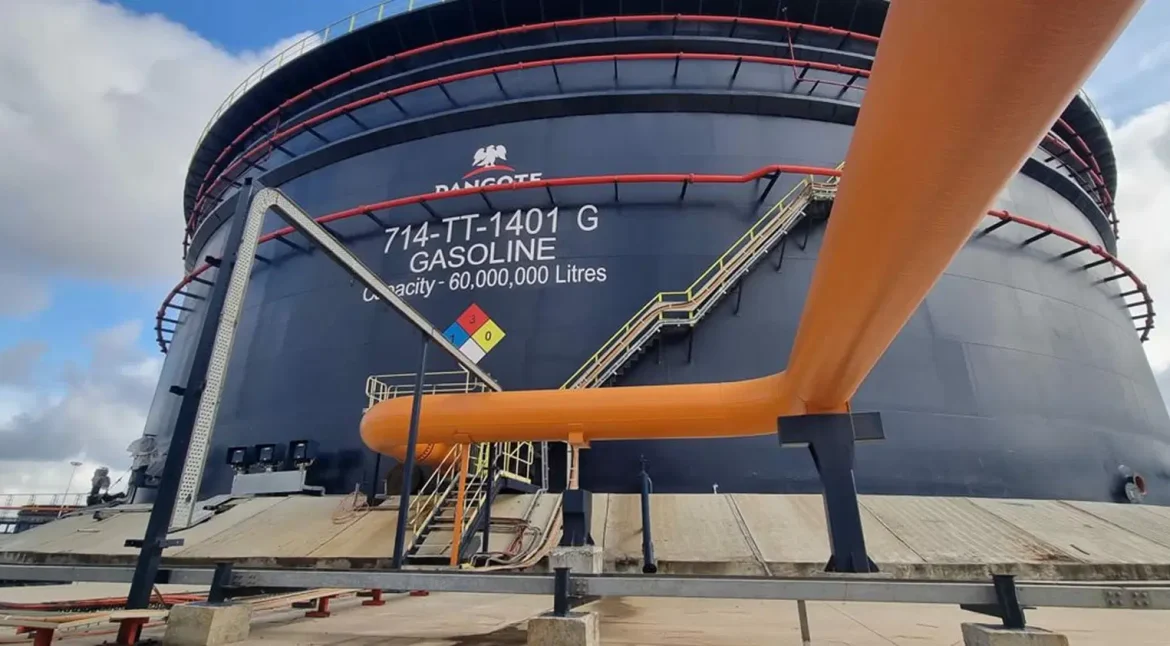
The Dangote Petroleum Refinery has resumed the sale and gantry loading of Premium Motor Spirit in naira, ending a brief shift to dollar-denominated transactions while increasing its ex-depot petrol price by about 13% to ₦1,215 per litre.
The new price represents an increase of ₦140 per litre, or 13.02%, from the previous gantry price of ₦1,075. The adjustment took immediate effect, with outstanding truck-loading orders also expected to be repriced under the new template. (The Guardian Nigeria)
“Dangote Petroleum Refinery has resumed the sale of Premium Motor Spirit in naira, providing a measure of relief to marketers and consumers,” the company said in its announcement, adding that the gantry price had been fixed at ₦1,215 per litre. (TheCable)
The decision reverses the refinery’s move earlier in July to price petroleum products for marketers in US dollars. Gantry and coastal loading had subsequently been suspended, creating uncertainty for operators dependent on the Lekki-based facility for domestic petrol supplies. (TheCable)
Although the return to naira transactions reduces the immediate foreign-exchange burden on marketers, the higher ex-depot price is expected to place additional pressure on retail petrol prices across Nigeria.
Marketers typically add transportation, financing, storage and operational costs to the refinery’s gantry price before selling petrol at filling stations. Consequently, consumers could face pump prices considerably above ₦1,215 per litre, depending on their location and the cost of moving the product.
The revised Dangote price nevertheless remains below some rates quoted by import-dependent depots. Industry checks indicated that some depot owners were selling petrol for about ₦1,274 per litre following the disruption to naira-denominated supplies. (Business Day)
The price increase comes at a difficult time for Nigerian households and businesses already struggling with high transportation, energy and food costs. Petrol is widely used not only for vehicles but also to power generators because of the country’s unreliable electricity supply.
Any sustained increase in fuel prices could therefore affect public transport fares, logistics expenses and the cost of consumer goods.
The resumption of naira sales may improve access to products for independent marketers that would have struggled to secure dollars for refinery purchases. However, operators will still need substantial working capital to acquire petrol at the revised rate.
The development also highlights the growing influence of Dangote Refinery on Nigeria’s deregulated downstream petroleum market. With a stated processing capacity of 650,000 barrels per day, the facility has become a major source of locally refined fuel and an important competitor to imported petroleum products.
Under Nigeria’s deregulated pricing system, petrol prices are influenced by crude-oil costs, exchange rates, shipping expenses, domestic supply and competition among refiners and importers. The government no longer maintains a uniform nationwide pump price.
Market participants will now be watching whether the restoration of gantry loading improves supply sufficiently to moderate retail margins. Much will also depend on crude prices and the naira’s exchange rate, both of which have significant effects on production and import costs.
For consumers, the announcement offers mixed consequences: naira-denominated sales have returned, but at a substantially higher price that could soon be reflected at filling stations nationwide.