

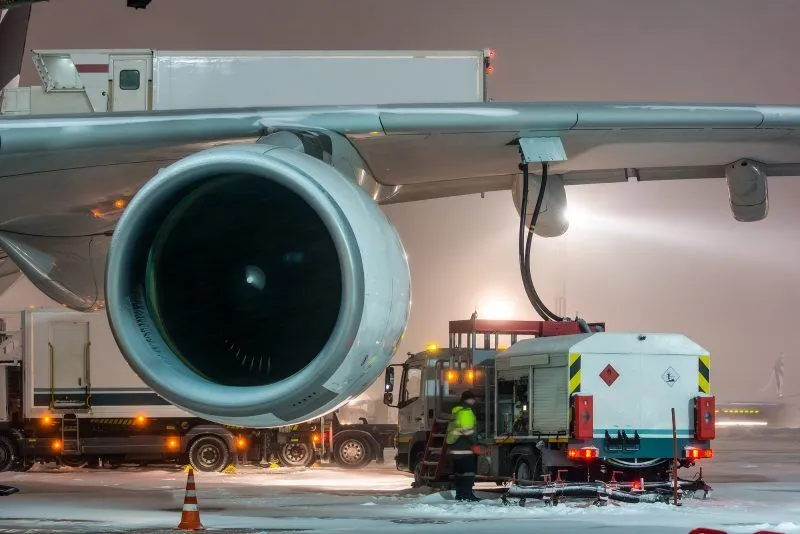
At ₦1,820 a litre — a fraction of what middlemen were charging — Africa’s largest refinery has just rewritten the cost equation for an aviation industry that was minutes from collapse
For weeks, Nigerian airline executives have been doing the math in public and not liking
the answer.
Aviation fuel, known in the trade as Jet A-1, had climbed from around ₦900 a litre
before the Iran war to between ₦2,700 and ₦2,900 — with some marketers, the Airline
Operators of Nigeria said, quietly selling at ₦3,500. Domestic carriers warned the
government they were days from grounding aircraft. Some had already started
cancelling routes. Ticket prices on the Lagos-Abuja corridor doubled inside a month.
Now Aliko Dangote has stepped in and removed the middleman from the equation.
The Dangote Petroleum Refinery has begun supplying jet fuel directly to Nigerian
airlines at ₦1,820 per litre, the company confirmed this week. The price was first
pegged publicly at the end of April; over the past few days the refinery has moved from
declaring the price to actually delivering fuel into airline trucks at the gantry.
International carriers were first in line: Ethiopian Airlines, by far the biggest African long haul operator, has already begun receiving direct Jet A-1 deliveries from Dangote, the
refinery’s Managing Director David Bird confirmed.
Local airlines are now plugging into the same pipeline. The Nigerian Midstream and
Downstream Petroleum Regulatory Authority (NMDPRA) has publicly endorsed the
move, saying Dangote’s disclosed gantry price will “enhance market stability, improve
transparency, and strengthen compliance” among aviation fuel marketers — language
that is regulator-speak for: this should stop the gouging.
The Lagos Chamber of Commerce and Industry has been blunter. It has been pushing
the federal government for weeks to back direct refinery-to-airline supply, arguing that the layered marketer system was costing the sector hundreds of millions of naira a day
and pushing carriers toward insolvency.
The numbers explain the urgency. The $20 billion Lekki-based refinery now supplies
more than 90 percent of Nigeria’s aviation fuel needs, by Dangote Group’s own count.
That gives one private company the power to set the floor price for an entire national
industry. Until this week, that power was being used mostly through long marketer
chains that added their own markup at every step. Cutting those chains, even partially,
immediately lowers the cost base for every airline in the country.
Airline executives are cautiously celebrating. Allen Onyema, the Airline Operators of
Nigeria vice president who has been one of the loudest voices warning of a sector
collapse, has welcomed the price disclosure and direct-supply model as a lifeline.
Privately, executives say that if ₦1,820 holds, ticket prices on busy domestic routes
could ease within weeks. Publicly, they are being careful not to over-promise: jet fuel is
only one input, and aircraft maintenance, foreign exchange and airport charges are all
still under pressure.
There is also a quieter political story unfolding behind the announcement. Dangote’s
refinery has, in just over a year, taken control of the most strategically important
segment of Nigeria’s downstream petroleum economy. It now sets the floor for petrol
prices, the floor for diesel prices, and — as of this week — the floor for jet fuel. That is
enormous market power concentrated in one private actor. The NMDPRA’s public
approval is a signal that, for now, the government is comfortable with that arrangement.
Critics warn it should be watched closely.
For travellers, the test is simple: do flights stop getting cancelled, and do prices come
down? For the airlines, the test is whether ₦1,820 is the start of a sustained,
transparent supply or a one-off political gesture. For Dangote, the test is whether the
refinery can hold the line in the face of further Iran-driven crude shocks.
And for the rest of the Nigerian economy, the message is bigger than aviation. A single
private refinery has just demonstrated that it can intervene in a sector emergency faster
than the federal government can. That fact, more than the ₦1,820 price tag, may be the
most consequential thing about this week’s announcement.