

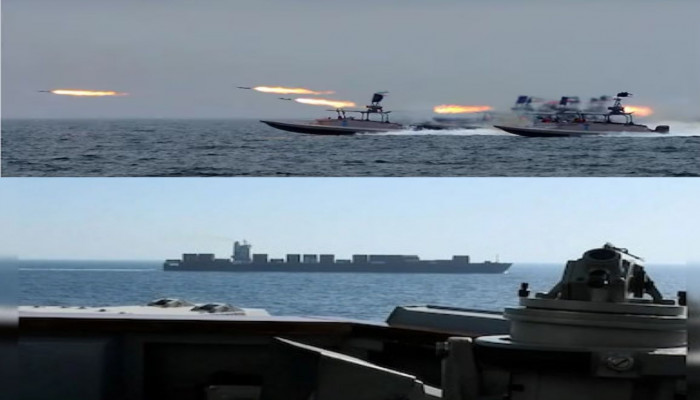
The fragile ceasefire between the United States and Iran is teetering on the edge of collapse this morning after Tehran launched drone strikes against American military vessels in the Gulf of Oman, a dramatic escalation following the US Navy’s seizure of an Iranian-flagged cargo ship.
The incident began on Sunday when the guided-missile destroyer USS Spruance intercepted the M/V Touska, an Iranian commercial vessel that had attempted to run the American naval blockade near the Strait of Hormuz. According to US officials, the Touska ignored repeated warnings over a six-hour standoff before the Spruance fired on the ship’s engine room to disable its propulsion. US Marines then rappelled onto the vessel and took custody of it.
President Trump confirmed the seizure on social media, framing it as a necessary enforcement of the blockade that has been in place since April 13. But Iran sees it very differently.
Iran’s top joint military command, Khatam al-Anbiya, accused the United States of violating the ceasefire by firing on a civilian commercial vessel. A military spokesperson issued a stark warning, stating that the armed forces of the Islamic Republic of Iran would soon respond and retaliate against what they called armed piracy by the US military.
That retaliation came swiftly. According to Iran’s semi-official Tasnim news agency, Iranian forces launched drone strikes against US military ships in the Gulf of Oman. Details remain scarce about the scale of the attack, the number of drones deployed, or whether any American assets sustained damage. The Pentagon has not issued a detailed public response as of this writing.
The diplomatic fallout has been equally severe. A second round of negotiations between Washington and Tehran had been scheduled for this week in Pakistan, with Vice President JD Vance and senior US officials expected to travel to Islamabad. But Iran’s Foreign Ministry declared this morning that there are no plans for talks, effectively pulling the plug on what many had hoped would be a pathway to de-escalation.
The timing could not be more critical. The current ceasefire is set to expire on Wednesday, and with both sides accusing the other of violations, the prospect of a renewal looks increasingly dim. International observers are watching closely as global oil markets react to the continued instability in one of the world’s most vital shipping lanes.
The Strait of Hormuz, through which roughly a fifth of the world’s oil supply passes daily, has been effectively at a standstill since the US imposed its blockade. Travel and energy experts have already warned that if the conflict continues, consumers should brace for fewer flights, higher fuel prices, and increasing economic volatility through the summer months. For now, the world watches as two nuclear-capable adversaries trade blows in one of the most strategically important waterways on Earth, with a ticking clock on a ceasefire that fewer and fewer believe will hold