
For more than three decades, Somaliland has operated as a state in everything but name. It has its own passport, currency, army, police force, and a democratic system that has delivered multiple peaceful transfers of power — a rarity on the continent. What it has never had is the one thing that matters most in the architecture of international relations: recognition.
Now, buoyed by Israel’s landmark decision to formally recognise Somaliland as an independent state in December 2025, the breakaway region is making its most audacious play yet. In an interview with AFP on Saturday, Khadar Hussein Abdi, Somaliland’s Minister of the Presidency, laid the offer on the table with striking directness: exclusive access to the territory’s mineral wealth and the right to establish military bases, all in exchange for American recognition.
“We are willing to give exclusive access to our minerals to the United States. Also, we are open to offer military bases to the United States,” Abdi told AFP. “We believe that we will agree on something with the United States.”
It is a proposition calibrated to appeal to the Trump administration’s transactional instincts: rare earth minerals critical to the global battery and electric vehicle supply chain, and a strategic military foothold on one of the world’s most contested maritime corridors. Whether Washington bites will have consequences far beyond the Horn of Africa.
The Israeli Breakthrough
The story begins on December 26, 2025, when Israeli Prime Minister Benjamin Netanyahu signed a joint declaration with Somaliland President Abdirahman Mohamed Abdullahi establishing full diplomatic relations, including the exchange of embassies and ambassadors. Israel became the first — and so far only — country in the world to recognise Somaliland’s independence since it declared autonomy from Somalia in 1991.
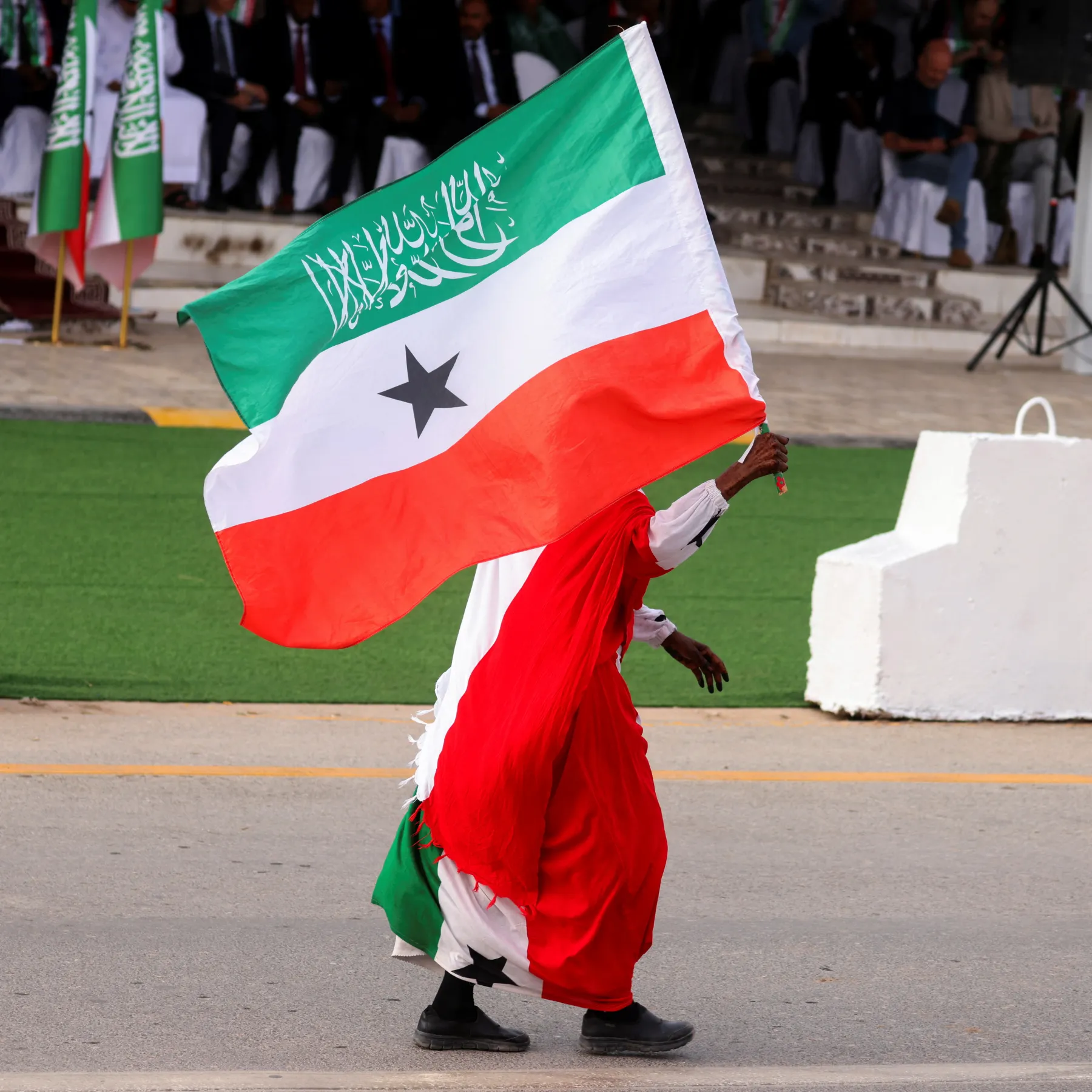
Netanyahu framed the recognition as being “in the spirit of the Abraham Accords, signed at the initiative of President Trump.” For Somaliland, it was a moment of euphoric vindication. Social media was flooded with images of residents in Hargeisa waving Israeli flags; one woman used an Israeli flag as a hijab. President Abdullahi praised Netanyahu for his “leadership and commitment to promoting stability and peace.”
But the recognition was never purely altruistic. Analysts point to Somaliland’s strategic location across the Gulf of Aden from Yemen, where Houthi rebels have repeatedly attacked Israeli-linked assets and disrupted Red Sea shipping lanes in solidarity with Palestinians. An Israeli presence in Somaliland would provide a valuable intelligence and monitoring position on a corridor that has become central to Middle Eastern power dynamics. Earlier in 2025, U.S. and Israeli officials had reportedly approached Somaliland about accepting displaced Palestinians from Gaza, an idea that was ultimately abandoned.
What Somaliland Is Offering
Somaliland’s mineral pitch centres on deposits of lithium, coltan, and other rare earth materials — resources that have become geopolitically critical as the world’s major powers compete for supply chain dominance in batteries, semiconductors, and electric vehicles. Somaliland officials describe their soil as rich in these sought-after materials, though it is important to note that comprehensive independent geological assessments have not yet been completed.
The military base offer carries perhaps even greater strategic weight. Somaliland sits on an 850-kilometre coastline along the Gulf of Aden, straddling one of the busiest and most volatile maritime corridors on earth. The port of Berbera, already upgraded with significant UAE investment, offers deep-water access and proximity to the Bab el-Mandeb Strait — the southern chokepoint of the Red Sea through which a substantial share of global energy and trade shipments pass. A U.S. military presence there would complement existing American installations in nearby Djibouti and provide additional leverage in a region where China, Turkey, the UAE, and Russia are all jostling for influence.
President Abdullahi has separately suggested granting Israel privileged access to Somaliland’s mineral resources, and Minister Abdi told AFP that the possibility of an Israeli military presence was not off the table. “The sky is the limit,” Abdullahi told reporters when describing the potential scope of the Israeli-Somaliland trade partnership.
Somalia’s federal government has responded with a ferocity that reflects the existential stakes. President Hassan Sheikh Mohamud described Israel’s recognition as “the greatest violation of Somalia’s sovereignty” and “a threat to the security and stability of the world and the region.” Prime Minister Hamza Abdi Barre’s office called it a “deliberate attack” on Somalia’s autonomy.
Mogadishu has drawn an explicit red line on military installations. Somalia’s defence minister, Ahmed Moalim Fiqi, stated that the government would “under no circumstances” accept Israel’s recognition, and that any foreign military base in Somaliland would be confronted. President Mohamud echoed this in an interview with Al Jazeera: “As Somalis, we will never allow this. We will not accept such an attempt, and we will stand against it. We would resist to the extent of our capacity.”
In a move underscoring the severity of Mogadishu’s response, Somalia recently cancelled security and defence agreements with the UAE concerning key ports, citing breaches of the country’s sovereignty — a signal that Mogadishu is willing to rupture valuable relationships to defend the principle of territorial integrity.
A Wall of International Opposition
Mogadishu has not stood alone. The backlash against Israel’s recognition has been sweeping and coordinated. The African Union reaffirmed its “unwavering commitment to Somalia’s unity, sovereignty and territorial integrity” and stated that recognising Somaliland “runs counter to the fundamental principles of the African Union.” The AU Peace and Security Council convened an emergency ministerial session on January 6 to address the matter.
IGAD, the East African Community, the Arab League, and the Organisation of Islamic Cooperation all issued statements backing Somalia’s position. Individual condemnations came from Egypt, Turkey, Saudi Arabia, Qatar, Djibouti, Sudan, Iran, Pakistan, Jordan, Algeria, and more than a dozen other nations. A joint statement signed by 21 Arab, Islamic, and African states rejected the recognition outright. The European Union reaffirmed “the importance of respecting the unity, the sovereignty and the territorial integrity of the Federal Republic of Somalia.”
Notably absent from the individual condemnations was the UAE, which has significant strategic investments in Somaliland, including in the Berbera port. The Emirates’ silence has been interpreted by analysts as a quiet hedge — a signal that Abu Dhabi may be keeping its options open.
The question that now looms largest is whether the United States will follow Israel’s lead. So far, the signals from Washington have been ambiguous. When asked about Somaliland shortly after Israel’s recognition, President Trump was noncommittal: “Everything is under study. We’ll study it. I study a lot of things and always make great decisions and they turn out to be correct.” When told about Somaliland’s offer of port access, he responded dismissively: “Big deal.”
But the political groundwork has been laid. In June 2025, influential Republicans introduced a bill calling for the U.S. to recognise Somaliland as a separate, independent country. In August, Texas Senator Ted Cruz wrote to Trump urging formal recognition. Somaliland’s offer of exclusive mineral access and military bases is designed to transform the recognition question from a matter of abstract principle into a concrete strategic opportunity — the kind of transactional deal that the Trump administration has historically found appealing.
The counterarguments are substantial. Somalia’s ambassador to the U.S., Dahir Hassan, warned that “any policy that weakens Somali sovereignty would only embolden extremists and threaten the stability of the entire Horn of Africa.” Al-Shabaab, the al-Qaeda-linked militant group that Washington has spent years helping Somalia combat, could exploit the sovereignty dispute to recruit fighters and justify attacks. Recognition of Somaliland could also set a precedent that reverberates across a continent where separatist movements exist in multiple countries.
Africa’s Critical Minerals Scramble
Somaliland’s mineral pitch arrives at a moment when the global scramble for Africa’s critical minerals is intensifying. The continent holds significant reserves of lithium, cobalt, coltan, and other materials essential to the energy transition and advanced technology manufacturing. China has long dominated the critical minerals supply chain; the United States and European Union are racing to diversify their sources.
But as the African Union and others have warned, this scramble risks becoming a new form of resource extraction dressed in geopolitical clothing — one in which unrecognised territories and weak governance structures become vehicles for great power competition, with limited benefit to local populations. Somaliland’s offer of “exclusive” mineral rights to Washington raises questions about who would benefit from these concessions, under what terms, and with what safeguards for environmental protection and community rights.
The absence of comprehensive independent geological surveys of Somaliland’s mineral deposits adds a layer of uncertainty. While officials in Hargeisa speak confidently of lithium and coltan riches, the actual scale and commercial viability of these resources remains unverified. The promise may be ahead of the proof.
Somaliland’s gambit cannot be understood in isolation. It sits at the intersection of several converging forces: the intensifying U.S.-China competition for African resources and influence; the reshaping of Red Sea security dynamics by the Houthi insurgency and the Gaza conflict; the Trump administration’s transactional approach to foreign policy; and the long-standing tension between Africa’s commitment to inherited colonial borders and the aspirations of peoples who have governed themselves for decades without recognition.
The irony is that Somaliland’s case for statehood, on its merits, is arguably stronger than many existing states. Under the criteria of the Montevideo Convention — a defined territory, a permanent population, a functioning government, and the capacity to enter into relations with other states — Somaliland makes a compelling argument. It has maintained democratic governance and relative stability for over 30 years, in a region synonymous with state failure. But international law operates within political reality, and the political reality is that the AU, the Arab world, and most major powers remain opposed.
What is clear is that the ice has been broken. Israel’s recognition, whatever its motivations, has transformed Somaliland’s status from a frozen question into a live geopolitical issue. Hargeisa is pressing its advantage with the urgency of a territory that knows this window may not stay open. For Mogadishu, the African Union, and the broader international order, the challenge is equally urgent: how to respond to a reality that no longer fits neatly into the old frameworks of sovereignty and territorial integrity. The minerals are in the ground. The bases are on the table. The question is what happens next.