
Three years ago, a peace agreement signed in Pretoria was supposed to end one of Africa’s deadliest modern conflicts. The two-year war in Ethiopia’s northern Tigray region had killed an estimated 600,000 people, displaced millions, and drawn in the armed forces of neighbouring Eritrea. The November 2022 cessation of hostilities agreement was meant to chart a path to normalcy.
That path has collapsed. In February 2026, the Horn of Africa finds itself staring at the prospect of a new conflagration one that could prove even more destructive than the last. The International Crisis Group, in a briefing published on February 18, warned in stark terms that conflict involving Ethiopia’s federal government, the Tigray region, and Eritrea “could erupt at any time.”
The warning is not theoretical. Bloomberg has reported that both Ethiopia and Eritrea are actively deploying troops and military equipment near northern Tigray, citing regional diplomats. Ethiopian military convoys have been observed moving northward through Bahir Dar, while Eritrean forces have deployed to areas inside Tigray itself. Unverified footage circulating on social media shows heavy weaponry being transported toward the border zone.
Abiy’s Dramatic Reversal
Perhaps the most significant escalatory signal came from Ethiopian Prime Minister Abiy Ahmed himself. In an address to parliament in early February, Abiy acknowledged for the first time that Eritrean troops were responsible for mass killings, the destruction of homes, and the looting of factories during the Tigray war. The admission represents a seismic shift in Ethiopia’s official position. Throughout the conflict and its aftermath, Abiy’s government had either denied Eritrean involvement outright or referred to allied forces in vague terms without naming Asmara.
In 2021, Abiy did concede that Eritrean troops had entered Tigray, but stopped short of attributing specific atrocities to them. The February 2026 statement went much further, directly accusing Eritrea of committing war crimes a move that Eritrean Information Minister Yemane Gebremeskel dismissed as “cheap and despicable lies.” Gebremeskel noted pointedly that Abiy’s government had until recently been “showering praises and state medals” on Eritrean army officers.
The reversal was widely interpreted as a calculated political manoeuvre a way for Addis Ababa to reframe its relationship with Asmara and lay the rhetorical groundwork for a possible military confrontation. For Tigrayans who endured the atrocities first-hand, the belated acknowledgement offered little comfort and much cynicism.
The Red Sea Question
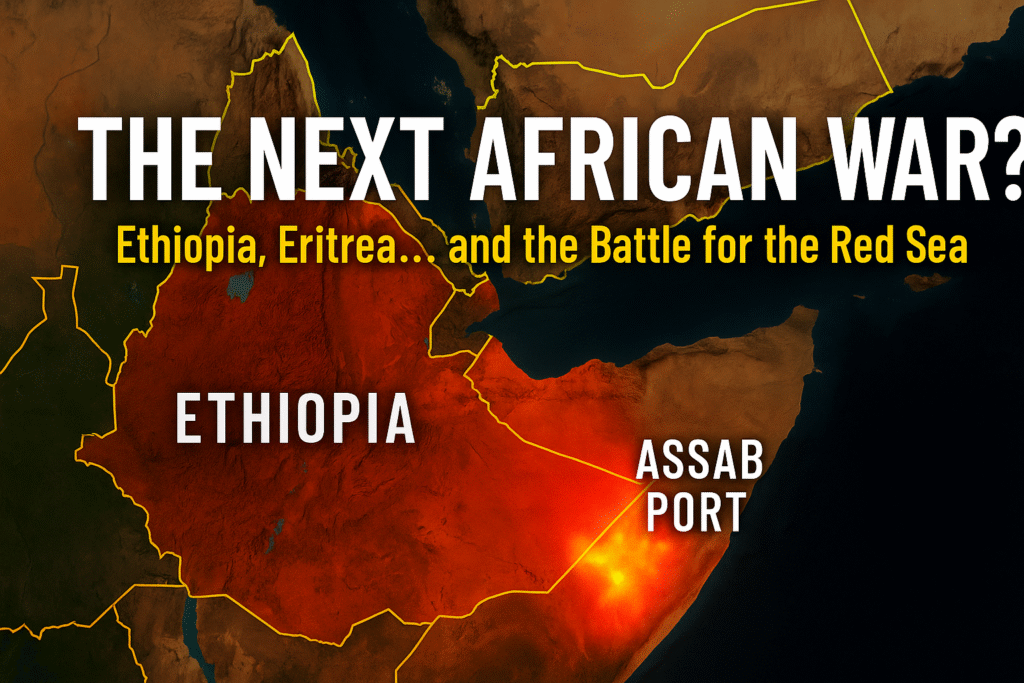
At the heart of the escalation lies a question that has shaped Ethiopian geopolitics for decades: access to the sea. When Eritrea gained independence in 1993 following a decades-long armed struggle, Ethiopia — Africa’s second most populous nation — became landlocked. The loss of the Red Sea ports of Assab and Massawa has been felt as a national wound ever since, with Ethiopia forced to depend on Djibouti for the vast majority of its trade.
Abiy has brought this grievance to the centre of Ethiopian politics with increasing force. Speaking to parliament, he declared that “the Red Sea and Ethiopia cannot remain separated forever” — language that Eritrea views as a barely veiled threat of territorial aggression. Assab, a port just 60 kilometres from the Ethiopian border, has become the focal point of Addis Ababa’s ambitions. Many Ethiopians view reclaiming sea access as a matter of national destiny; many Eritreans view it as an existential threat to their sovereignty.
Last October, Abiy called for international mediation — naming the United States, China, Russia, and the European Union as potential brokers — to find a “peaceful resolution” that would secure Ethiopia sea access. But diplomatic overtures have been accompanied by military posturing, and Eritrea has shown no willingness to negotiate over its coastline.
The Tigray Tinderbox
Complicating matters enormously is the unresolved political situation in Tigray. The 2022 Pretoria agreement was supposed to deliver disarmament, the return of displaced populations, and a political settlement. Three years on, none of these goals has been fully achieved. Disputed territories in western Tigray remain under Amhara administration. Hundreds of thousands of Tigrayans displaced during the war have not returned home. And the Tigray People’s Liberation Front (TPLF), the region’s dominant political force, has fractured.
In 2025, the TPLF ousted its interim leader, Getachew Reda, accusing him of being too close to Abiy. The federal government replaced him with Lieutenant General Tadesse Werede, but the factional dynamics within Tigray have only grown more volatile. One TPLF faction, led by Debretsion Gebremichael, has reportedly forged clandestine links with Eritrea — an alliance that has infuriated Addis Ababa and created a three-way power struggle.
In late January 2026, the Tigray Defence Forces moved into the disputed territory of Tselemti in northwestern Tigray, clashing with federal troops and Amhara militias. Days later, TDF forces entered Korem and Alamata in southern Tigray’s Raya district. The federal government responded by cancelling all flights to Tigray and reportedly carrying out drone strikes in the region. The escalation was sharp and sudden — and it has not de-escalated.
The Demand to Withdraw
On February 7, Ethiopian Foreign Minister Gedion Timothewos sent a formal letter to his Eritrean counterpart demanding the “immediate withdrawal” of Eritrean forces from Ethiopian territory along their shared border. The letter accused Eritrea of occupying Ethiopian towns including Sheraro and Gulomakada, and of supporting armed groups operating inside Ethiopia.
Eritrea responded by denouncing the accusations as “patently false and fabricated.” Asmara has counter-accused Ethiopia of harbouring ambitions to seize Eritrean territory, pointing to Abiy’s repeated public statements about Red Sea access. Ethiopia subsequently wrote to the United Nations Secretary-General, formally notifying the international body that Eritrea was “actively preparing for war.”
A Regional Conflagration
What makes the current crisis so dangerous is that it does not exist in isolation. The Horn of Africa is already engulfed in overlapping conflicts. Sudan’s civil war, which erupted in April 2023, has created the world’s largest displacement crisis and drawn in regional players. Ethiopia has been accused of training Sudan’s Rapid Support Forces (RSF) at a secret camp, according to a Reuters investigation published in February 2026 — a relationship that would deepen Asmara’s hostility, given Eritrea’s own involvement in Sudan’s conflict dynamics.
The rift between Saudi Arabia and the UAE that began in late December 2025 adds another layer of volatility. Both Gulf powers are deeply involved in the Horn of Africa through economic investments, military bases, and diplomatic relationships, and a deepening of their rivalry could lead both to intensify their competing interventions in the region.
The International Crisis Group’s warning is unambiguous: without coordinated regional and international intervention to ease tensions, the three parties Addis Ababa, Asmara, and Mekelle — risk sliding into a broader regional conflict that could prove “difficult to contain.” The Pretoria agreement’s original brokers — Kenya, South Africa, and Nigeria — have been urged to re-engage both sides before the teetering peace deal collapses entirely.
The Human Cost
For ordinary Tigrayans, the prospect of another war is almost incomprehensible. More than 80 per cent of hospitals in the region were destroyed during the last conflict. Sexual violence remains rampant. Hundreds of thousands of young people are out of school. Foreign investment has evaporated, and the economy remains crippled. The federal government’s decision to withhold foreign funds meant for the region has deepened a humanitarian crisis in which much of the public service has gone unpaid for months.
As one Tigrayan woman told Al Jazeera from a displacement camp in Mekelle: the fear is not just of another war, but of a “slow, certain death” from the grinding deprivation that has followed the last one.
What to Watch
Several triggers could tip the current tensions into open conflict. Any attempt by the TPLF faction allied with Eritrea to seize power in Tigray would almost certainly provoke a military response from Addis Ababa. A further Ethiopian military push into disputed territories could draw Eritrean intervention. And the ongoing troop deployments on both sides of the border create the conditions for accidental escalation — a skirmish that spirals before diplomacy can catch up.
The last war between Ethiopia and Eritrea, from 1998 to 2000, killed tens of thousands. The Tigray war killed an estimated 600,000. A new conflict, overlapping with the Sudan war and inflamed by Gulf rivalries, Red Sea power politics, and unresolved ethnic disputes, could be catastrophically worse. The Horn of Africa is a powder keg. The fuses are lit. The question is whether anyone will step in to extinguish them before it is too late.